
Double K-Anonymity: Securing Location Privacy in the Social Internet of Vehicles (SIoV)
A Location Privacy Protection Algorithm Based on Double K-Anonymity in the Social Internet of Vehicles
This paper introduces a double k-anonymity location privacy protection algorithm designed for the Social Internet of Vehicles (SIoV). By utilizing a trusted cloud server to decouple user identities from location-based service (LBS) requests through permutation, combination, and matrix encryption, the method significantly enhances anonymity.
TL;DR
As the Internet of Vehicles (IoV) evolves into the Social Internet of Vehicles (SIoV), vehicles are no longer just transport nodes but social entities. This connectivity, however, creates a massive privacy leak. This paper proposes a double k-anonymity algorithm that uses a trusted cloud server to shuffle and encrypt identity-request pairs, effectively "hiding" users in a crowd of requests.
Academic Context: This is a robust enhancement to traditional k-anonymity, shifting from simple ID suppression to a more complex attribute-shuffling mechanism that addresses the sophisticated correlation attacks prevalent in modern social networks.
Problem & Motivation: The SIoV Privacy Trap
In an SIoV environment, obtaining Location-Based Services (LBS) like traffic warnings or navigation acts as a "privacy tax." To get the service, you must provide your location.
Existing solutions typically use k-anonymity, hiding one user among others. However, the authors identify two critical flaws in prior work:
- Structural Correlation: Attackers with prior knowledge of "hotspots" (like shopping malls or intersections) can use context to pick out specific users even within a group.
- Semi-Trusted Providers: Many service providers are "honest-but-curious" or may even sell data, meaning the party providing the service is often the one attacking your privacy.
Methodology: The Double K-Anonymity Framework
The core innovation lies in the introduction of a Trusted Cloud Server that acts as a buffer and a "shuffler."
1. The Architecture
The system workflow is divided into four distinct stages:
- Data Splitting: Every request is split into three sets: IDs (), Locations (), and Requests ().
- Reshuffling: The server stores the IDs but randomly scrambles the association between specific locations and request contents.
- Matrix Encryption: The reshuffled data forms a matrix . A random matrix is generated to encrypt , creating a new matrix that is sent to the Service Provider.
- Feedback Loop: The Service Provider processes the obscured requests, and the Cloud Server maps the results back to the original User IDs.
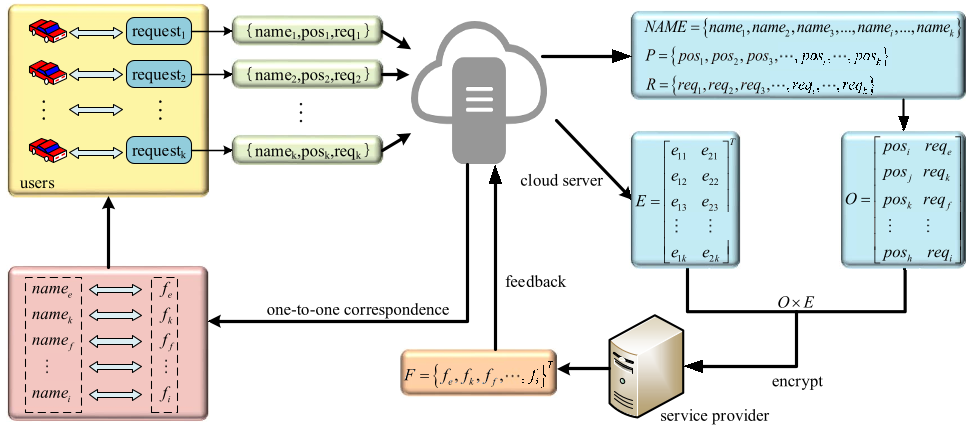 Above: The overall framework showing the Cloud Server isolating users from the Service Provider.
2. Theoretical Intuition (Entropy)
The paper uses Location Entropy () and Request Entropy () to measure uncertainty. By increasing these values, the algorithm ensures that even if an attacker intercepts the data, the probability of correctly linking a specific location to a specific user identity is minimized.
Experiments & Results: Standing Out in the Crowd
Using SUMO (Simulation of Urban Mobility) with real-world map data from Bologna, Italy, the authors verified the algorithm across different hotspots (parking lots, malls, and intersections).
Key Breakthroughs:
- Location Entropy Superiority: Compared to state-of-the-art methods like MOP (Mutually Obfuscating Paths) and Dynamic Virtual Schemes, the double k-anonymity approach maintains significantly higher entropy over time.
- Service Availability: A common fear in privacy research is the "data loss rate." The authors found that as the number of users () increases, the data loss rate actually decreases, reaching an optimal balance around 400 nodes before hardware constraints on the cloud server cause a slight uptick.
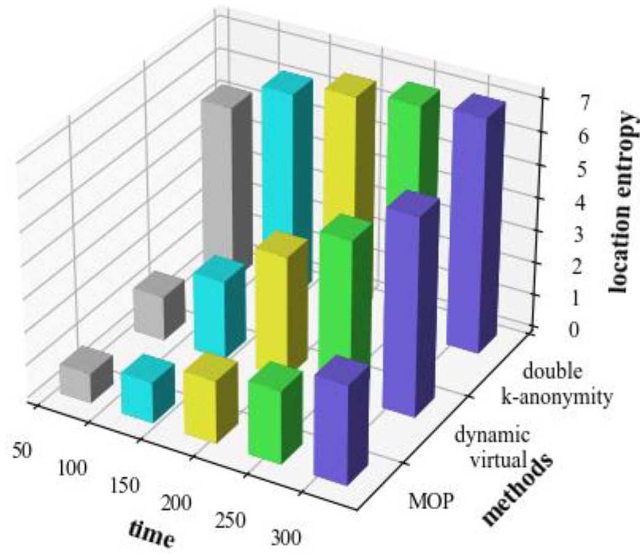 Above: Performance comparison showing the proposed method maintaining higher location entropy than MOP and Dynamic Virtual schemes.
Critical Analysis & Conclusion
Takeaway
The "Double K-Anonymity" approach proves that privacy in SIoV shouldn't just rely on hiding an ID; it must rely on breaking the correlation between behavioral data (the request) and spatial data (the location). By treating these as independent variables that can be permuted, the algorithm achieves a higher degree of confusion for attackers.
Limitations
- Centralization: The cloud server is a "Trusted Third Party." If this server is compromised, the entire privacy model collapses.
- Latency: As noted by the authors, introducing an intermediary inevitably adds "hops" to the communication, which could be critical for time-sensitive IoV safety applications.
Future Outlook
The next step for this technology lies in decentralized shuffling (e.g., using blockchain or edge computing) to remove the reliance on a single cloud server, further hardening the system against infrastructure-level attacks.