
The Heartbeat of the Machine: A Deep Dive into Driver Emotion Recognition
10369_Driver Emotion Recognition for Intelligent Vehicles A Survey.
This paper presents a comprehensive literature survey on Driver Emotion Recognition (DER) for intelligent vehicles, reviewing 63 peer-reviewed studies published since 2002. It categorizes the field into representation, elicitation, sensing (Face, Biophysiological, Speech, Behavior), and machine learning methodologies, highlighting a transition toward multi-modal sensing and real-world application.
TL;DR
Driving isn't just a mechanical task; it's an emotional journey. This landmark survey by Zepf et al. (2020) systematically decodes 18 years of research into how cars can "feel" what we feel. By analyzing 63 core studies, the paper establishes a roadmap for transforming vehicles from passive tools into empathetic companions capable of detecting stress, anger, and fatigue to save lives.
The "Why": Why Automotive Affective Computing?
Most accidents aren't caused by engine failure; they are caused by human failure. Anger, anxiety, and high cognitive load degrade decision-making. The authors identify a critical gap: while we have advanced ADAS (Advanced Driver Assistance Systems) to track lane departures, we lack "internal" sensing to track the driver's mental collapse before the mistake happens.
Methodology: The Four Pillars of Sensing
The paper breaks down the sensing landscape into four technical domains, each with its own Inductive Bias:
1. Face and Head Gestures
- The Intuition: Humans express "Valence" (positive/negative) through facial action units (FACS).
- The Tech: Moving from RGB cameras to Thermal/Infrared to handle the "Night Driving" problem.
- The Challenge: A smile isn't always joy; it can be a grimace of frustration or a reaction to sunlight.
2. Biophysiological Signals (The Gold Standard for Arousal)
- Cardiac (ECG/PPG) & EDA: These signals are controlled by the Autonomic Nervous System, making them much harder to "fake" than facial expressions.
- Insight: HRV (Heart Rate Variability) is the "smoking gun" for stress detection.
3. Speech
- Paralinguistics: It's not what you say, but how you say it. Pitch and loudness are key features, though cabin noise remains a major adversary.
4. Behavioral (CAN-bus)
- The Car as a Sensor: Aggressive steering, sudden braking, and even grip strength on the steering wheel provide a direct window into the driver's state.
 Figure 1: The standard pipeline for DER: Elicitation -> Sensing -> Pre-processing -> Feature Extraction -> Classification.
Analysis: SVMs, NNs, and the Power of Fusion
The survey finds that 73% of modern work relies on Supervised Machine Learning.
- SVMs remain the workhorse for small-to-medium datasets due to their robust margin-based classification.
- Temporal Logic: The field is moving away from "static snapshots" toward window-based analysis (5 seconds to 5 minutes), recognizing that emotions are processes, not moments.
- The Winner: Multi-modal Fusion: Combining Face (Valence) with EDA (Arousal) and CAN-bus (Context) provides the most resilient performance.
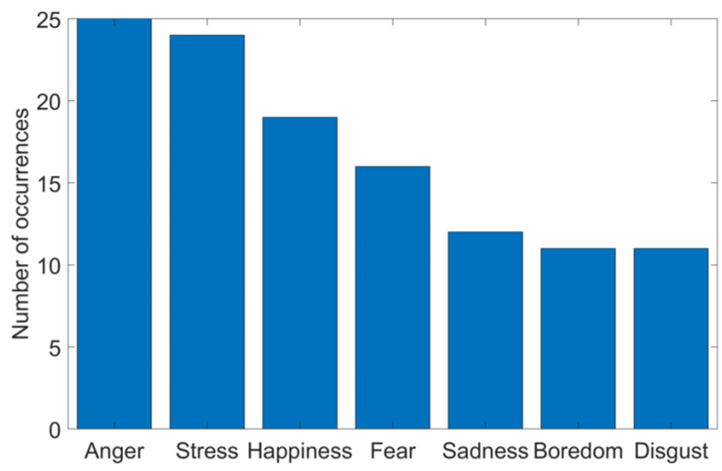 Figure 2: Distribution of signals and emotional states. Note the heavy focus on Negative Valence (Anger/Stress).
Critical Analysis: The Generalization Gap
Despite the high accuracy reported in papers (some up to 97%), the authors offer a sobering warning: Simulators are not Reality.
- The "White-Coat" Effect: People behave differently when they know they are being monitored.
- Missing Context: A high heart rate could mean the driver is angry at a traffic jam, or simply excited because they like the song on the radio. Future SOTA work must integrate GPS and external traffic data to "de-noise" the human signal.
Conclusion and Future Outlook
As we move toward Level 3 and Level 4 Autonomous Vehicles, the role of DER shifts. It’s no longer just about preventing crashes; it’s about Occupant Experience Management.
- Personalization: Moving from "Generic Models" to "Person-Specific" adaptations.
- Empathic Interaction: A car that changes the ambient lighting or navigation voice tone to de-escalate driver frustration.
The "Intelligent Vehicle" of 2026 and beyond will not just see the road; it will see us.
Takeaway for Researchers: To move the needle, we need larger, open-access real-world datasets (not just simulators) and a deeper focus on unobtrusive sensing like radar-based heart-rate monitoring.