
Digital Echoes of Power: Decoding Candidate Popularity in the 2014 Greek EU Elections
Drivers of Candidates' Social Media Popularity in the 2014 European Parliamentary Elections in Greece
This study investigates the drivers of social media popularity—measured by Facebook likes, Twitter followers, and YouTube views—among Greek candidates during the 2014 European Parliamentary elections. Using quantitative analysis, it identifies party affiliation and incumbency status as primary predictors of online support, particularly on Facebook.
TL;DR
Does social media democratize political influence, or does it simply reinforce existing power structures? This study analyzes the 2014 European Parliamentary elections in Greece, revealing that Facebook popularity is primarily driven by party momentum and incumbency status. While Twitter and YouTube showed less sensitivity to these factors, Facebook emerged as a digital stronghold for established political players and winning parties.
Context: A Turbulent Political Landscape
The 2014 elections in Greece occurred during a period of intense economic austerity and political volatility. The study focuses on the rivalry between the traditional center-right New Democracy and the rising radical-left party SYRIZA. This backdrop provides a unique laboratory to test the Normalization Hypothesis: the idea that social media eventually replicates traditional offline power balances.
The "Popularity Paradox"
Politicians often adopt Web 2.0 tools with the hope of "going viral," yet many suffer from chronically low engagement. The researchers identified a critical gap: we know why politicians use social media, but we don't fully understand what makes them popular. They hypothesized that two factors are key:
- Party Affiliation: Does belonging to the "winning" party translate to digital likes?
- Incumbency Status: Does prior political experience provide a "head start" in the digital arena?
Methodology: Measuring the Digital Pulse
The study analyzed 83 Greek candidates, examining their footprint across the "Big Three" platforms of the era: Facebook, Twitter, and YouTube.
Key Findings: The Facebook Dominance
The data revealed a socio-technical divide between platforms:
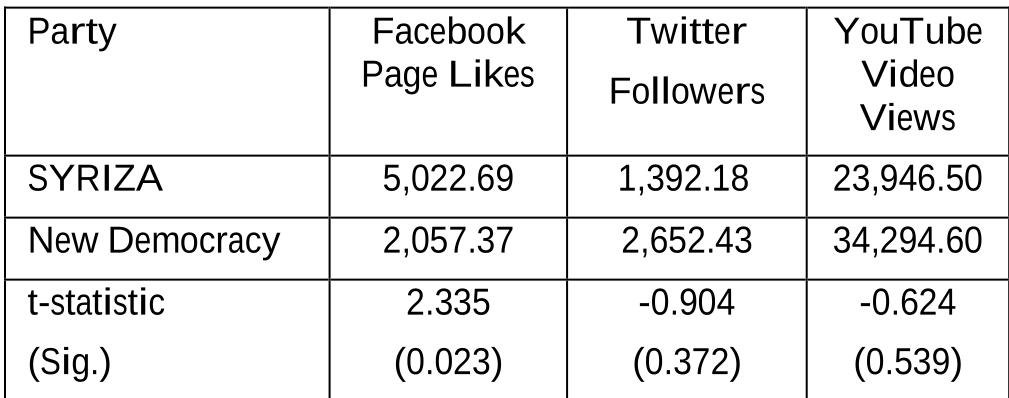
- The SYRIZA Surge: Candidates from the winning party (SYRIZA) had significantly higher Facebook engagement. This suggests that the "offline enthusiasm" for a party's platform spills over into the digital space, reinforcing the candidate’s visibility.
- The Incumbent Advantage: Contrary to some US-based studies suggesting that challengers use social media more effectively to overcome incumbents (the Equalization Hypothesis), this study found that incumbents in Greece dominated Facebook.
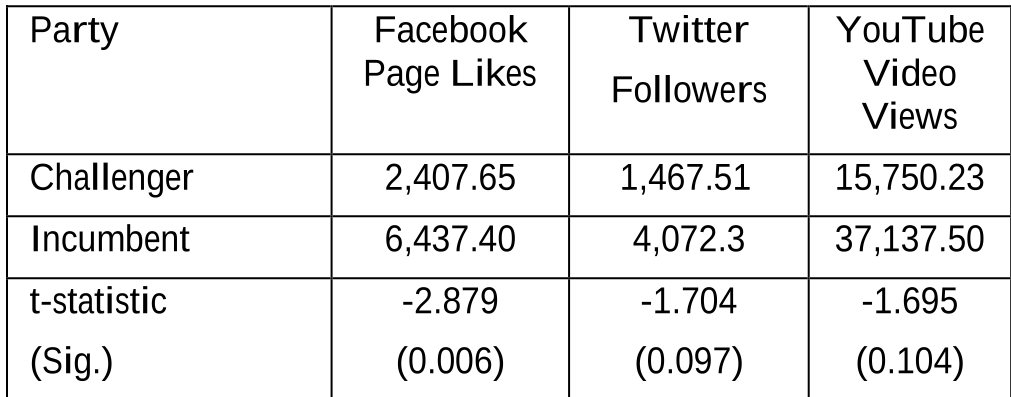
As shown in the table above, incumbents averaged 6,437 Facebook likes compared to just 2,407 for challengers. Interestingly, this advantage did not statistically extend to Twitter or YouTube, suggesting that Facebook was the primary "social" battleground where existing networks were most effectively converted into digital support.
Critical Insight: Why Facebook?
The authors argue that Facebook’s success for incumbents is due to its nature as a network-based horizontal communication tool. Incumbents are established figures with pre-existing offline networks. In a "party-centered" political system like Greece's, these real-world connections are more easily mapped onto Facebook's friend/like structures than onto the more broadcast-oriented environments of Twitter and YouTube.
Conclusion and Future Outlook
This research confirms that in the 2014 Greek context, social media served more as a reinforcer of status than a disruptor.
- The Takeaway: If you are a winning party or an established incumbent, your Facebook profile will likely reflect that power.
- The Limitation: The study is context-specific to the 2014 Greek debt crisis.
- Future Directions: As algorithms move away from chronological feeds toward interest-based recommendations (like TikTok), the "incumbent advantage" found in this study may face new challenges.
For political marketers, the lesson is clear: Social media is not a magic bullet for unknown candidates; popularity is still deeply rooted in party reputation and career longevity.