
DAFC: Bridging the Digital Divide via Drones and Fog Computing
Drone-Assisted Fog-Cloud IoT Content Service Platform for Rural Communities
The paper introduces the Drone-Assisted Fog-Cloud (DAFC) framework, a multi-layer IoT content distribution system designed for rural communities with limited high-speed Internet. By combining stationary fog nodes, public transit vehicles as routine carriers, and drones for on-demand "rescue" missions, the system achieves a Robust Delay Tolerant Network (DTN) that significantly outperforms standard connectivity in underserved areas.
TL;DR
Access to high-speed internet is often taken for granted in urban centers, but for millions in rural and tribal lands, it remains a luxury. This paper presents DAFC (Drone-Assisted Fog-Cloud), a clever framework that transforms local vehicles and autonomous drones into a "physical Internet." By leveraging the predictable movement of public service vehicles and optimizing drone flight paths via Ant Colony Optimization, the system enables high-volume content sharing without needing a single meter of fiber-optic cable.
Problem & Motivation: The Connectivity Gap
The "Digital Divide" is not just a social issue; it's a geographic and economic one. ISPs refuse to lay cables where the "payback" period is too long due to sparse populations.
The authors identify a critical insight: Content delivery does not always require real-time synchronization. Educational videos, social media uploads, and entertainment can tolerate delays of hours or even a day. Existing solutions like standard CDNs fail because they assume a "wired" backhaul. The challenge here is: How do we move gigabytes of data across miles of rugged terrain when the only available 'link' is a moving garbage truck or a pedestrian?
Methodology: A Multi-Layered "Mailbox" Architecture
The researchers break the problem into three distinct layers:
- The Edge Layer: Residents generating content.
- The Fog Layer: Strategically placed "drop boxes" (Wi-Fi enabled storage) at gas stations and clinics.
- The Cloud Layer: The central orchestrator connected to the global internet.
The "Rescue" Mechanism
Since fog nodes aren't connected to the web, how does the cloud know when a node is full? The paper uses a lightweight DTN (Delay Tolerant Network) where pedestrians' phones carry tiny "rescue messages" (SOS signals) to any node with internet access.
Drone Scheduling via mTSP and ACO
When a "rescue" signal is received, the cloud dispatches drones. However, drones have limited battery. The authors model this as a Multiple Traveling Salesmen Problem (mTSP).
- Clustering (DBSCAN): First, they group fog nodes that are close to each other.
- Optimization (Ant Colony Optimization): They use a modified ACO algorithm to find the shortest path for a fleet of drones to visit all "distressed" fog nodes and return to the depot.
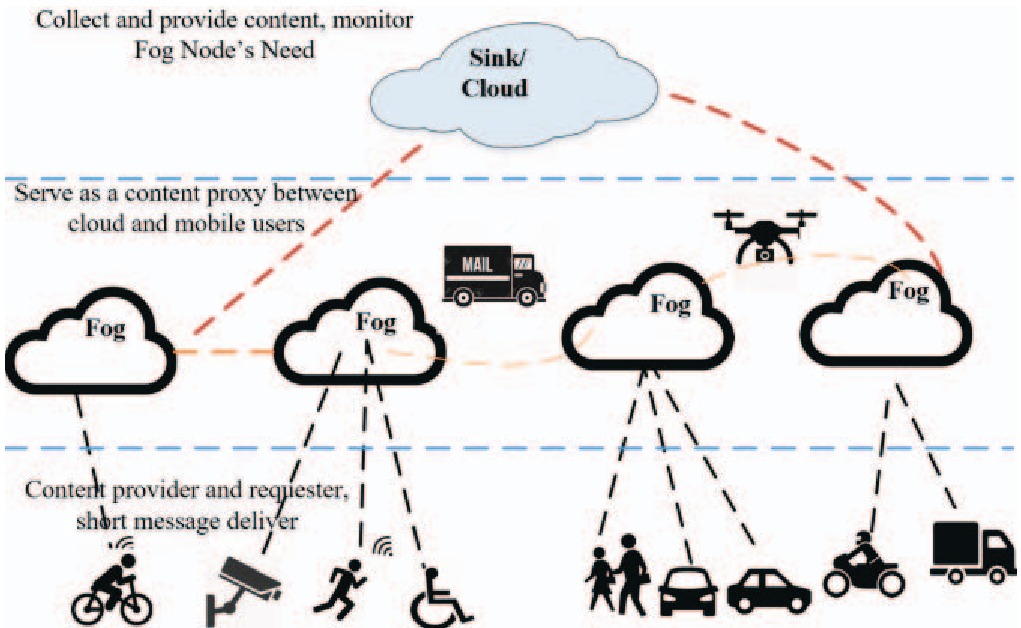 Fig 1: The layered DAFC architecture showing the interaction between Fog nodes, Vehicles (RCD), and Drones (OCD).
Experiments & Results
The authors simulated the Lower Sioux Indian Community in Minnesota. Using the ONE simulator, they compared a community with only limited cellular access against one equipped with DAFC.
Key Findings:
- Throughput: The DAFC platform significantly boosted the volume of data shared daily across the community.
- Urgency Handling: For content with a 6-hour "Time-to-Live" (TTL), drones were the difference between success and failure, drastically increasing delivery rates.
- Efficiency: The optimized ACO path planning reduced drone travel distance significantly compared to a "Greedy" approach, preserving precious battery life for data transmission.
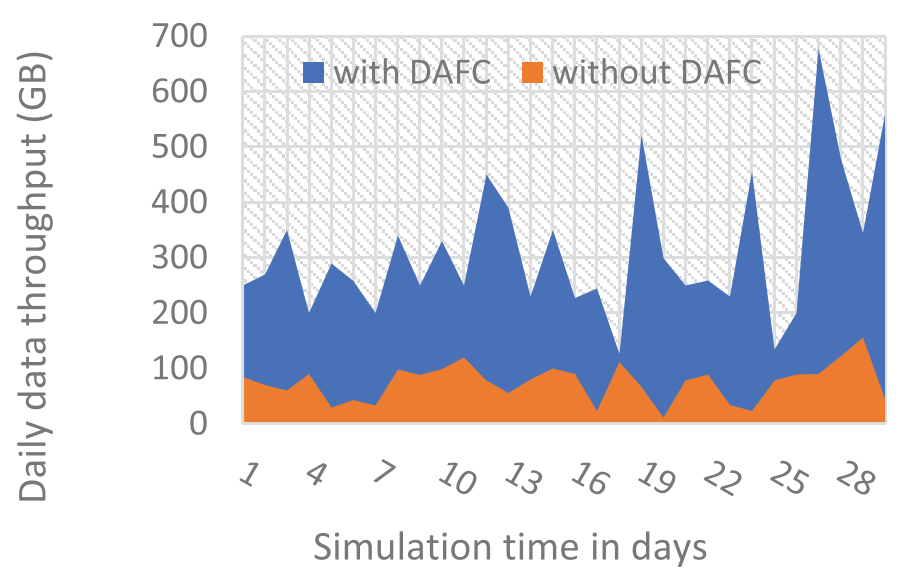 Fig 2: Success rate comparison showing the massive uplift provided by drones for urgent (low TTL) content.
Critical Insight & Conclusion
The genius of DAFC is its sustainability. It doesn't ask the community to buy expensive new infrastructure; it asks them to put a $50 Wi-Fi storage device on a truck that is already driving those roads.
Limitations: The system relies on "Rescue Messages" reaching the sink. In extremely sparse areas, if no pedestrian passes by, the drone may never be triggered. Future work might benefit from integrating satellite-based "pings" to trigger the drone fleet, combining the low-latency of LEO satellites with the high-bandwidth of physical drone-based data transport.
Takeaway: DAFC proves that by re-thinking the "Network" as a physical, opportunistic entity rather than a static wire, we can provide high-speed services to the most remote parts of the globe.