
DUALFormer: Breaking the Scalability Bottleneck with Dual-Dimensional Graph Transformers
Dualformer: Dual graph transformer
The paper introduces DUALFormer, a novel Graph Transformer (GT) architecture that utilizes a dual-dimensional design to decouple local and global information processing. By shifting global self-attention from the node dimension to the feature dimension and integrating a sequential local GNN module, it achieves SOTA performance on benchmarks like Cora and PubMed while maintaining linear complexity.
TL;DR
DUALFormer is a streamlined Graph Transformer that solves the dual challenges of scalability and the locality-globality trade-off. By moving global self-attention to the feature dimension and following it with a local GNN module, it achieves linear complexity while setting new SOTA records on key benchmarks like PubMed and ogbn-proteins.
Problem & Motivation: The Trade-off Dilemma
In the landscape of Graph Neural Networks (GNNs), the primary limitation has always been the "horizon": GNNs are excellent at local message passing but suffer from over-smoothing and over-squashing when trying to capture long-range dependencies.
Graph Transformers (GTs) were introduced to provide a global receptive field. However, they hit a wall:
- The Quadratic Wall: Standard Self-Attention (SA) scales at , making it impossible to process graphs with millions of nodes.
- The Expressivity Gap: To solve scalability, researchers often use sampling (NAGphormer) or clustering (GOAT), but these methods often "blur" the fine-grained local structure or only provide an approximation of global context.
The authors of DUALFormer asked a pivotal question: Instead of looking at how nodes relate to nodes, can we look at how features relate to features to capture the same global essence?
Methodology: The Dual-Dimension Architecture
The core innovation of DUALFormer lies in its decoupled dual-dimensional design. Instead of forcing one layer to handle everything, it separates the concerns.
1. Global Attention in Feature Space
Based on the approximation theory of Linearized Transformers, the authors demonstrate that: In DUALFormer, the attention score matrix characterizes feature-to-feature correlations. Since the feature dimension is usually much smaller than the number of nodes , this operation becomes incredibly efficient.
2. Local Graph Convolution
Once the global dependencies are baked into the features, a local GNN (like SGC or APPNP) is applied. This module uses the actual graph topology to constrain feature updates, ensuring that the model doesn't lose the "structural bias" that makes graph data unique.
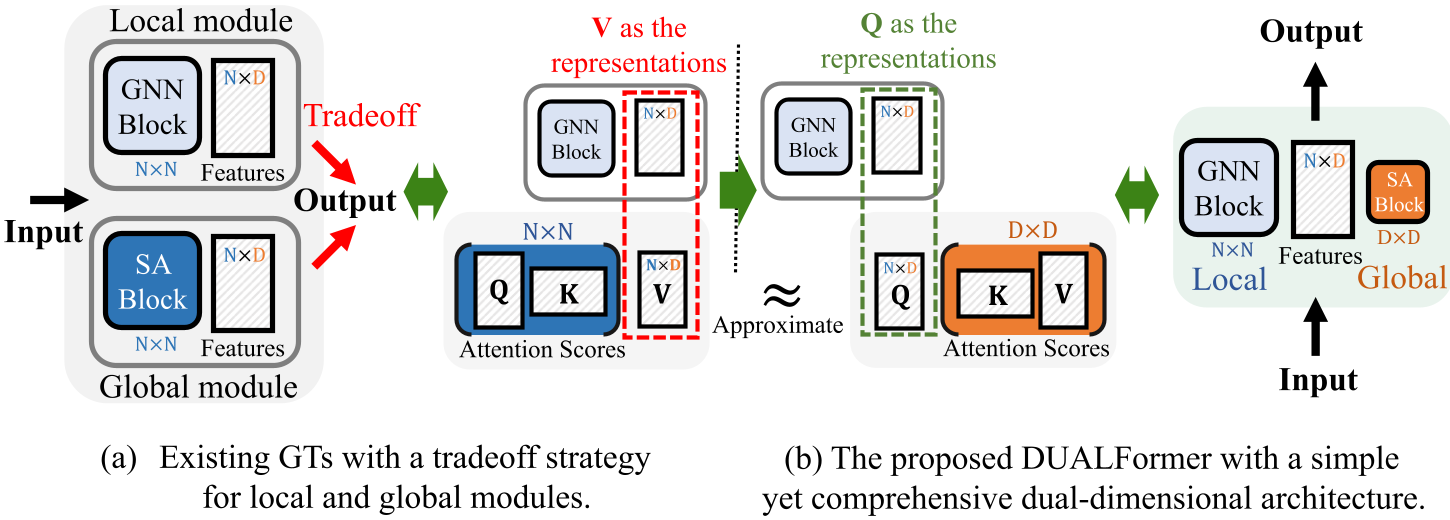 Figure 1: Comparison between standard GTs and the DUALFormer architecture.
3. Theoretical Discriminability
The authors prove (Theorem 1) that the Global Attention module reduces intra-class variance while keeping inter-class variance unchanged. This effectively pushes different classes further apart in the latent space, making the classifier's job easier.
Experiments & Results: Efficiency meeting Effectiveness
DUALFormer was tested across 11 real-world datasets, ranging from small citation networks to the massive ogbn-products.
SOTA Performance
On PubMed, DUALFormer achieved an accuracy of 83.97%, a significant leap over the previous SOTA CoBFormer (81.42%). Even on massive graphs like ogbn-proteins, it achieved an ROC-AUC of 82.98%, proving its effectiveness in large-scale scenarios.
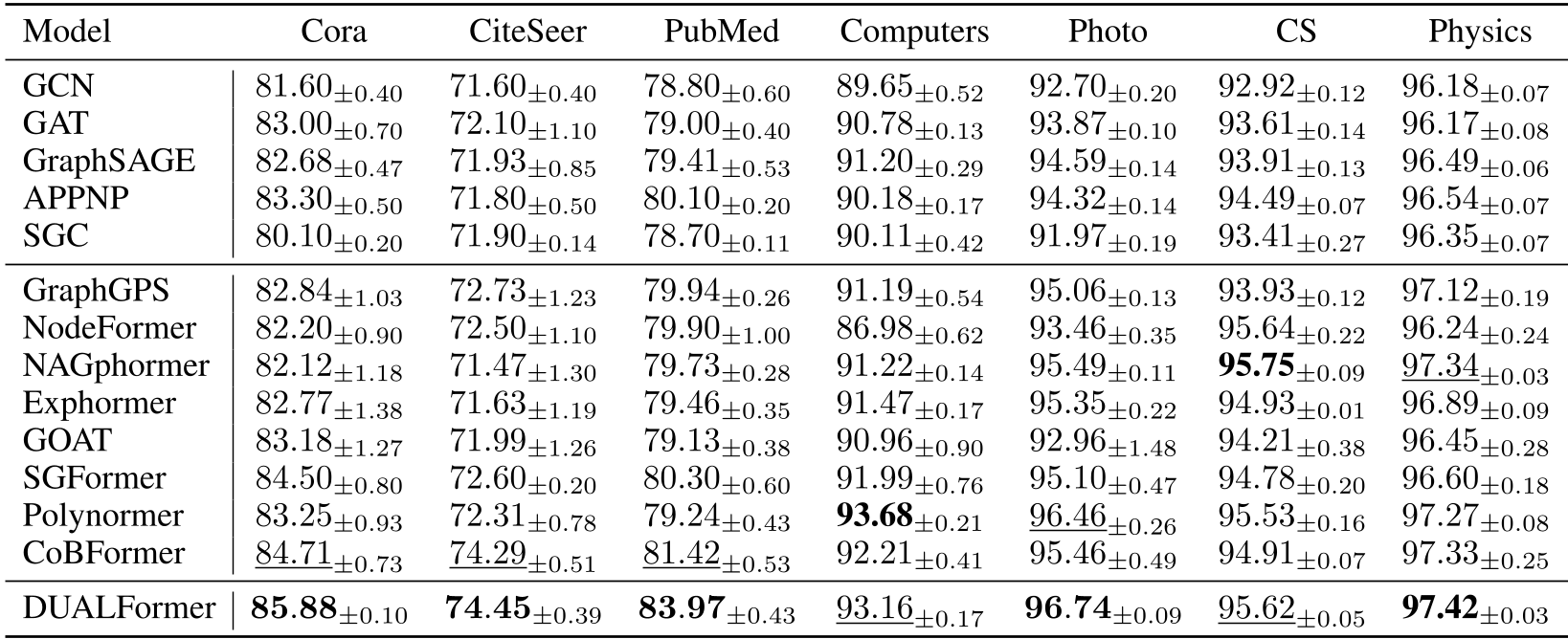 Table 1: Node classification results across 7 benchmark datasets.
Linear Scalability
One of the most impressive results is the scalability study on ogbn-products. As shown in the figures below, both training time and GPU memory usage grow linearly with the number of nodes, whereas traditional GTs would explode.
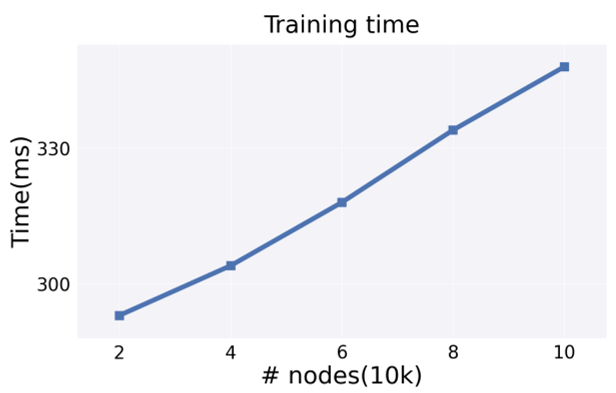 Figure 2: Training time and GPU memory usage showing O(n) growth.
Critical Analysis & Conclusion
Why does it work?
DUALFormer works because it recognizes that in graph data, global information is often redundant. By modeling feature-wise correlations, the model captures the "global signals" (e.g., common themes across a citation network) without needing to compute the relationship of every single paper to every other paper.
Limitations & Future Work
- Heterophily: While DUALFormer performs well, the authors note that GTs in general still struggle to significantly outperform specialized GNNs on heterophilic graphs (where connected nodes have different labels).
- Edge Tasks: Currently, the model is optimized for node classification. Extending this dual-dimensional logic to link prediction remains an open challenge.
The Bottom Line
DUALFormer proves that we don't need "heavy" attention to get global results. By strategically decoupling the feature and node dimensions, we can build Graph Transformers that are both powerful enough for complex tasks and light enough for the world's largest graphs.