
DPR: Maximizing Urban Crowdsourcing Profits via Flexible Duration Recruitment
Duration-Variable Participant Recruitment for Urban Crowdsourcing With Indeterministic Trajectories
This paper introduces a duration-variable participant recruitment (DPR) framework for urban crowdsourcing, aimed at maximizing spatial coverage under budget constraints. By discretely scheduling vehicular sensing resources at the epoch level rather than fixed-duration recruitment, the method significantly enhances sensing efficiency in the presence of indeterministic trajectories.
TL;DR
To build smart cities without the astronomical costs of static infrastructure, we turn to "Urban Crowdsourcing"—using the sensors inside everyday vehicles. However, current recruitment is inefficient and "all-or-nothing." This paper proposes DPR (Duration-Variable Participant Recruitment), a mechanism that recruits vehicles for specific time slots (epochs) rather than entire shifts. By modeling vehicle movement as a probability map and using a greedy selection algorithm, it clears the way for high-efficiency sensing even when budgets are tight and traffic is unpredictable.
Background: The Efficiency Gap in Mobile Sensing
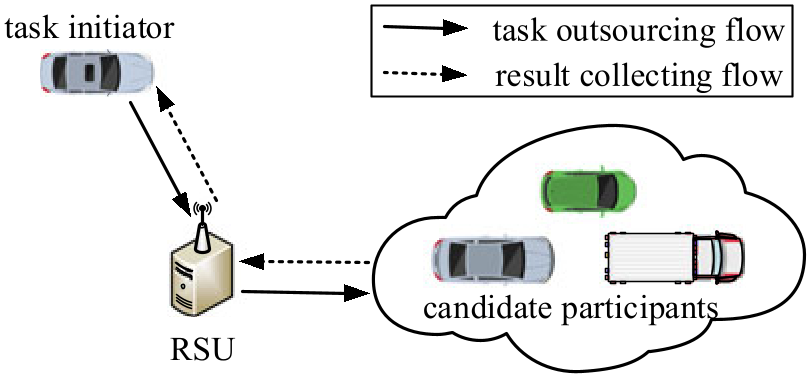
Modern cities are dynamic. Capturing real-time air quality or traffic flow via dedicated sensors is expensive to build and maintain. Crowdsourcing by vehicles (taxis, buses, private cars) is the logical alternative.
The core friction lies in recruitment logic. Previous SOTA methods (like VPR) typically ask: "Should we hire Vehicle A for the next hour?" This paper argues that's the wrong scale. By asking: "Should we hire Vehicle A for minutes 5-10, and Vehicle B for minutes 15-20?", we can eliminate redundant sensing in crowded areas and fill gaps in sparse zones.
The Challenge: Indeterministic Trajectories
Urban movement isn't a fixed line; it's a probability cloud. A taxi might stay in ROI A or turn toward ROI B. The authors tackle this by:
- Probabilistic Trajectory Model: Utilizing historical traces to calculate the likelihood of a vehicle being in a specific Region of Interest (ROI) at a specific time.
- Budgetary INLP: A complex mathematical formulation where the goal is to maximize the sum of "Spatial Coverage" (the probability that at least vehicles cover an ROI) without exceeding a fixed budget.
Methodology: Two-Step Near-Optimal Recruitment
The formulated problem is NP-hard. To make it solvable in real-time, the paper introduces a two-step pipeline:
1. The Participant Selection (Pruning)
Before deciding when to hire, we must decide who is worth hiring. The authors use Pearson Correlation Coefficients to group vehicles with similar travel patterns (likely to provide redundant data) and select only the most "unique" or cost-effective representatives.
2. The DPR Algorithm
Instead of a brute-force search, the algorithm utilizes a greedy iterative approach. In each round, it calculates a weighting metric : Translation: It looks for the "Observation Block" (Vehicle at Time ) that provides the biggest leap in coverage for every dollar spent.
Experiments & Real-World Impact
The researchers tested their model against 320 real taxi traces from Rome. The results were clear:
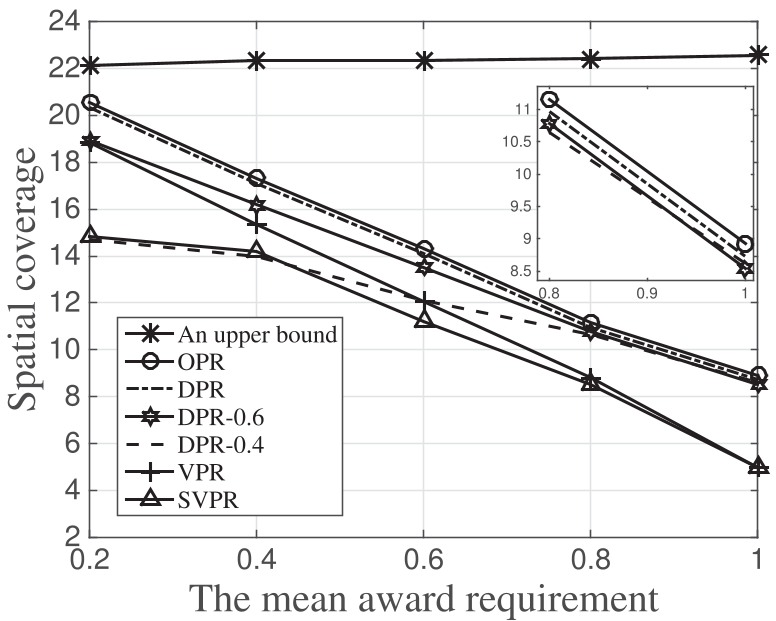
- Better Coverage: Compared to hiring vehicles for the "all-required" period (VPR), DPR achieved significantly higher spatial coverage within the same budget.
- Efficiency: As the budget increases, the gap between DPR and less flexible methods widens, proving that "flexibility" is the key to scaling urban sensing.
- Complexity: The algorithm maintains a linear relationship with the number of vehicles and epochs, making it deployable on standard server hardware used by Roadside Units (RSUs).
Critical Insight: Why Flexibility Works
The "Secret Sauce" of this paper is the Duration-Variable Principle. In urban sensing, different vehicles bring different "Observation Diversity." A vehicle that is highly valuable at 8:00 AM (because it's in a neglected ROI) might be totally redundant at 8:15 AM (because it's moved into a cluster of other sensors). DPR allows the system to "drop" the vehicle the moment its marginal utility drops, preserving the budget for more valuable future epochs.
Conclusion
This work bridges the gap between theoretical crowdsourcing and the messy, probabilistic reality of urban mobility. By breaking recruitment down from "Shift-level" to "Epoch-level," it provides a blueprint for cost-effective, high-coverage smart city surveillance.
Future Outlook: The next frontier for this research involves integrating Dynamic Bidding, where vehicles can adjust their "ask price" in real-time based on their battery levels or current traffic conditions.