
Dutkat: Balancing the Scales of Maritime Privacy and Illegal Fishing Detection
Dutkat: A Multimedia System for Catching Illegal Catchers in a Privacy-Preserving Manner
The paper introduces Dutkat, a multimodal, privacy-preserving surveillance system designed to detect illegal fishing activities. By deploying edge-based AI algorithms on fishing vessels, the system monitors activities locally and only transmits flagged evidence to mainland authorities, effectively balancing regulatory enforcement with the privacy of legal fishers.
TL;DR
Dutkat is a distributed AI system that tackles the global crisis of illegal fishing by moving the "watchful eye" from human monitors to local edge devices. By processing multimodal data (video and sensors) directly on fishing vessels, it protects the privacy of law-abiding fishers while autonomously flagging suspicious activities for forensic review, all while bypassing the limitations of expensive satellite bandwidth.
The Maritime Paradox: Why Monitoring Fails
Sustainable fishing is a pillar of global food security, yet it is plagued by tax evasion, license fraud, and over-exploitation. The traditional solution—placing cameras on every boat—creates two massive hurdles:
- Privacy Infringement: No worker wants a 24/7 live-stream of their every move sent to a government agency. It violates the principle of proportionality.
- Bandwidth Bottlenecks: Trawlers in the Arctic Sea rely on satellite links. Streaming high-definition video from thousands of vessels is technically and financially impossible.
The authors of Dutkat recognize that the current regime, which manages to inspect only about 5% of vessels, is insufficient. We need 100% coverage, but without the "Big Brother" baggage.
Methodology: Intelligence at the Edge
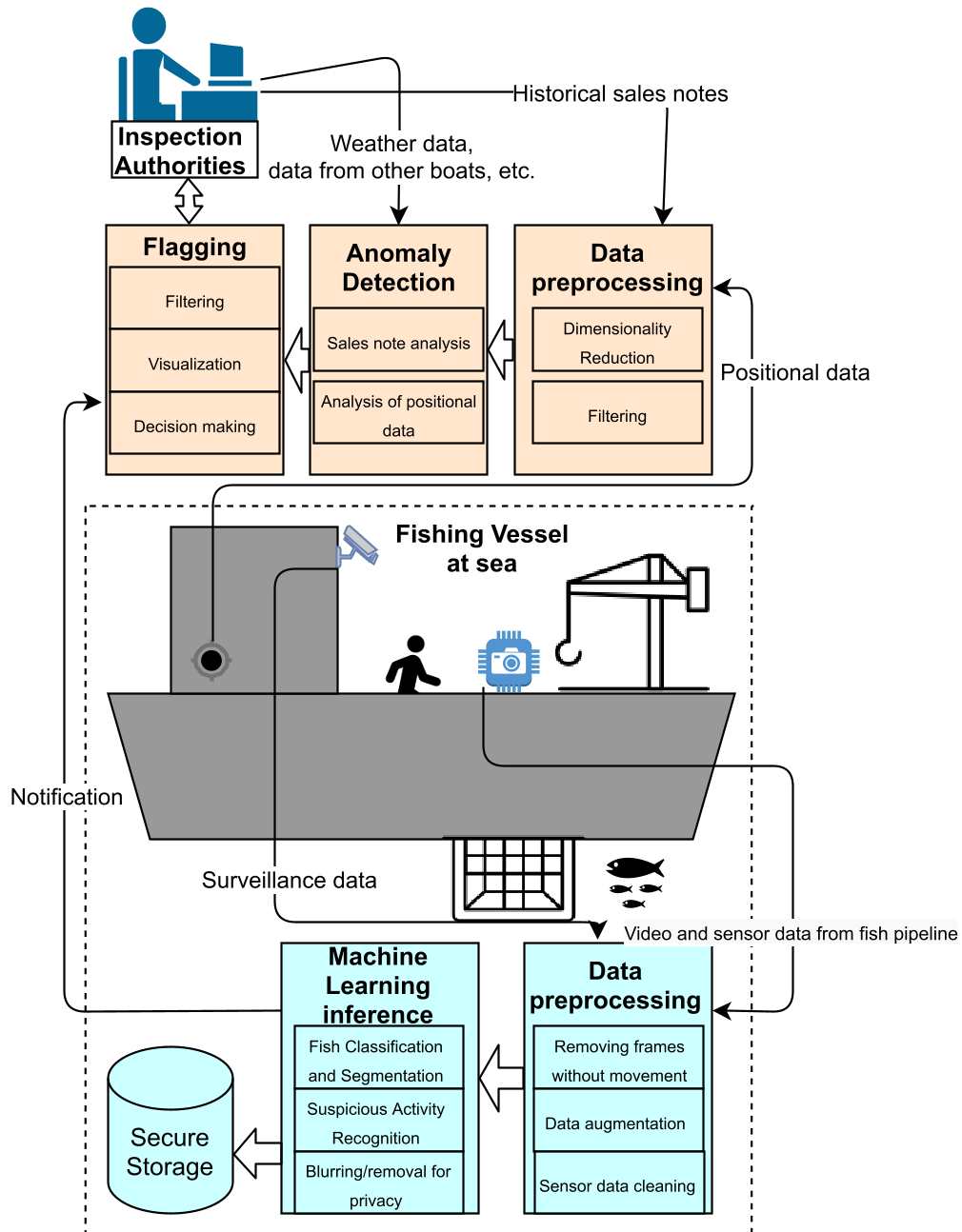
Dutkat’s architecture is built on the philosophy of Decentralized Multimedia Retrieval. Instead of a "Cloud-First" approach, it adopts an "Edge-First" stance.
The Four-Plane Architecture
The system is organized into a vertical stack that spans the vessel and the mainland:
- Data Monitoring Plane: Physical IoT sensors and cameras on the deck and processing line.
- Storage Plane: Distributed local storage where raw data lives (and stays, unless flagged).
- Analysis Plane: The AI "Brain" (leveraging Nvidia Jetson Xavier NX clusters) that performs activity recognition and species counting.
- User Control Plane: A dashboard for authorities to see which vessels are "flagged" before they even dock.
Multimodal Fusion
What makes Dutkat robust is its use of cross-data analysis. It doesn't just look at video; it correlates:
- Visual Data: Detecting anomalous movements (e.g., discarding catch illegally).
- Positional Data (AIS): Checking if the vessel is in a restricted zone.
- Economic Data (Sales Notes): Comparing the reported catch against the AI's visual estimation of volume and species.
Critical Challenges: Beyond the Black Box
The authors identify "Research Directions" (R1-R6) that highlight why this isn't just a standard CV task:
- Transparent AI (R1): For legal enforcement, "the AI said so" isn't enough. Decisions must be explainable to withstand court scrutiny.
- Continuous Learning (R5): Fish appearance changes with seasons and locations. A model trained in the North Sea might fail in the tropics due to "domain shift."
- Data Scarcity (R6): Most surveillance datasets are urban. There is a dire need for "Fish-in-the-wild" datasets that account for harsh lighting, sea spray, and overlapping catch.
Experimental Insight: From 5% to 100% Coverage
While this paper focuses on the concept and architecture, the primary "result" is the shift in the operational paradigm. By using local AI to act as a "virtual inspector," the system addresses the labor-intensive nature of manual review.
The system leverages Transfer Learning to recognize suspicious activities where specific maritime data is scarce, and uses Stereoscopic Imaging for high-accuracy fish segmentation—solving the problem of overlapping fish in the processing pipeline.
Deep Insight & Conclusion
Dutkat represents a sophisticated evolution in Privacy-Preserving AI. It proves that we can achieve high-stakes regulatory oversight without creating a surveillance state. The core innovation isn't just the AI itself, but the distributed trust model: the data stays on the boat (the edge) until there is probable cause (the flag).
Limitations to Watch
- Edge Hardware Resilience: Salty, high-vibration maritime environments are brutal for high-end GPUs like the Jetson Xavier.
- Adversarial Tactics: Will illegal actors find ways to "spoof" the sensors or move activities into camera blind spots?
Ultimately, Dutkat’s architecture is a template for the future. Whether it’s autonomous cars protecting passenger privacy or body-cams for police officers that only record "incidents," the move toward flag-based forensic retrieval is the most viable path toward ethical AI surveillance.