
Harvesting the Digital Persona: Turning Social Media Noise into Biometric Intelligence
+DUYHVWLQJ )DFHV IURP 6RFLDO 0HGLD 3KRWRV IRU %LRPHWULF $QDO\VLV
This paper presents a proof-of-concept framework for harvesting and organizing large-scale biometric datasets from social media using web scraping and unsupervised learning. By employing the DBSCAN algorithm for identity clustering, the authors successfully curated thousands of face images into identity-specific galleries without relying on official APIs.
TL;DR
As the demand for diverse, large-scale facial datasets grows, researchers are hitting "API walls" set by social media giants. This paper demonstrates a successful proof-of-concept for bypassing these restrictions through web scraping and unsupervised identity clustering. By leveraging DBSCAN and CNN embeddings, the authors transformed thousands of raw, unlabeled social media posts into structured biometric galleries with high precision.
Background: The Hunger for Data vs. Privacy Walls
The current state-of-the-art (SOTA) in face recognition—dominated by Deep Learning—is notoriously data-hungry. To solve issues like demographic bias and performance variance, researchers need "in-the-wild" data. However, platforms like Instagram have deprecated their APIs to protect user data, creating a bottleneck. This work positions itself as a technical evaluation of how "public" data remains accessible to those with the right scraping and machine learning toolkits.
Problem & Motivation
The authors identify two critical gaps:
- Data Scarcity for Research: Traditional datasets often lack the demographic scale found on social networks.
- Inadequate Safeguards: Despite regulations like GDPR, the "public" nature of social media makes traditional data protection (like API throttling) ineffective against sophisticated scraping.
The core intuition is that social media users naturally provide enough redundancy (multiple "selfies") to allow unsupervised algorithms to identify and group them without any manual labeling.
Methodology: The Scraping & Clustering Pipeline
The authors developed a multi-stage pipeline to turn a hashtag search into a clean biometric dataset:
- Discovery: Utilizing hashtags like
#selfieor#prettyfaceto identify "high-yield" profiles. - Scraping: Using Python libraries (BeautifulSoup/Selenium) to extract raw images directly from the web interface, bypassing API limitations.
- Feature Extraction: Each face is passed through a Convolutional Neural Network (CNN) to produce a 128-dimensional vector representing unique facial geometry.
- Cascade Clustering: Use DBSCAN (Density-Based Spatial Clustering of Applications with Noise). Unlike K-Means, DBSCAN doesn't require knowing the number of people (clusters) in advance.
Note: The methodology relies on identifying high-density areas in the 128-d vector space to define individuals, treating non-subject faces as "noise".
Experimental Results
The experiment yielded significant volume from a relatively small seed of profiles:
- Volume: 100 profiles generated ~58,000 faces.
- The Power of Cascade: Initially, large galleries caused lower accuracy. By applying a cascade approach (clustering the sub-clusters), they achieved a "positive outcome" with zero false positives in the primary subject group.
- Resilience: The system successfully grouped faces even when subjects had occlusions (glasses, hats) or varying lighting.
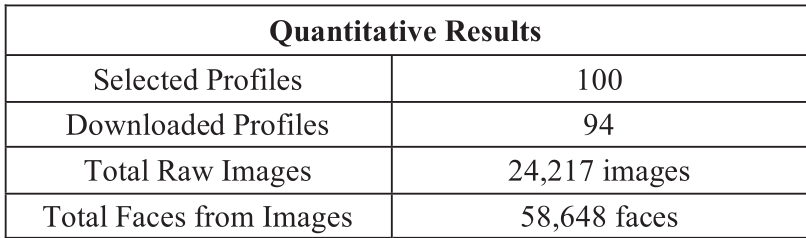 Table 1: Quantitative scale of the harvested data.
Critical Analysis & Conclusion
Takeaway
This paper serves as both a "how-to" for biometric researchers and a "warning shot" for privacy advocates. It proves that identity clustering can effectively automate the creation of labeled datasets from the chaos of social media.
Limitations
- Computational Efficiency: While DBSCAN works for thousands of images, the authors admit that Chinese Whispers clustering might be necessary for millions of images due to speed requirements.
- Identity Duplication: As the dataset scales to thousands of profiles, identifying if "Person A" in one profile is the same as "Person B" in another becomes a cross-cluster challenge.
Future Outlook
The authors suggest that the next frontier is secondary identity discovery. Most profiles contain friends and family; by clustering these "background" people, the dataset size could grow exponentially beyond the initial user list. This highlights a future where your biometric signature is harvested not just from your profile, but from every photo you've ever appeared in on someone else's feed.