
The Power of the Dyad: How Cultural Intelligence Governs Global Virtual Teams
Effects of a Dyad's Cultural Intelligence on Global Virtual Collaboration
This study examines how Dyadic Cultural Intelligence (CQ) influences processes and outcomes in Global Virtual Collaboration (GVC). Using a simulation with 35 cross-cultural dyads (China-Germany), it classifies CQ effects using "selected score models" to distinguish between the influence of the lower and higher CQ individuals within a team.
TL;DR
In the world of global virtual collaboration (GVC), not all "intelligence" is created equal. This research uncovers a fascinating duality: the person with the lowest Cultural Intelligence (CQ) in a pair dictates how well the team talks and feels (the process), while the person with the highest CQ determines the actual quality of the work (the outcome).
Moving Beyond Rigid Culture Models
For decades, managers handled cultural diversity like a game of Tetris—trying to fit specific nationalities together or avoiding "faultlines." This "rigid approach" ignores human adaptability. The authors of this study argue that Cultural Intelligence (CQ)—the ability to adapt across cultures—is the "soft" factor that makes or breaks virtual teams.
But here is the catch: when two people from different countries (in this case, China and Germany) work together via screen and headset, whose CQ matters more? The expert's or the novice's?
The "Weak Link" vs. "High Flyer" Hypothesis
The researchers used a Collaborative Performance Framework to track how inputs (CQ) turn into processes (Behaviors) and finally into outcomes (Quality and Satisfaction).
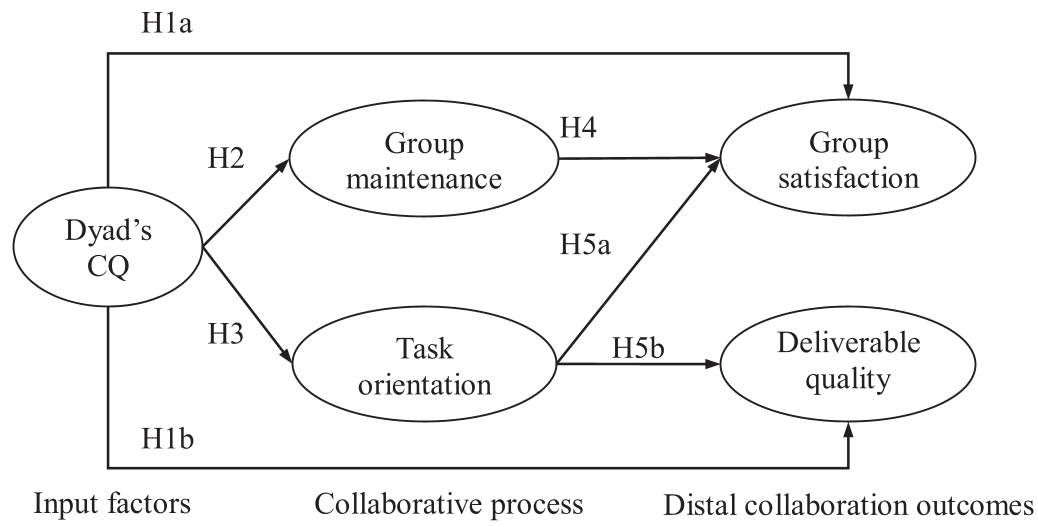
They discovered a critical split in how CQ functions:
- The Floor (CQ-L): The member with the lower CQ acts as a bottleneck. If one person can't adapt their communication style, the collaboration stalls. This directly impacts Group Satisfaction.
- The Ceiling (CQ-H): For "disjunctive" tasks (where a single best solution is needed), the member with the higher CQ can "carry" the team to a high-quality result by facilitating communication and bridging gaps, even if the process was bumpy.
Methodology: Coding the Human Element
The study analyzed 70 participants across 35 dyads. To get beyond "self-report" bias, the team used Bales’ Interaction Process Analysis (IPA). They didn't just ask if the collaboration was good; they transcribed every voice recording and chat log to count:
- Group-Maintenance Behaviors: Agreements, tension release, and showing solidarity.
- Task-Orientation Behaviors: Giving suggestions, opinions, and orientation.
Key Results: Process vs. Performance
The findings, summarized in the updated research model below, show that while we might want everyone to have high CQ, different levels serve different masters.
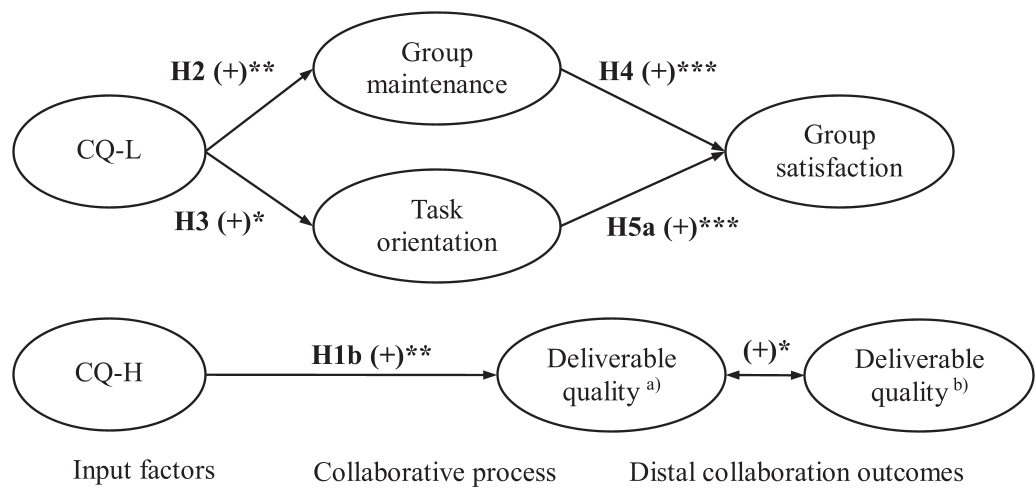
- Process Bottleneck: CQ-L was a strong predictor of both group maintenance (β=0.47) and task orientation (β=0.42). If the "weakest link" has low motivational or behavioral CQ, the team simply interacts less.
- Quality Driver: CQ-H predicted the quality of the final proposal (β=0.45). Interestingly, the "lower" member's CQ had almost no impact on the final grade of the work, provided the "higher" member could navigate the cognitive demands of the task.
Deep Insights for Modern Managers
This study offers a "parsimonious" (efficient) roadmap for global HR and project leads:
- For Short-Term "Sprint" Teams: Focus on the ceiling. Ensure at least one "Cultural Bridge" (High CQ) is present to safeguard the deliverable quality.
- For Long-Term "Stable" Teams: Focus on the floor. Invest in CQ training for the lowest-scoring members. Why? Because over time, low satisfaction leads to turnover and team collapse, regardless of work quality.
- Tech Support: Designers of Virtual Environments (like Slack or Zoom) should consider "Artificial CQ" features—real-time prompts that encourage agreement or flag cultural communication pauses—to help low-CQ members bridge the gap.
Conclusion: An Adaptive View
This research shifts the focus from who you are (National Culture) to how you adapt (Cultural Intelligence). In the age of remote work, GVC is no longer a luxury; it is the default. Understanding that the "weakest link" governs the vibe while the "strongest link" governs the value allows organizations to build more resilient, intelligent global teams.