
SOCKER: Bridging the Gap Between Virtual Socializing and Real-World Encounters
A Dynamic Community Creation Mechanism in Opportunistic Mobile Social Networks
The paper introduces SOCKER, a dynamic Mobile Social Community (MSC) creation mechanism for Opportunistic Mobile Social Networks (OSNs). It utilizes social-aware broker selection strategies to facilitate face-to-face interactions by matching users based on popularity and inter-user closeness.
TL;DR
While Facebook and LinkedIn excel at virtual connectivity, we often miss social opportunities with the people standing right next to us. SOCKER is a decentralized framework that turns mobile phones into "social brokers." By analyzing your mobility patterns and relationship strengths, it dynamically forms real-world social groups (Mobile Social Communities) for activities like football games or parties, ensuring high success rates and user satisfaction without a central server.
The Missing Link in Mobile Socializing
The paradox of the modern era is that we are more connected than ever online, yet more isolated in physical spaces. Current Opportunistic Networks (OSNs) research focuses heavily on content routing but ignores the intentional formation of groups with specific constraints, such as:
- Fixed Sizes: Most social activities have a person limit (e.g., a 5v5 soccer match).
- Different Social Goals: "Open" activities aim to meet new people; "Close" activities seek familiarity.
- Privacy and Efficiency: Users shouldn't have to broadcast their preferences to everyone to find a match.
Methodology: The Art of the Broker
SOCKER transforms community creation into an information dissemination and matchmaking problem. Instead of flooding the network, it uses a Single-Copy Approach.
1. Social-Aware Broker Selection
The system identifies "Brokers"—users who are most likely to facilitate a community. It uses two primary metrics:
- Weighted Weekly Popularity (WWP): Not all encounters are equal. Recent encounters are weighted more heavily to predict future mobility.
- Inter-User Closeness: By specifically tracking encounters during non-working hours, SOCKER distinguishes between a random colleague and a close friend.
2. The Dynamic Algorithm
When an initiator starts a task, they specify the Required Community Size (RCS) and Expiry Time (CET). When the initiator's phone meets a "better" broker (someone with higher popularity or better social ties), it hands over the task.
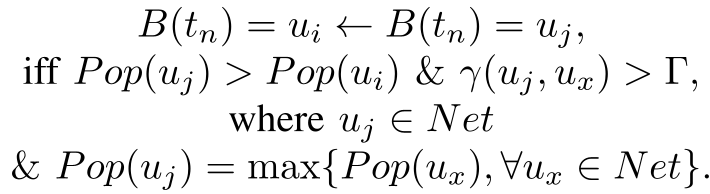 Broker Selection logic for Close-Activities ensures the broker is socially relevant to the initiator.
Experiments and Insights
The authors validated SOCKER using the famous MIT Reality Mining dataset, which tracks the Bluetooth encounters of 100+ subjects over a year.
Key Findings:
- Brokers Matter: Without brokers (No-Switch), the Community Completion Ratio (CCR) stays below 30%. With SOCKER’s multi-switch strategy, it climbs toward 80-90% as the expiry time increases.
- Temporal Context is King: Weighting recent popularity (Assumption 1) proved far more effective than a simple average of historical data.
- Social Awareness Wins: When organizing "Close" activities, using brokers who are socially connected to the initiator (Assumption 2) dramatically improved the speed of finding members without overwhelming the network with irrelevant messages.
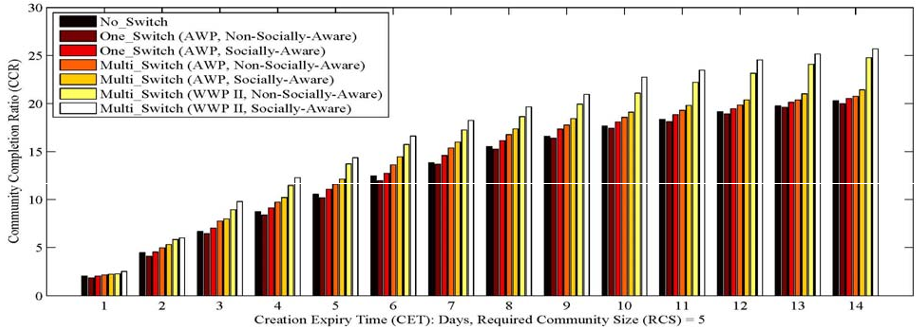 Graph (a) shows the CCR of socially-aware vs. non-socially-aware approaches, proving that social context accelerates community formation.
Critical Analysis & Conclusion
SOCKER succeeds by recognizing that mobility is not random. By treating mobility as a proxy for social accessibility, the authors provide a lightweight way to organize physical life without the privacy risks of a central tracking server.
Limitations: The model assumes users are willing to act as brokers. In real-world scenarios, an incentive mechanism (like digital tokens or reputation) might be needed to encourage users to spend battery life on matchmaking for others.
Future Outlook: As we move toward a "Post-App" era dominated by local AI agents, protocols like SOCKER could allow our devices to negotiate our social lives autonomously, reclaiming the "physicality" of our social networks.
Takeaway: The next time you want to organize a quick game of pickup basketball, your phone might already be talking to the broker who knows exactly who is nearby and interested.