
Dynamic DDDAS: Revolutionizing Shellfish Farm Management via Machine Learning
A Dynamic Data-driven Decision Support for Aquaculture Farm Closure
The paper introduces a dynamic data-driven decision support system (DDDSS) for predicting aquaculture farm closures, specifically for shellfish farms in Tasmania. It proposes and compares two machine learning strategies—regression with expert rules and direct time series classification—integrated into a framework that updates models incrementally as new environmental data arrives.
TL;DR
By shifting from static data analysis to a Dynamic Data-Driven Application System (DDDAS), researchers from CSIRO have developed a method to predict aquaculture farm closures at least 24 hours in advance. Leveraging machine learning models that update in real-time with incoming sensor data, the system achieves over 80% accuracy, moving the industry from reactive manual checks to proactive intelligent management.
Background: The Static Data Problem
In the shellfish industry, water quality is everything. Contaminants—often proxied by salinity levels, rainfall, and river flow—dictate whether a farm is "Open" (safe for harvest) or "Closed." Historically, the Tasmanian Shellfish Quality Assurance Program (TSQAP) relied on manual decisions based on current sensor snapshots.
The problem? This is static. It doesn't account for the temporal evolution of environmental factors, nor does it provide the "early warning" farmers need to plan labor and logistics.
The Core Insight: Dynamic Learning
The authors argue that a Decision Support System (DSS) shouldn't just be a fixed calculator. Instead, it must be dynamic. Their proposed architecture (DDDAS) treats the model as a living entity. As new sensor data flows in from the Bureau of Meteorology (BOM) and river gauges, the model's parameters are refined.
Two Technical Pathways
The study tests two distinct philosophies in machine learning:
- Regression + Expert Rules: Predict the environmental proxy (e.g., Salinity) for , then apply a hard threshold (e.g., "If Salinity < 30 PSU, then Close").
- End-to-End Classification: Train a model to recognize the "fingerprint" of a closure directly from a sliding window of historical sensor data.
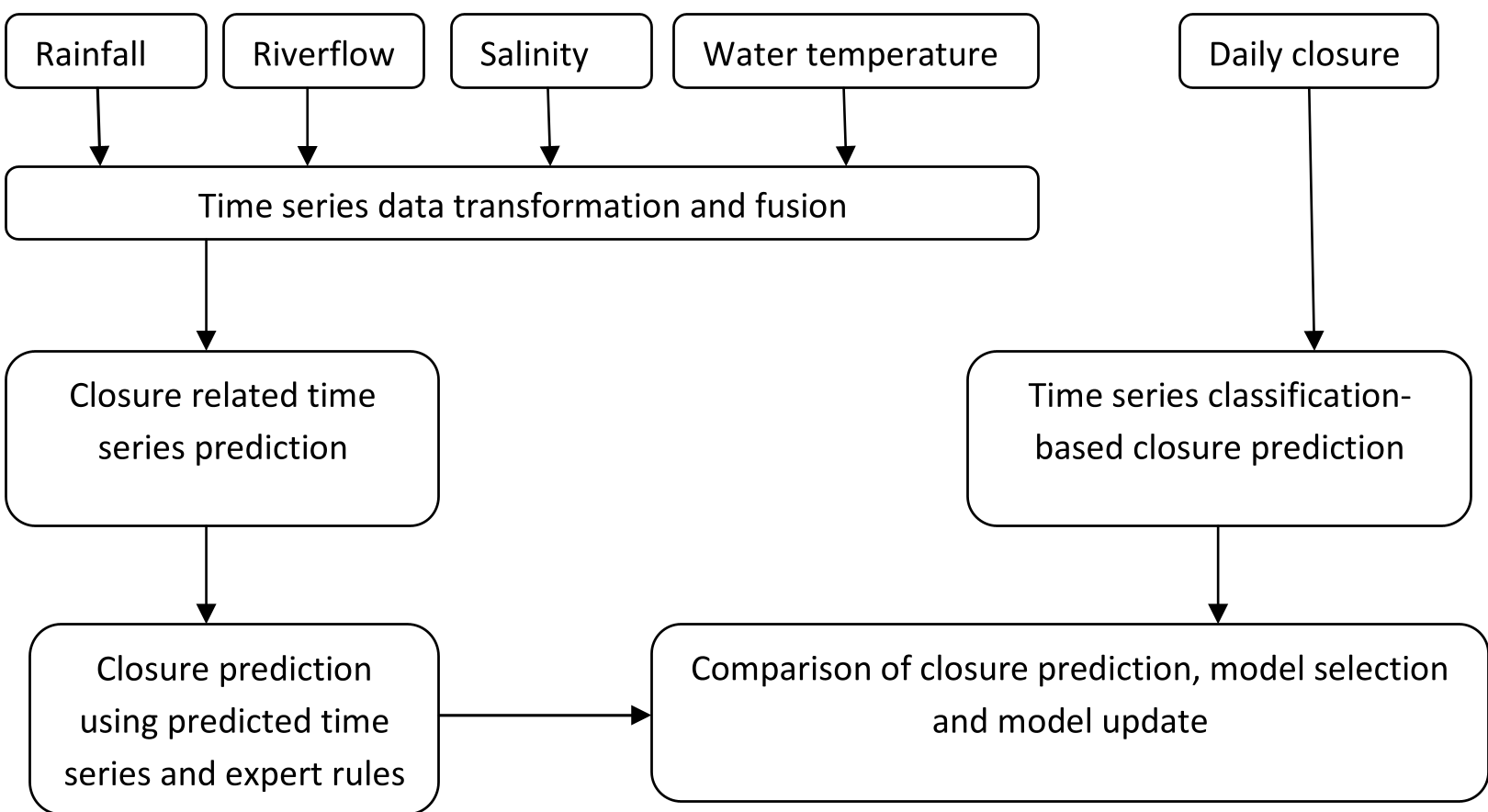 Figure: The Off-line learning phase where historical environmental time series are fused to train the initial models.
Methodology: Fusing Heterogeneous Streams
Aquaculture data is messy. Salinity and temperature might be recorded every few minutes, while rainfall is a daily aggregate. The researchers performed Temporal Fusion, transforming all inputs into a uniform daily resolution.
By using a 5-day lagged window, they captured the "inertia" of these environmental systems—recognizing that heavy rainfall today might not impact salinity at the shellfish lease until 24 hours later.
Results: Classification Wins
The experiments at Moulting Bay yielded a critical insight for practitioners: The direct classification approach (Neural Networks) was significantly more robust.
- Regression (M5P + Rules): Performance was hindered by "cascading errors." If the salinity prediction was slightly off, the expert rule would fail.
- Classification (Neural Networks): By learning the complex, non-linear relationship between all variables simultaneously, the NN achieved an 81% accuracy in predicting closures.
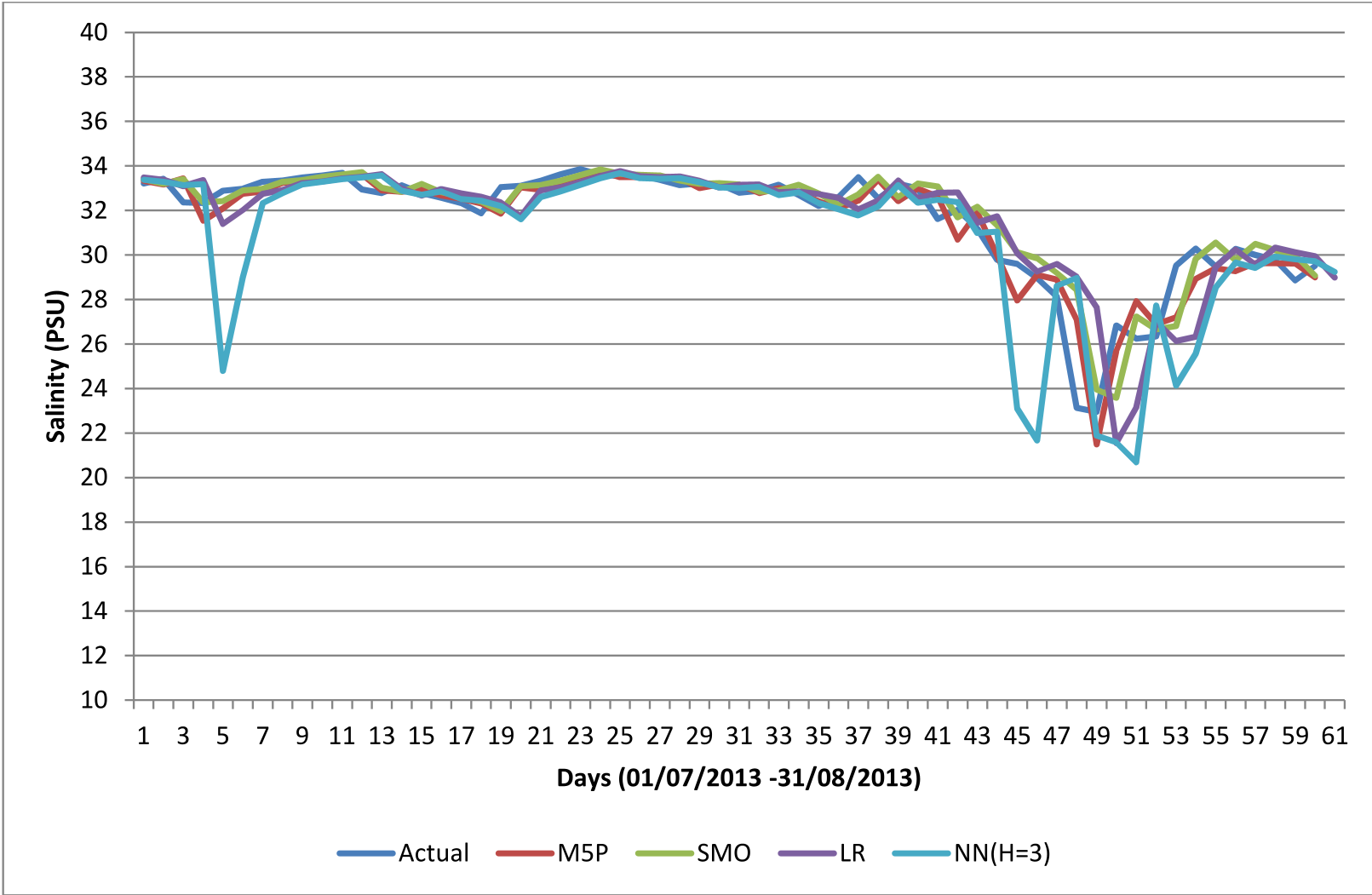 Figure: Comparison of actual vs. predicted Salinity levels used in the regression-based approach.
Deep Insight & Conclusion
This work demonstrates that Inductive Bias—in this case, the decision to trust a neural network's holistic classification over a manual expert rule—is the key to dealing with environmental volatility.
Takeaway for the Industry: The future of smart aquaculture lies in "Closing the Loop." By integrating real-time data arrival with online model updates (Figure 3), farms can move away from "worst-case scenario" manual closures and toward highly surgical, data-backed operational decisions.
Future Directions: The current model struggles with missing sensor data (a common issue in harsh marine environments). Future iterations utilizing Probabilistic Graphical Models or Generative Adversarial Networks (GANs) to "fill in the gaps" of missing sensor streams will be the next frontier in aquaculture DDDSS.