
DDC-Spark: Scaling Patient-Centric Healthcare with Dynamic Distributed Clustering
Dynamic Distributed Clustering Approach Directed to Patient-Centric Healthcare System
The paper introduces a Dynamic Distributed Clustering (DDC) framework tailored for patient-centric healthcare systems using Apache Spark. It leverages an updated hierarchical K-Medoids approach to process large-scale Electronic Health Records (EHR) without requiring a predefined number of clusters, achieving SOTA performance on the HCUP dataset.
TL;DR
Predicting disease patterns in massive Healthcare databases requires more than just raw power; it requires intelligent data organization. This paper presents a Dynamic Distributed Clustering (DDC) framework built on Apache Spark. By moving away from fixed-K clustering and utilizing a hierarchical merging strategy, the authors achieved up to 51.7% reduction in clustering errors on Big Data benchmarks, enabling faster and more accurate patient-centric insights.
Background: The Big Data Bottleneck in Healthcare
Electronic Health Records (EHR) are a goldmine for "Personalized Medicine." However, this data is notoriously "dirty"—sparse, high-dimensional, and irregular. While clustering (specifically K-Medoids) is ideal for identifying patient phenotypes because it is robust to outliers, it typically doesn't scale well. Specifically:
- The K-Problem: You usually have to tell the algorithm how many clusters (K) to find. In healthcare, we don't always know how many disease categories exist.
- The Scalability Wall: Standard K-Medoids is computationally expensive (), making it a nightmare for HDFS-scale datasets.
Methodology: The Dynamic Two-Phase Approach
The authors solve these issues by splitting the task into a local-to-global hierarchy, optimized for the Spark Framework.
Phase 1: Local Parallel Clustering
The dataset is partitioned into Resilient Distributed Datasets (RDDs). Each worker node runs a local K-Medoids algorithm. To save bandwidth and memory, the system uses a Data Reduction technique: instead of passing all data points to the master node, it only transmits the medoids (central points) and the cluster boundary points.
 Figure 1: The proposed High-level Architecture. Note the transition from raw sensor/EHR data to the Spark-based clustering module.
Phase 2: Dynamic Global Aggregation
This is where the "Dynamic" magic happens. Using an overlay method, "Leader" nodes collect neighboring cluster models and merge them. This process continues up a tree structure until a root node is reached. Because merging is based on spatial proximity of boundaries, the final number of clusters is determined by the data's natural shape, not a pre-set parameter.
Experimental Validation
The framework was tested on the Healthcare Cost and Utilization Project (HCUP) dataset, featuring up to 30 million records and 5 GB of raw data.
1. Performance and Latency
The system maintained impressive efficiency. As the dataset size increased sixfold (from 5M to 30M records), the average latency for query retrieval increased by only ~3.7%. This demonstrates the linear scalability provided by the Spark implementation.
2. Accuracy vs. The Giants
The DDC model was compared against K-means, K-prototypes, and Object Clustering Iterative Learning (OCIL).
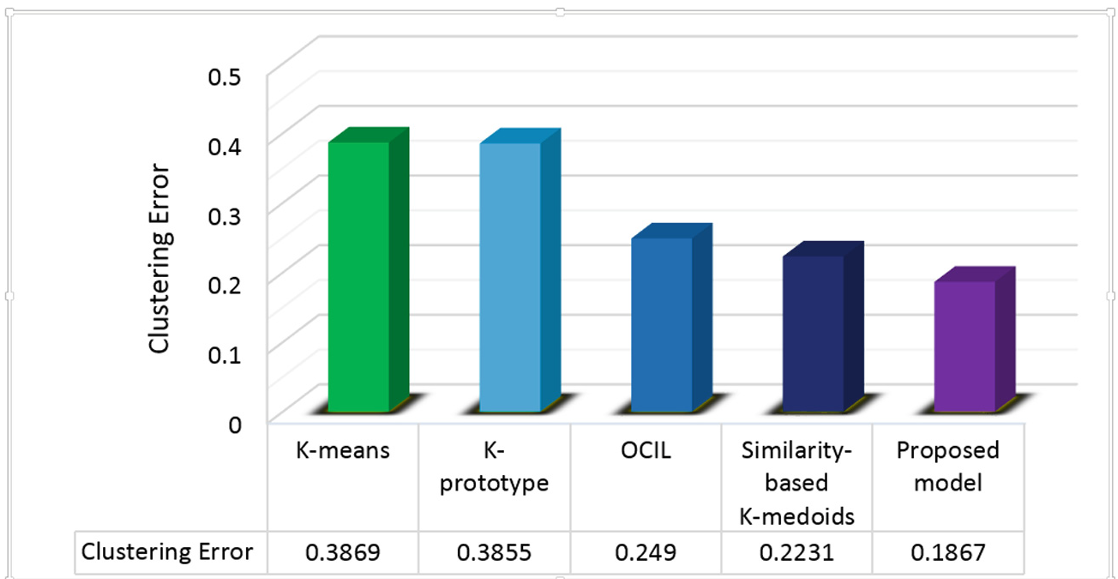 Figure 2: The DDC approach significantly outperforms K-means and OCIL, reducing the error rate to a mere 0.36%.
The results (as seen in Figure 2 and 4 of the paper) highlight that while K-means often gets stuck in local minima or struggles with irregular clusters, the DDC's hierarchical merging retains the precision of local data distributions.
Critical Insight & Conclusion
The true value of this work lies in its Communication Efficiency. By only sharing boundary points and medoids between nodes, the authors bypassed the "Data Shuffling" bottleneck that often plagues distributed machine learning.
Takeaways for the Industry:
- Dynamic > Static: In clinical settings where new diseases or variants emerge, algorithms that don't require a fixed "K" are superior.
- Hybrid Architecture: Combining local efficiency with global hierarchical merging is the blueprint for real-time healthcare analytics.
Future Outlook: The authors suggest that the next frontier is integrating Deep Learning to handle the unstructured bits of EHRs (like doctor's notes) before the clustering phase, potentially creating an even more potent diagnostic tool.