
Dynamic Enrichment: Capturing the "Heat" of Social User Interests
Dynamic enrichment of social users' interests
The paper introduces a dynamic user profile enrichment approach for social networks that combines tagging behavior, temporal evolution, and resource metadata. By utilizing a "Temperature" concept to measure resource popularity over time, the method significantly improves the identification of current user interests, achieving an overall precision of 0.58 on the Delicious dataset.
TL;DR
In the volatile world of social networks, what you liked yesterday isn't necessarily what you care about today. This paper proposes a dynamic enrichment framework that uses the concept of "Temperature" to track the popularity and freshness of resources, combined with a metadata-weighting mechanism to ensure that the tags added to a user's profile are both timely and semantically relevant.
The Problem: Static Profiles in a Dynamic World
Most adaptation systems treat user profiles as collection bins for history. However, the authors argue that:
- Behavioral Noise: Accessing a page doesn't always imply interest.
- Temporal Decay: Interests become "outdated." An interest relevant in Period A might be irrelevant in Period B, only to reappear as a "Buzz" in Period C.
Methodology: The Heat of the Moment
The core of the methodology is a multi-step pipeline designed to extract the most relevant "current" interests from the noise of a social stream.
1. The Temperature Concept
Instead of just counting tags, the system calculates a Temperature for every resource. This metric is a weighted sum of three critical factors:
- Freshness: Inverse of the time elapsed since the last tag.
- User Similarity: The cosine similarity between users who interact with the same resource—if your "neighbors" like it, the temperature rises.
- Popularity: The sheer volume of tags associated with the resource.
2. Semantic Weighting via Metadata
To avoid the "ambiguity" of social tags (where users might tag something "cool" or "stuff"), the system validates tags against the resource's semi-structured metadata.
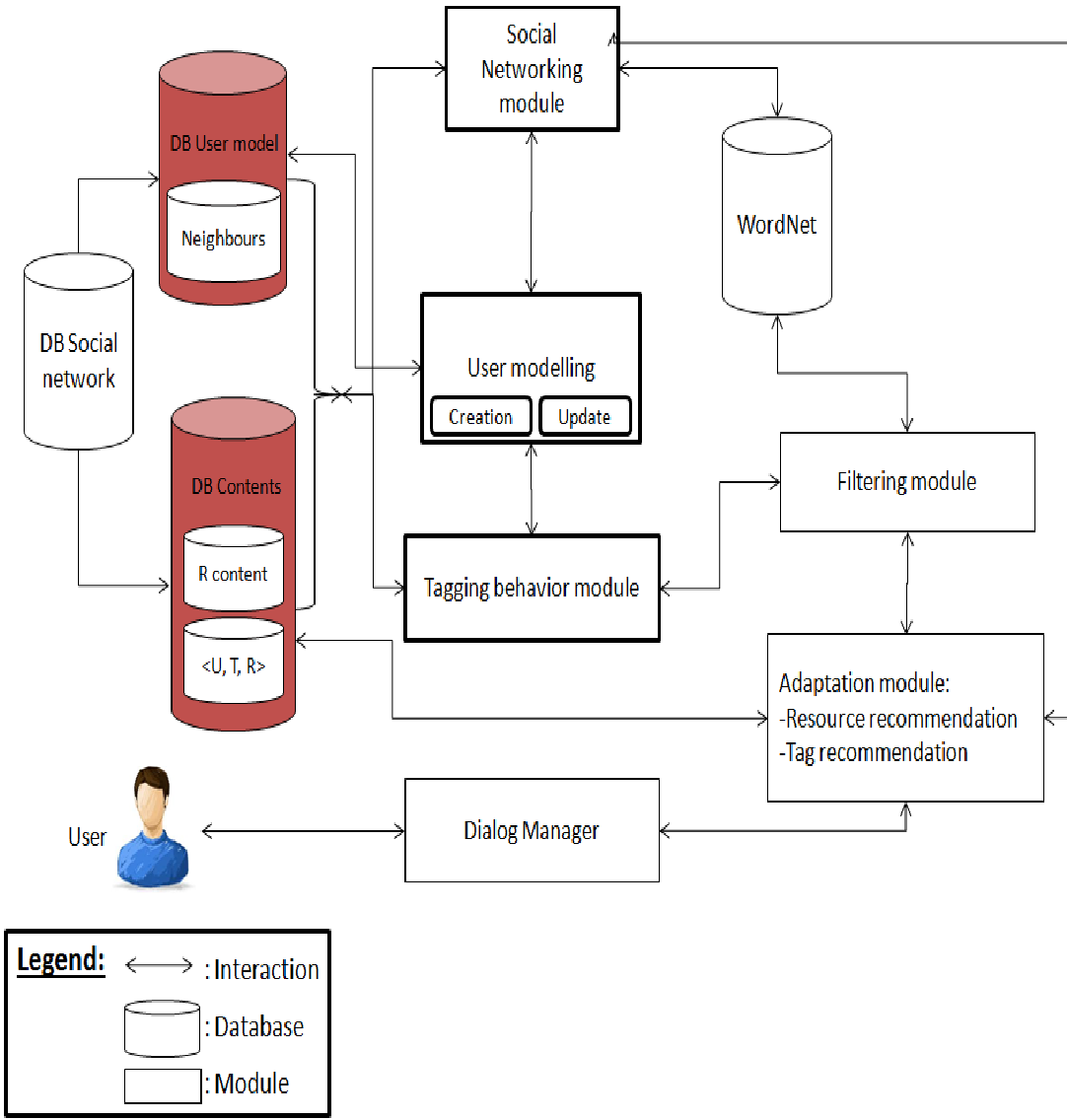
The weight is determined by the tag's occurrence in the Title, Keywords, and Description of the resource. Only tags crossing a specific threshold are used to enrich the profile.
Experiments: Proving the Pulse
The researchers tested their approach on the Delicious social database. By dividing the timeline into 1-day windows ( day), they tracked the evolution of 1,867 users.
Key Findings:
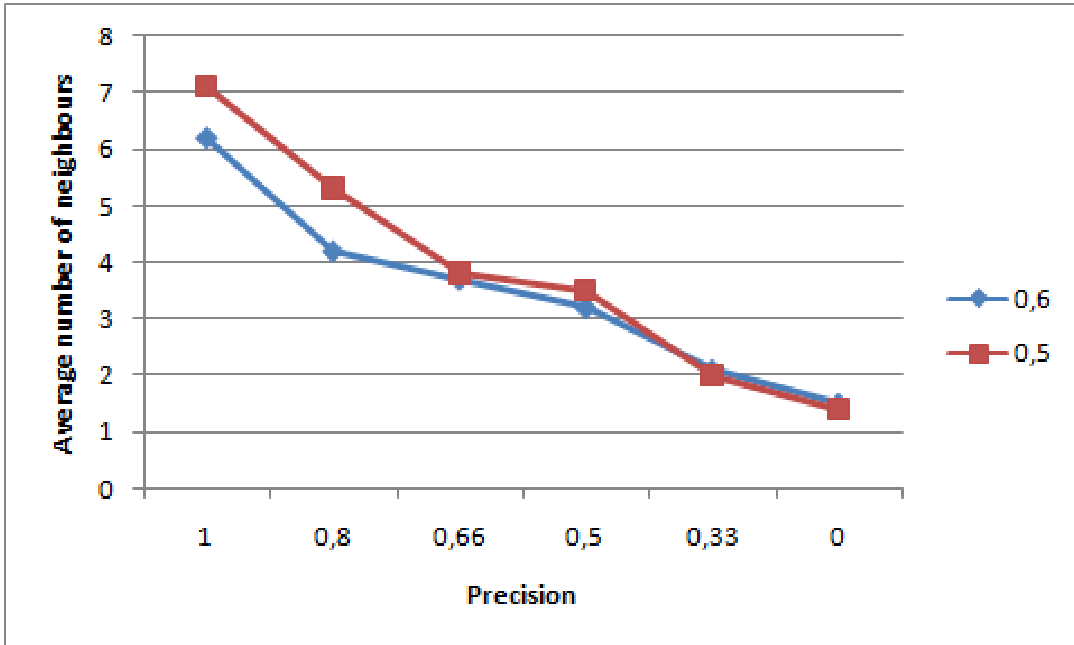
- Optimal Thresholding: The system performs best at a threshold of 0.5, balancing the quantity of new interests with their accuracy.
- The Power of Social Ties: Users with more "neighbors" (friends) saw significantly higher precision in their profile enrichment. This suggests that "Social Intelligence" is the primary driver of the enrichment quality.
- Clarity vs. Ambiguity: Using WordNet for validation, the authors showed that over 80% of enriched tags were comprehensible, successfully filtering out much of the typical social media "slang" or irrelevant noise.
Critical Insight: Beyond Frequency
The "Temperature" model is a sophisticated way to handle interest fluctuations. Unlike simple decay functions that permanently delete old interests, a temperature-based model allows an interest to "cool down" and later "re-heat" if it becomes popular again. This perfectly mirrors the "Buzz" cycle of modern social media.
Conclusion & Future Look
The paper successfully demonstrates that by combining who is tagging (neighbors), when they are tagging (freshness), and what the resource actually contains (metadata), we can build a profile that lives and breathes with the user.
Limitations: The system relies heavily on "active" users. For "cold-start" users with few tags or friends, the Temperature metric lacks enough data points to be effective. Future research into hybrid models—combining this social approach with deep content embeddings—could bridge this gap.