
Beyond the Follow Button: Unveiling Information Dissemination via Implicit Links and Social Influence
3411_A Dynamic Information Dissemination Model Based on Implicit Link and Social Influence.
This paper proposes a dynamic information dissemination model that incorporates "implicit links"—relationships where users share common interests or topical participation without explicit "follow" ties. By combining the KNN algorithm for link discovery and multiple linear regression for influence measurement, the authors enhance a flexible SIR (Susceptible-Infected-Recovered) model to predict social network dynamics more accurately.
TL;DR
The paper introduces a novel dissemination model that moves beyond explicit "following" relationships to include implicit links—hidden connections between users who interact with the same topics. By combining KNN-based link mining with a flexible SIR epidemic model, the authors achieve a significant leap in predicting how information "infects" a social network, increasing model accuracy (R-squared) by over 30%.
The "Invisible Network" Problem
Why does a meme go viral among people who don't follow each other? Most research focuses on the Explicit Link (who you follow). However, in modern social media, "Implicit Links" (shared interests or gaming relationships) often drive the narrative. Previous models suffered from two main flaws:
- Structural Blindness: Ignoring the impact of non-friend interactions.
- Algorithmic Rigidity: Manually setting infection and immune rates in SIR models, which fails to capture the nuance of human behavioral shifts.
Methodology: Bridging Topology and Influence
The authors propose a hybrid approach to quantify what they call the "Social Influence" of a node.
1. Excavating the Implicit Topology
Using the K-Nearest Neighbor (KNN) algorithm, the model identifies potential implicit links by analyzing:
- Friend Interactivity: How often users participate in the same 300+ research topics.
- Friend Similarity: Cosine similarity of personal tags and common friend density.
2. The Influence Regression Model
The influence is formulated using multiple linear regression:
- Individual Drive: Factoring in user activity and "content similarity" using Word2Vec.
- Explicit/Implicit Friend Drive: Measuring the average "opinion leader" status of neighbors.
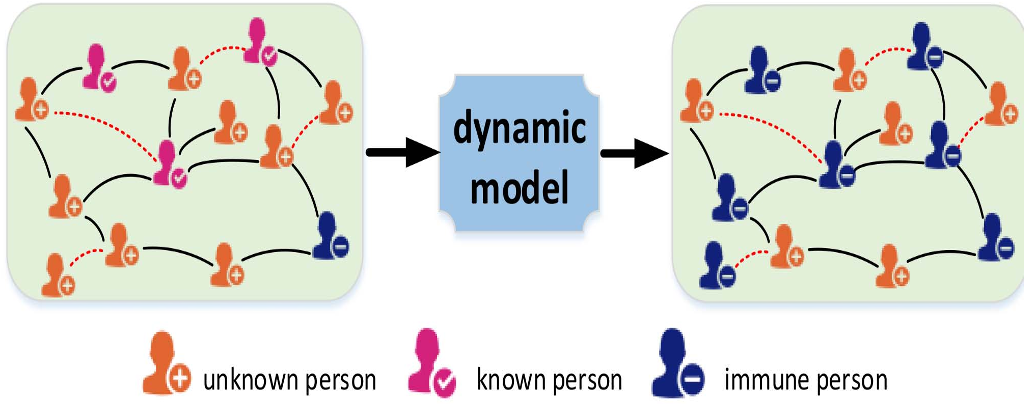 The model framework: From feature extraction to the flexible SIR dynamics.
Experiments: Real-World Validation
The model was tested on massive datasets from Tencent Weibo, covering topics like "Feng Xiaogang movies" and "Panda Girl assistance."
Key Evidence: The Power of the Implicit
When the authors added implicit links to the network topology, the R-squared (goodness of fit) jumped from 0.54 to 0.87. This proves that the "hidden" network is not just a noise factor but a primary driver of dissemination.
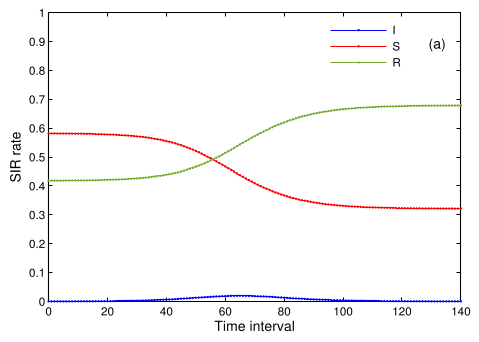 Comparison between actual data and the model’s estimated spread. Note the high alignment in the "infected" (known person) curve.
Deep Insights: Dynamic Driving Factors
The study performs an ablation-style analysis on the driving factors (Individuality vs. Explicit Links vs. Implicit Links).
- Finding: Explicit links remain the strongest factor, but implicit links consistently outperform individual attributes in driving dissemination.
- Mechanism: In "hired navy" scenarios (marketing accounts) or niche hobby groups, the implicit link becomes the dominant channel for information flow.
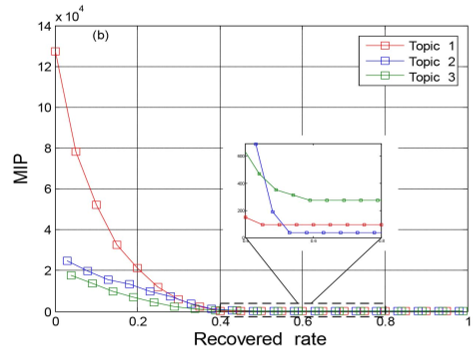 Trend analysis showing that while Explicit Factors (EF) are dominant, Hidden/Implicit Factors (HF) stay significantly high throughout the topic's lifecycle.
Conclusion & Future Outlook
This work successfully bridges the gap between static network topology and dynamic human behavior. By treating the infection rate as a function of calculated social influence rather than a constant, the flexible SIR model offers a powerful tool for public opinion supervision and rumor control.
Limitations: The model currently assumes a stable overall node count (no "birth/death" of accounts during the period). Future Work: The authors aim to extend this to multi-information dissemination, where different topics compete for a user's limited attention—just like competing viruses in a biological ecosystem.