
Skusie the Robot: Bridging the Diversity Gap in Early Childhood Collaboration
The Dynamic Interaction Between Engagement, Friendship, and Collaboration in Robot Children Triads
This paper introduces the Inclusive Design for Engaging All Learners (IDEAL) project, a triadic interaction framework involving a social robot and two kindergarten children from diverse backgrounds. Using the "Skusie" robot as a cultural broker, the study employs Epistemic Network Analysis (ENA) to quantify the dynamic interactions between friendship development, collaborative communication, and task engagement.
TL;DR
The IDEAL project explores a unique socio-technical triad: two children from different linguistic backgrounds and a social robot. By positioning the robot as a "newcomer friend" who needs help learning about Earth, the study investigates how this triadic relationship fosters Friendship, Collaboration, and Engagement. The research aims to turn classroom diversity into a collaborative strength using advanced behavioral analytics.
Problem & Motivation: The Challenge of Inclusive Education
As classrooms become more diverse, the risk of marginalization for children from minority backgrounds increases. Traditional pedagogical methods often struggle to create "equitable partnerships" where every child feels their home culture is an asset rather than a deficit.
The authors identify a critical gap: we know engagement is good for learning, but we don't fully understand how it interacts with cross-ethnic friendship and social collaboration in young children. Because 5-year-olds express social bonds through subtle behaviors rather than complex language, measuring these interactions requires a sophisticated, multi-dimensional approach.
Methodology: The Robotic Triad as a "Third Space"
The researchers designed a community consisting of one native English-speaking child, one Spanish-speaking child, and Skusie, a social robot.
The Skusie Persona
Unlike a traditional "teacher" robot, Skusie is framed as a peer who is "imperfect."
- The Setup: A "Wizard of Oz" method where a hidden researcher controls Skusie's responses.
- The Goal: Skusie asks open-ended questions about life (animals, school, family), forcing the two children to collaborate to "teach" the robot.
- The Mediator: Skusie speaks both languages and models "active listening," ensuring both children have equal agency.
Analytical Framework: ENA
To handle the complexity of triadic interactions, the study utilizes Epistemic Network Analysis (ENA). This allows researchers to see not just how much a child participates, but the connections between their behaviors (e.g., how a moment of "togetherness" leads to "cognitive engagement").
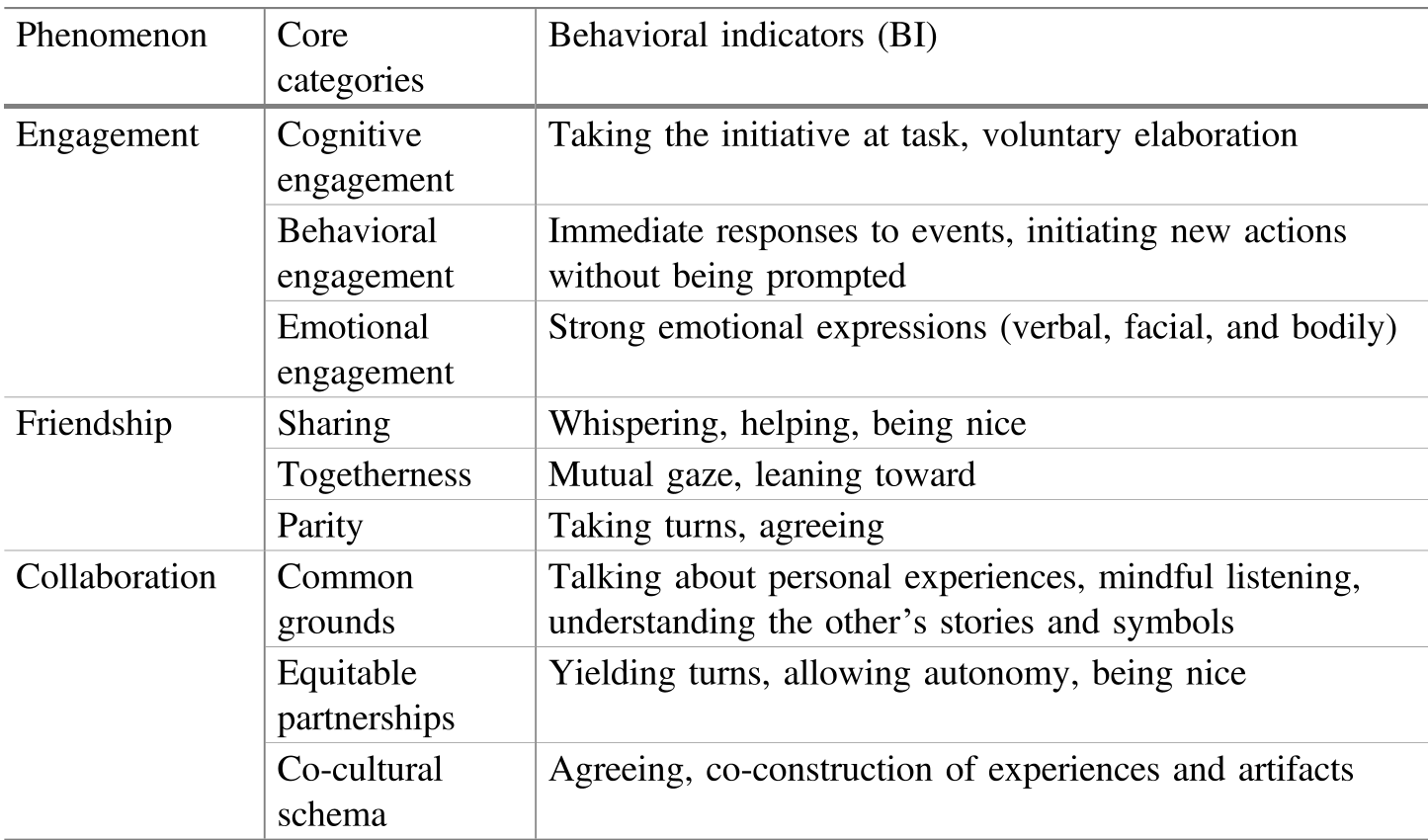
Experiments & Behavioral Indicators
The study identifies three core pillars and their corresponding behavioral markers:
- Engagement: Divided into Cognitive (taking initiative), Behavioral (immediate response), and Emotional (facial/bodily expressions).
- Friendship: Measured through "Sharing" (helping/whispering), "Togetherness" (mutual gaze), and "Parity" (agreeing/negotiating).
- Collaboration: Focused on "Common Grounds" and "Co-cultural schemas"—where children build a shared understanding of experiences.

Critical Analysis: Why This Matters
What makes this work stand out is the Robot-as-Cultural-Broker model. In many classroom settings, children might stick to peers with similar backgrounds. By introducing a third, neutral, and "needy" entity (the robot), the social barrier between the two children is lowered. The robot creates a "safe space" for children to practice intergroup contact theory—reducing cognitive bias through direct, joyful interaction.
Limitations & Future Work
While the framework is robust, the current data relies on a small sample (10 children). The use of the "Wizard of Oz" method, while effective for research, raises questions about the scalability of such systems. For these robots to be used in every classroom, the AI must eventually move from human-operated to fully autonomous while maintaining the same level of empathetic mediation.
Conclusion
The dynamic interaction between engagement, friendship, and collaboration is the "holy grail" of early childhood development. This research proves that technology does not have to be an isolating force; instead, when grounded in culturally-sustaining pedagogy, a social robot can act as a catalyst for human-to-human connection.