
DMLEC: Elevating Social Venue Classification via BPSO and Multi-layer Ensembles
Dynamic Multi-layer Ensemble Classification Framework for Social Venues Using Binary Particle Swarm Optimization
This paper introduces the Dynamic Multi-layer Ensemble Classification (DMLEC) framework, a novel architecture designed for social-venue classification in Location-Based Social Networks (LBSNs). By integrating Binary Particle Swarm Optimization (BPSO) for optimal classifier selection and a new weight-assignment mechanism, the model achieves a state-of-the-art accuracy of 97.1% on Foursquare datasets.
TL;DR
Social-venue classification is a critical task for identifying user behavior patterns and securing Location-Based Social Networks (LBSNs). This paper presents DMLEC (Dynamic Multi-layer Ensemble Classification), a framework that uses Binary Particle Swarm Optimization (BPSO) to navigate the massive search space of classifier combinations. By dynamically layering learners and applying a novel logarithmic weight-assignment rule, the model achieves a near-perfect 97.1% accuracy, far surpassing traditional ensemble methods like Bagging or Random Forests.
The Challenge: Why One Classifier is Not Enough
Predicting where a user is "checking in" based on sparse LBSN data (timestamps, coordinates, user IDs) is notoriously difficult. Single classifiers like Decision Trees or SVMs often possess specific inductive biases that fail to capture the multi-faceted nature of social movements. Current ensemble methods attempt to solve this, but they face two major hurdles:
- Selection & Placement: Which classifier works best in the first layer versus the final decision layer?
- Static Weighting: Treating all base learners equally (unweighted voting) dilutes the expertise of high-performing models.
BPSO-Driven Architecture: The Methodological Core
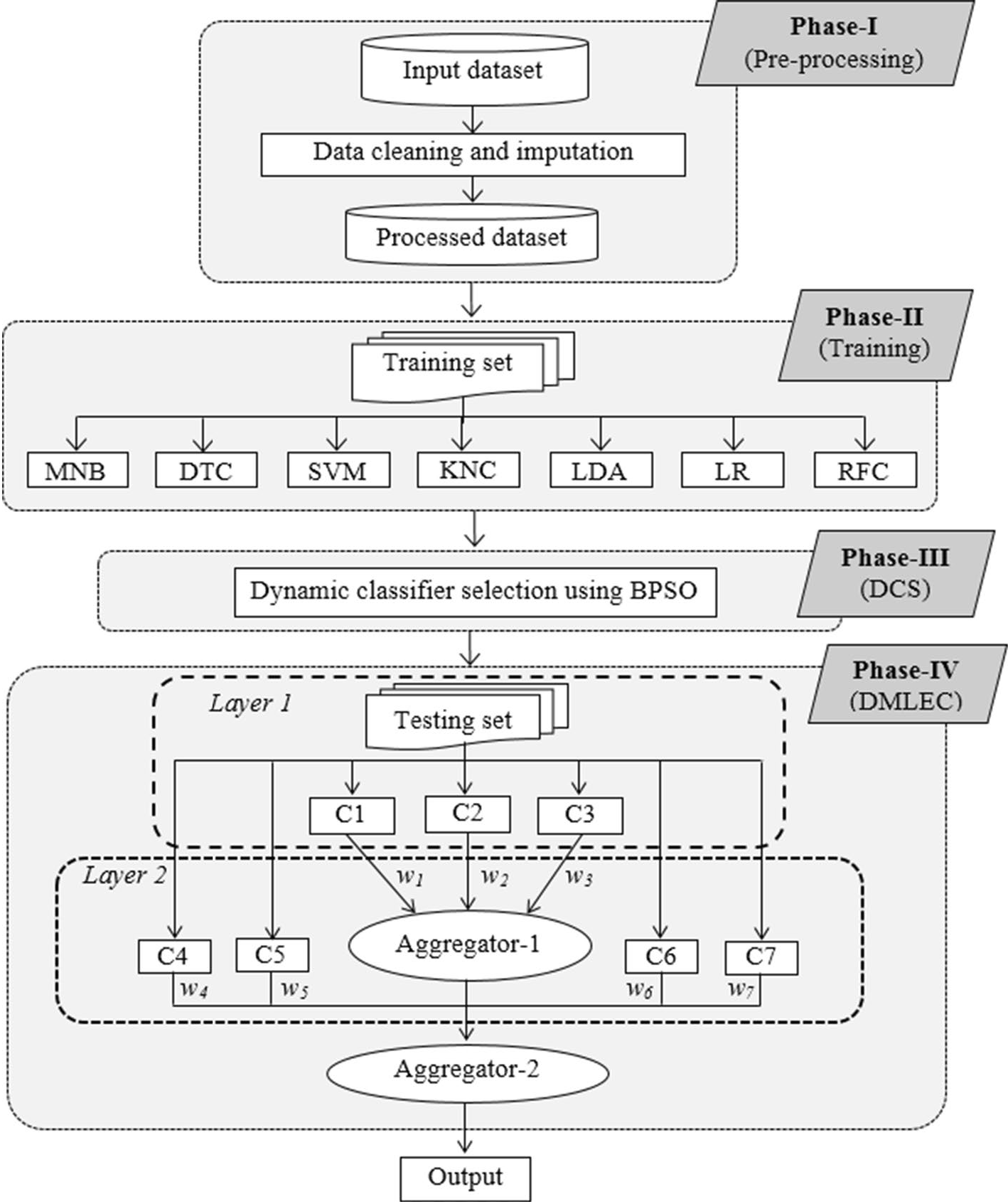
The authors treat the selection and placement of classifiers as an optimization problem. Using Binary Particle Swarm Optimization (BPSO), they represent potential ensemble configurations as "particles" in a hyperspace.
1. The Multi-layer Topology
The framework is structured into two distinct layers:
- Layer 1: An ensemble of 3 base classifiers whose output is processed via a majority vote.
- Layer 2: Takes the output of Layer 1 and combines it with 4 more base classifiers to produce the final prediction.
2. Logarithmic Weight Assignment
Instead of simple majority voting, the authors introduce a weight-adjustment function: This mathematical refinement ensures that a classifier with 90% accuracy has significantly more influence than one with 10%, effectively filtering out "noise" from weak learners.
Experimental Results: Setting a New Benchmark
The model was validated on Foursquare datasets from New York and Tokyo, involving tens of thousands of check-in records.
SOTA Comparison
As shown in the performance table below, DMLEC obliterates traditional benchmarks:
- Random Subspace: 68.8%
- Meta-Bagging: 68.5%
- DMLEC (Proposed): 97.1%
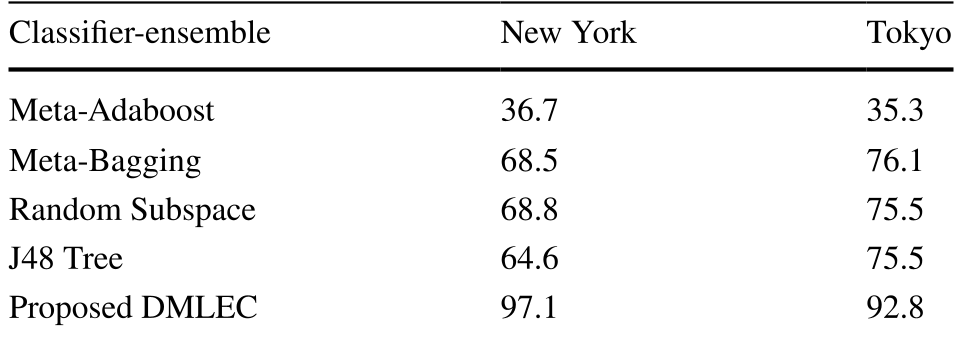
The results demonstrate that the repetition of high-performing classifiers (like RFC and DTC) across both layers, when guided by BPSO, creates a redundant but highly accurate checking mechanism that corrects errors made at individual levels.
Deep Insight: Why Does It Work?
The success of DMLEC lies in its Heuristic Search. The BPSO doesn't just pick "good" classifiers; it picks complementary ones. By using a V-shaped transfer function to convert continuous velocity into binary categorical decisions (to include or exclude a classifier), the model avoids the local minima that plague standard gradient-based optimization in discrete spaces.
Furthermore, the transition from a "flat" ensemble to a "layered" architecture allows for feature refinement. Layer 1 serves as a high-level feature aggregator, while Layer 2 acts as a specialized refiner, a structure reminiscent of early deep neural networks but with the interpretability of classical machine learning.
Critical Analysis & Conclusion
While DMLEC shows exceptional accuracy, the computational cost of running BPSO for every training cycle is non-trivial. However, for applications in security firms and governmental organizations tracking malicious users, a higher training overhead is a small price to pay for a 30% jump in reliability.
Future Outlook: The next step for this research is the integration of unstructured data (user reviews and tips). Adding Natural Language Processing (NLP) features into the DMLEC framework could potentially solve the remaining 3% error rate by understanding the "sentiment" behind a check-in.