
Dynamic Sampling: Breaking the Resolution-Throughput Barrier with 3D-FSR
Dynamic non-regular sampling sensor using frequency selective reconstruction
The paper proposes a novel dynamic non-regular sampling sensor and a 3D Frequency Selective Reconstruction (3D-FSR) algorithm to achieve high spatial and temporal resolution simultaneously. By scanning only a randomized subset of pixels per frame and reconstructing the missing data using spatiotemporal Fourier basis functions, the system circumvents the traditional bandwidth-vs-resolution tradeoff.
TL;DR
Researchers have developed a new sensor readout strategy that bypasses the fundamental limit of "high resolution OR high frame rate." By reading out a randomized, non-regular subset of pixels (25%-75%) and using a novel 3D-Frequency Selective Reconstruction (3D-FSR) algorithm, they achieve high-fidelity video that outperforms traditional Super-Resolution and Frame Rate Up-Conversion by up to 6.58 dB.
Background: The Hard Limit of Pixels-per-Second
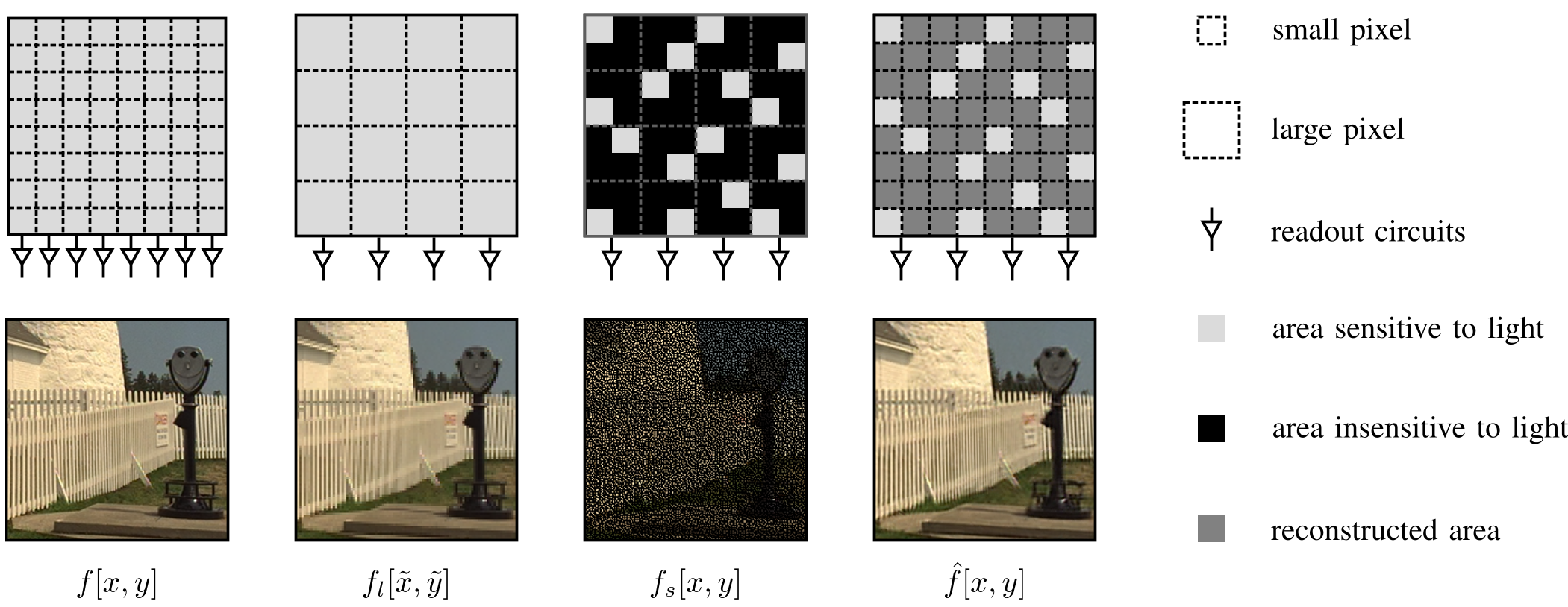
Typical CMOS sensors are bound by a throughput bottleneck. If you want 4K video, you often have to settle for a lower frame rate; if you want high-speed slow-motion, the resolution must drop. While "Non-regular sampling" was proposed previously to solve this, it relied on static masks. Like looking through a fixed screen door, if a detail is blocked by a wire, it stays blocked forever.
Motivation: Why Dynamic Sampling?
The authors' core insight is simple yet powerful: Temporal Diversity. If we change the "mask" (the sampling pattern) for every frame, a pixel missed in Frame 1 might be captured in Frame 2.
For static or slow-moving backgrounds, this effectively allows the sensor to "see" the entire high-resolution scene over a short window of time. The challenge then shifts from hardware bandwidth to mathematical reconstruction: how do we weave these scattered spatiotemporal samples back into a coherent video?
Methodology: Electronic Randomization & 3D-FSR
1. Randomized Readout (The Hardware)
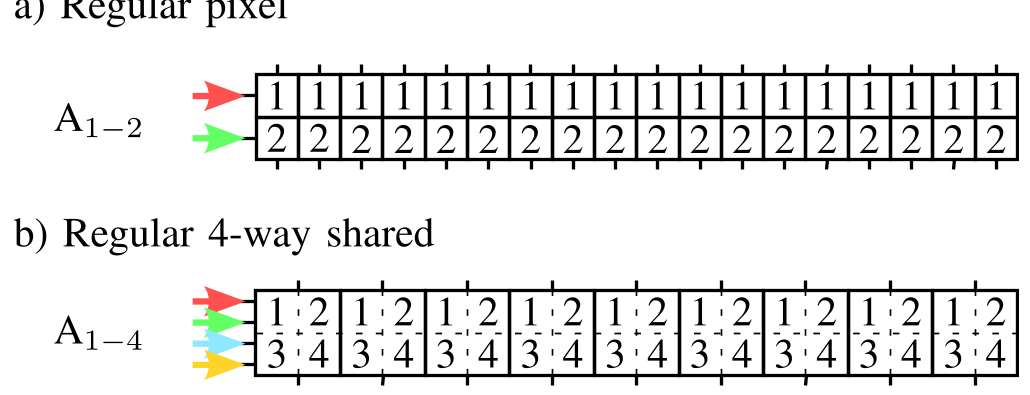
Instead of expensive optical masks, the team modified a 4-way shared pixel architecture. By randomizing the wiring of address lines to pixels in a 2x2 cluster, they can select different non-regular patterns electronically. This avoids diffraction artifacts and allows the sampling pattern to evolve every frame.
2. 3D Frequency Selective Reconstruction (The Math)
The reconstruction isn't just a simple interpolation. The authors treat the video as a 3D volume (X, Y, Time) and model it as a weighted superposition of 3D Fourier basis functions.
A critical innovation here is the Adaptive Frequency Prior. When data is scarce, the model favors low-frequency components to prevent "ringing" artifacts. As more data is gathered, the algorithm scales up to include high-frequency details.
Experimental Showdown: 3D-FSR vs. SOTA
The researchers compared their approach against standard industrial benchmarks:
- Frame Rate Up-Conversion (FRUC): High spatial resolution but low frame rate, where intermediate frames are guessed.
- Super-Resolution (SR): High frame rate but low spatial resolution, where pixels are upscaled.
Key Results:
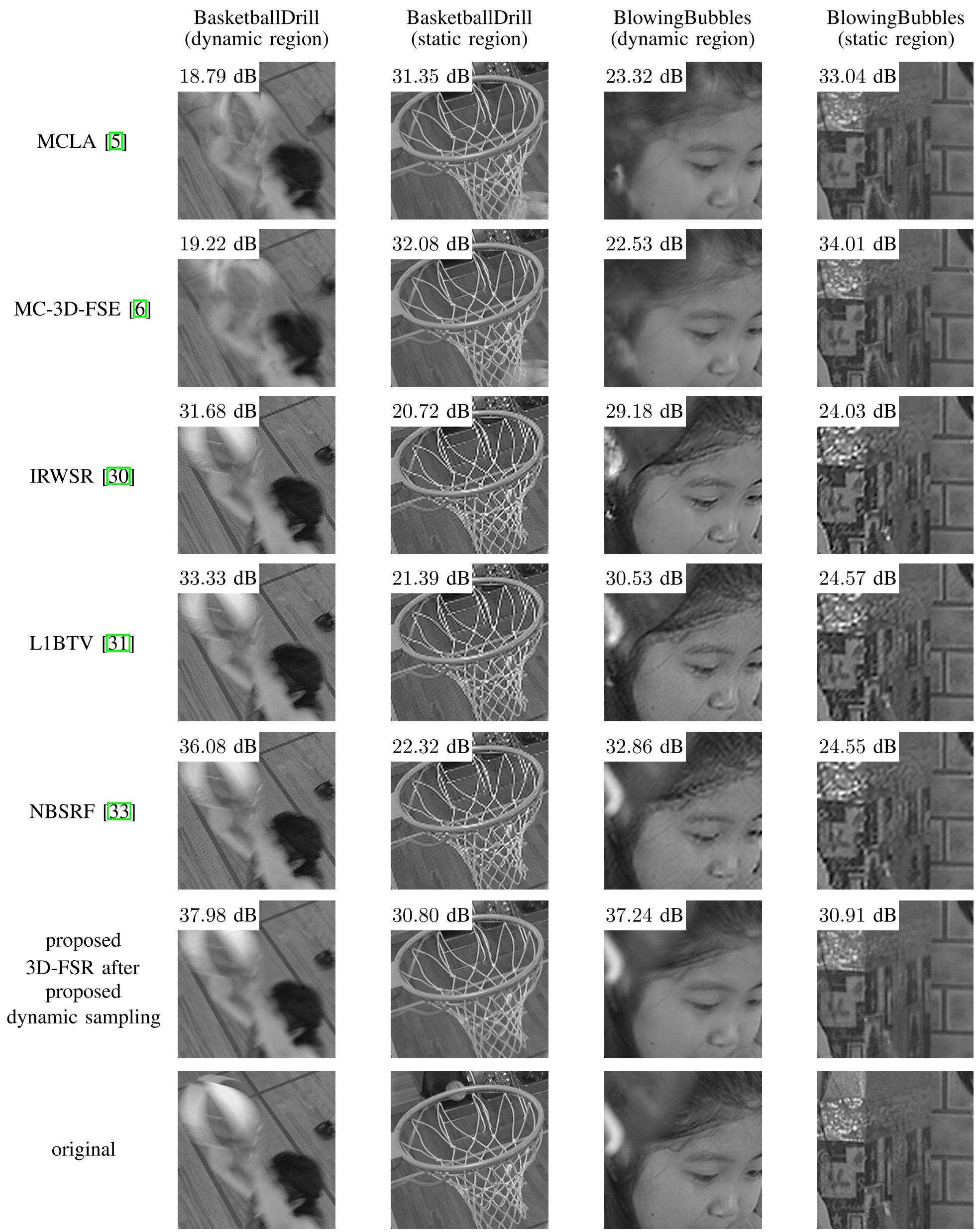
- Static Areas: The gains were massive. In the 'BQSquare' sequence, the dynamic strategy beat the static one by 8.55 dB.
- Motion Handling: Even in high-motion sequences like 'RaceHorses', the system maintained performance comparable to static sampling, proving its robustness.
- Visual Fidelity: Fine textures (text, table edges) that were blurry or aliased in FRUC/SR were rendered sharply by 3D-FSR.
Critical Insight & Conclusion
The beauty of this work lies in its synergy between hardware and software. By making the sampling dynamic, the authors converted a hardware throughput problem into a signal processing task that exploits the natural temporal redundancy of video.
Limitations: The current 3D-FSR is computationally heavy, and extremely fast motion still poses a challenge for 3D Fourier modeling without explicit motion compensation.
Future Outlook: Integrating Motion Estimation directly into the 3D-FSR loop could be the final step toward a sensor that truly "sees" everything, regardless of bandwidth. This has massive implications for surveillance, industrial monitoring, and high-end cinematography where lighting and resolution cannot be compromised.