
DREAM: Adapting Dynamic Recurrent Neural Networks for Banking Product Recommendations
Bankacılık Müşterileri İçin Dinamik Tekrarlayan Sinir Ağları Tabanlı Bir Tavsiye Sistemi A Dynamic Recurrent Neural Networks-Based Recommendation System for Banking Customers
This paper presents a Dynamic Recurrent Neural Network (DREAM) architecture specifically adapted for next-basket product recommendations in the banking sector. By leveraging the Santander Product Recommendation dataset, the authors utilize LSTM-based sequence modeling to capture dynamic user representations and temporal purchasing patterns, outperforming standard MLP and LSTM baselines.
Executive Summary
TL;DR: This study adapts the DREAM (Dynamic REcurrent nEural basket Model) architecture to the banking sector to solve the "next-basket" prediction problem. By treating monthly financial product holdings as sequential "baskets," the model learns dynamic customer representations that evolve over time. Experimental results on the Santander dataset demonstrate that this approach significantly outperforms standard Multi-Layer Perceptrons (MLP) and vanilla LSTMs, particularly in Recall and F1-score for realistic recommendation counts ().
Background: Within the academic coordinate system, this work resides at the intersection of Sequential Recommendation and Financial Data Mining. It is a "domain-adaptation" study that validates whether high-performing e-commerce architectures can translate to the more rigid and sparse environment of banking transactions.
Problem & Motivation: Beyond Static Demographics
Traditional banking recommendations often treat customers as static entities, using demographic data (age, income, location) to predict product affinity. However, financial needs are inherently temporal; a student getting a first job needs a credit card, which eventually leads to a mortgage.
The authors identify two fatal flaws in prior work:
- Loss of Sequential Information: Traditional models (Decision Trees, SVMs) use manually engineered features that collapse time into averages, losing the "order" of events.
- Handcrafted Bias: Feature engineering is costly and often misses latent interactions between products (e.g., the subtle relationship between a savings account and specific insurance types).
The insight here is that a customer's identity in a bank is not just who they are, but the trajectory of what they have done.
Methodology: The DREAM Framework
The core of the DREAM architecture is its ability to turn a sequence of product "baskets" into a single dynamic representation vector.
1. Representation Layer
Each month, a customer’s products are represented as a binary vector. To capture the semantic relationship between products, the model uses an embedding layer (similar to word2vec). These embeddings are aggregated via Max Pooling or Average Pooling to create a fixed-length "basket representation."
2. Sequential Modeling
These basket representations are fed into an LSTM (Long Short-Term Memory) network. The hidden state of the LSTM at the final time step represents the "Dynamic User Profile."
3. Optimization via BPR
Instead of simple classification, the model uses Bayesian Personalized Ranking (BPR). This assumes that a customer prefers a product they actually acquired over a "negative" product (one they didn't buy). This ranking-based approach is far more robust for recommendation tasks than standard cross-entropy.
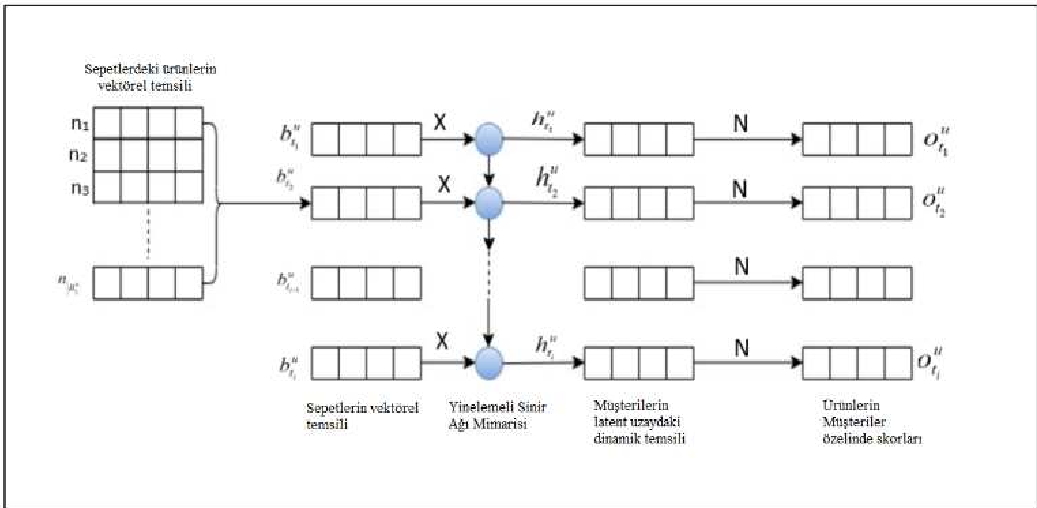 Figure 1: The DREAM architecture showing the flow from Item Embeddings to RNN-based sequence extraction.
Experiments & Results
The authors utilized the Santander Product Recommendation dataset (1.5 years of monthly data).
SOTA Comparison
The DREAM model was compared against two baselines:
- MLP: A static neural network using the most recent basket as input.
- Standard LSTM: A sequence model without the specific embedding/pooling/BPR structure of DREAM.
| Metric | DREAM (Avg Pool) | LSTM Baseline | MLP Baseline |
|---|---|---|---|
| Recall@4 | 90.79% | 53.55% | 48.30% |
| F1@4 | 74.98% | 63.41% | 57.66% |
The results (shown in the table below) indicate that DREAM's ability to maintain a "memory" of past interactions allows it to predict the next acquisition with much higher precision than models that only look at the current state.
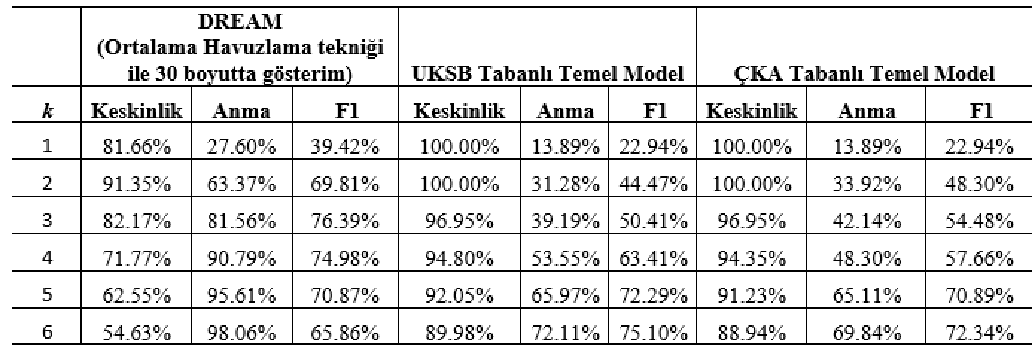 Table 1: Comparative analysis across different k-values. Note the dominance of DREAM at k=4, which represents the 99th percentile of typical banking transactions.
Critical Analysis & Conclusion
Takeaway
The primary contribution is the verification that dynamic embeddings are significantly more effective than raw binary vectors for banking data. The DREAM architecture's use of pooling layers allows it to handle varying numbers of products per month seamlessly, making it a "production-ready" candidate for financial institutions.
Limitations
- Cold Start: The paper focuses on customers with at least one transaction. It does not address how to recommend products to brand-new customers with zero history.
- External Factors: Macroeconomic shifts (interest rate changes) are not included in the model, which often dictate banking product popularity more than historical behavior.
Future Work
The authors suggest that integrating demographic metadata into the dynamic RNN hidden state could further bridge the gap between "who the customer is" and "what the customer does." Additionally, exploring Attention Mechanisms (as seen in the comparison with Santaloya's work) could help the model focus on specific "pivotal" past transactions rather than treating all historical months with equal decay.
Author Perspective: Hasan Avcı and C. Okan Sakar have demonstrated that the banking sector needn't reinvent the wheel; rather, by properly framing financial history as a sequence of "shopping baskets," they can unlock the power of modern deep sequential learners.