
Textual-ABM: Deepening Social Network Analysis with Author-Topic Evolution
Dynamic Social Network Analysis Using Author-Topic Model
The paper introduces Textual-ABM, an agent-based model for dynamic social network analysis that integrates the Author-Topic Model (ATM) to track evolving user interests. It also proposes H-IC (Homophily-based Independent Cascade), a diffusion model where infection probability is determined by topic similarity (homophily) rather than uniform distribution.
TL;DR
Most social network analyses look at who talks to whom, but they rarely focus on what they are talking about and how that changes over time. This paper introduces Textual-ABM, a framework that uses the Author-Topic Model (ATM) to simulate social dynamics. By grounding influence in "Homophily" (interest similarity), the authors' new diffusion model, H-IC, proves to be significantly more effective at predicting information spread than traditional random models.
The Missing Link: Why Content Matters in Dynamics
The study of dynamic social networks usually falls into two camps:
- Structural Fluctuation: Watching edges appear and disappear.
- Node Evolution: Watching node properties change.
However, prior work often misses the semantic layer. If two researchers suddenly start publishing on "Quantum Computing," their likelihood of influencing each other increases. Traditional models that use a fixed or random probability () for information "infection" fail to capture this. The authors argue that Homophily—the tendency of individuals to associate with similar others—is the engine of social dynamics.
Methodology: Integrating ATM with Agent-Based Models
The core of the paper is the Textual-ABM architecture. It treats every user as an "Agent" with a unique ID, a list of connections, and most importantly, a Topic Probability Distribution (TP-Dis) derived from their textual output.
1. Author-Topic Model (ATM)
Unlike standard LDA, which treats documents as mixtures of topics, ATM links topics directly to authors. This enables the model to represent an agent's "interest profile" as a vector in latent topic space.
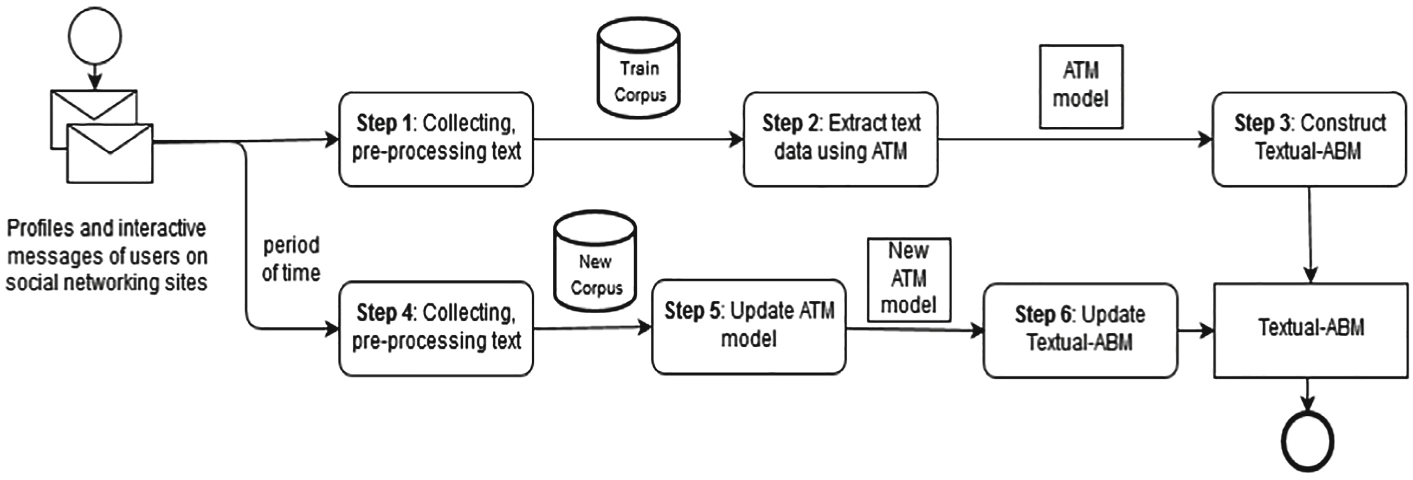 Figure: The Textual-ABM Framework, illustrating the flow from text collection to agent updating.
2. The Hellinger Distance for Homophily
To measure how "similar" two agents are, the authors use the Hellinger Distance on their topic distributions. The infection probability in their diffusion model is defined as: This ensures that the "closer" two people are in their research interests, the higher the chance that information will pass between them.
Experiments: NIPS Dataset Analysis
The authors tested their model on a robust dataset of NIPS conference papers (2000–2012), involving 2,479 scientists.
Key Findings:
- Static Superiority: In a static snapshot of the 2010 network, the H-IC model achieved an active node percentage nearly 3x higher than the random baseline (R-IC).
- Dynamic Resilience: In a static network, information diffusion usually stops quickly (around step 8). In a Dynamic Textual-ABM, the diffusion process is constantly "re-invigorated" as agents change their interests and form new "Major Topic Relations," leading to sustained cascades.
 Figure (Placeholder): Performance comparison showing H-IC consistently outperforming R-IC across multiple years.
Critical Analysis & Future Outlook
The strength of this work lies in its hybrid nature. By combining the generative power of ATM with the behavioral simulation of ABM, it creates a more "human" social simulation.
Limitations:
- Computational Cost: Updating ATM models via EM-iteration for thousands of agents in real-time is computationally expensive.
- Text Dependency: The model requires a steady stream of text to define interests; it may struggle with "lurkers" or users who interact without generating content.
Future Work: Integrating more advanced embedding techniques (like BERT or GPT-based embeddings) instead of bag-of-words ATM could further refine the "Homophily" calculation, allowing the model to understand nuance and sentiment in dynamic networks.
Conclusion
Textual-ABM and the H-IC model represent a shift from purely structural social analysis to semantic social analysis. It proves that in the real world, the "what" of a conversation is just as important as the "who" when it comes to the spread of ideas.