
EMEN Analysis: Deciphering Social Robustness through Cyclic Entropy and Statistical Mechanics
Analysis of Dynamic Social Network: E-mail M ssages Exchange Network
This paper introduces a framework for analyzing the dynamics of Email Messages Exchange Networks (EMEN) using cyclic entropy. It employs a polynomial-time approximation algorithm based on statistical mechanics and Bethe approximation to count network cycles, establishing cyclic entropy as a metric for network robustness and evolution.
TL;DR
This research shifts the focus of Social Network Analysis (SNA) from simple node degrees to the "hidden" cycles within a network. By applying a statistical mechanics-based approximation to the NP-Complete problem of cycle counting, the authors reveal that Email Messages Exchange Networks (EMEN) evolve in predictable patterns. They found that the frequency of emails matters far less to network robustness than the structural formation of new communication loops.
Motivation: Why Move Beyond Node Degrees?
Most studies characterize social networks using degree distribution or clustering coefficients. While useful, these metrics often view the network as a static entity. The authors argue that cycles (loops) are the true indicators of structural balance and robustness. However, counting cycles in large graphs is computationally expensive (NP-Complete). This paper addresses this bottleneck by introducing an approximation method that allows us to see how a "virtual" social network matures over time.
Methodology: The Statistical Mechanics of Loops
The core innovation lies in the definition of Cyclic Entropy. In statistical mechanics, entropy represents the degree of disorder. Here, it is derived from the distribution of cycles of varying lengths.
1. Network Modeling
The researchers proposed three ways to define an "edge" in an email network:
- DBEE (Directional Binary): An edge exists if either party sent an email.
- CEE (Compulsory/Mandatory): An edge exists only if both parties exchanged emails (reciprocity).
- WEE (Weighted): Adds weights based on the frequency of messages.
2. The Approximation Engine
To avoid the exponential time of exact backtracking algorithms (like Johnson's), the authors used a Bethe Approximation combined with Belief Propagation. This allows for the estimation of the number of cycles () for a given length () in polynomial time.
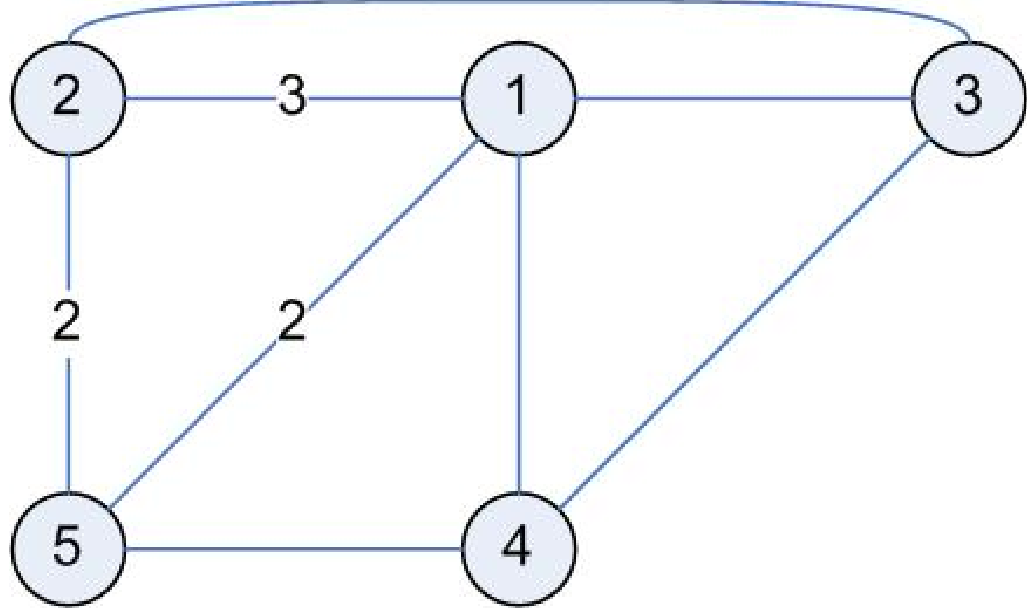 Figure: The DBEE model (left) captures one-way signals, whereas the CEE model (right) focuses on established mutual relationships.
Experiments and Insights
Using 11 months of real-world email logs, the researchers tracked how entropy changed as the network grew.
Key Findings:
- Linear vs. Logarithmic Growth: In the DBEE model, entropy follows an trend, suggesting that growth slows down as the network saturates. In contrast, the CEE model (reciprocal links) shows an linear increase, indicating a more "uncontrollable" but steady structural expansion.
- The Weight Paradox: Interestingly, the weight of the links (how many emails were sent) had almost no effect on the cyclic entropy.
Insight: What defines the "disorder" or robustness of a social group is who you talk to, not how often you talk to them.
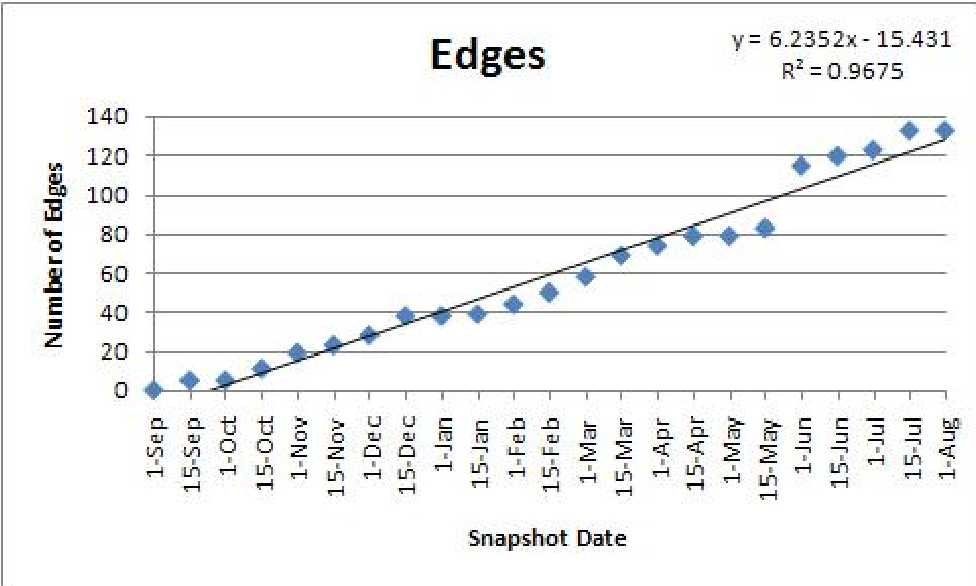 Experimental Results: Showing the monotonic increase of cyclic entropy over time in the DBEE model.
Critical Analysis & Conclusion
Takeaway
The study successfully transitions cycle counting from a theoretical complexity nightmare to a practical tool for monitoring dynamic networks. By proving that reciprocal (compulsory) interactions lead to linear entropy growth, the authors provide a structural explanation for how organizational hierarchies and social circles stabilize.
Limitations
While the approximation is efficient, it relies on Gaussian curve fitting () to finalize the distribution. If a network's cycle distribution deviates significantly from this "universal" Gaussian form—such as in highly segmented or non-random graphs—the approximation accuracy might degrade.
Future Outlook
This approach holds significant potential for cybersecurity. By monitoring sudden shifts in cyclic entropy, system administrators could potentially detect abnormal communication patterns indicative of a virus outbreak or a coordinated insider threat before individual node metrics flag the behavior.