
Beyond Static Ties: Modeling the Living Topology of Societies through Dynamic Homophily
Representing dynamic social networks in discrete event social simulation
The paper introduces a Discrete Event Simulation (DES) framework for representing dynamic social networks using "Value Homophily." By integrating agent BVI (Beliefs, Values, and Interests) into the Cultural Geography (CG) model, the authors achieve a SOTA approach for simulating evolving societal structures under external influence.
TL;DR
Social networks are not frozen; they are living tissues that expand and contract as our beliefs evolve. This paper presents a framework within the Cultural Geography (CG) model to simulate these shifts. By combining Value Homophily with Discrete Event Simulation (DES), the researchers have created a system where agent relationships are continuously recalculated based on their stances on salient issues, such as security and governance.
Background: The Limits of Static Social Graphs
In military stability operations or public policy planning, the "Center of Gravity" is the population. Most prior work treats the social graph as a static input derived from survey data. However, in conflict zones, a single event can polarize a community, turning neighbors into strangers. The authors argue that to be valid, a simulation must account for Value Homophily—the tendency for individuals to associate with those who share their current beliefs, not just their demographic background.
Methodology: The Mechanics of "Social Distance"
The core innovation lies in the dynamic link weight calculation. Unlike static models, the "distance" () between two agents is a function of both static socio-demographic labels and dynamic BVI (Beliefs, Values, and Interests).
The Architecture of the CG Model
The simulation environment manages agents who possess internal states governed by the Theory of Planned Behavior (TPB) and Narrative Identity. As agents receive information, their "issue stances" change, which in turn triggers the Social Network Umpire to redraw the ties.
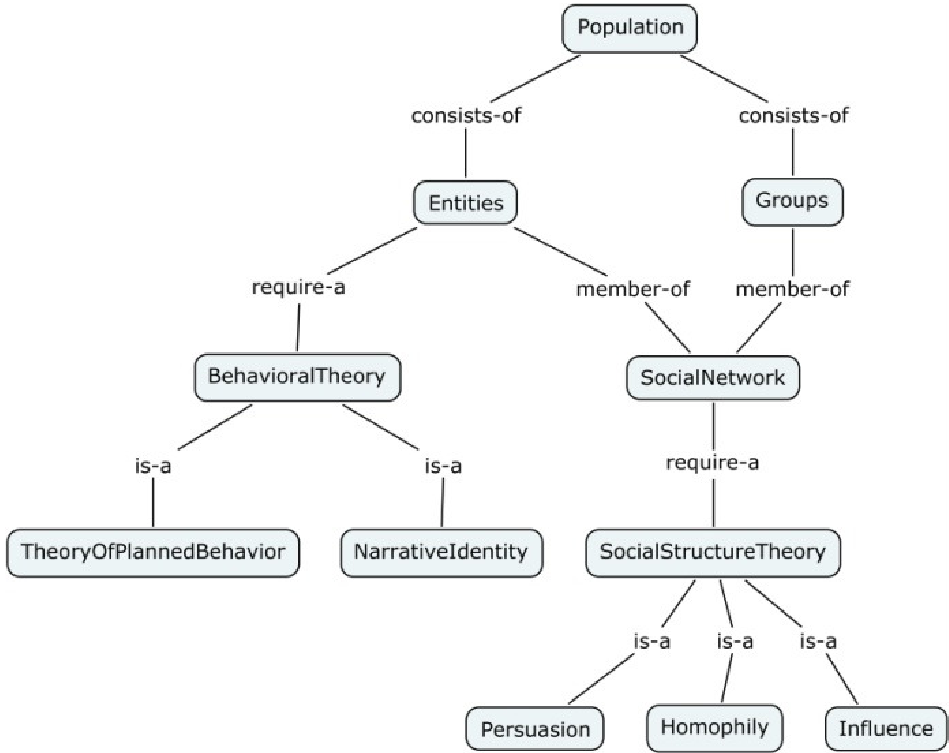 Figure 1: The expanded conceptual model integrating TPB, Narrative Identity, and Homophily.
The Distance Equation
The link weight is calculated using a normalized Euclidean distance across dimensions of identity and stance: This allows the simulation to respond and re-route information flow as the population segments become more or less aligned.
Experiments: Sensitivity and Change Detection
Using an unclassified scenario of southern Afghanistan, the authors conducted a Design of Experiments (DOE) using a Nearly Orthogonal Latin Hypercube (NOLH) to handle the high-dimensional parameter space efficiently.
Key Findings from Factor Analysis
The sensitivity analysis revealed that the number of neighbors () and the communication expiration time () were the most significant drivers of societal satisfaction. Interestingly, the network refresh rate was less critical, suggesting that social structures possess a certain "inertia" even as individual minds change.
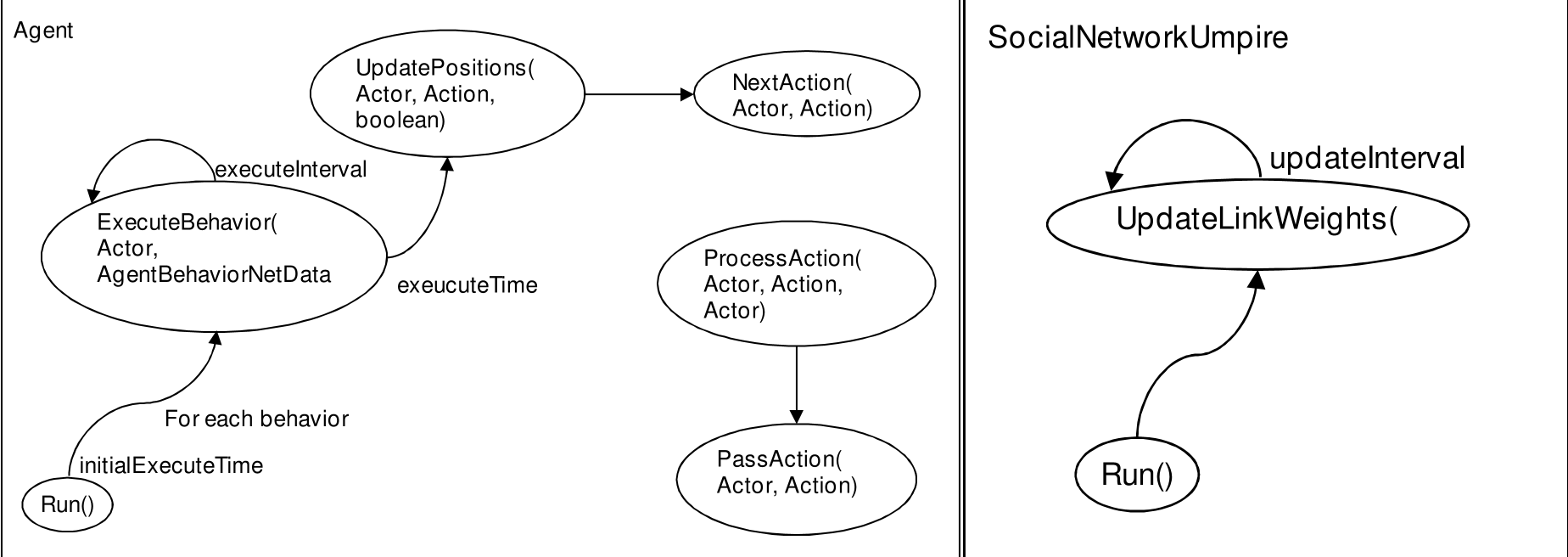 Figure 2: Event graph representation and the Social Network Umpire mechanism.
Social Network Change Detection (SNCD)
To "see" the network changing, the authors applied CUSUM (Cumulative Sum) control charts to network metrics like Betweenness Centrality and Closeness. This technique—borrowed from industrial quality control—allows researchers to identify exactly when a society has undergone a structural shift that might lead to radicalization or stabilization.
Critical Insight & Future Outlook
This work bridges the gap between high-level social theory and low-level algorithmic implementation. By using Discrete Event Simulation, the model avoids the "time-step" bottlenecks of traditional agent-based models, allowing events to unfold at their natural scales.
Takeaway: The real value of this research isn't just in predicting the future, but in providing a "laboratory of the possible" where policymakers can test how sensitive a community's cohesion is to specific messaging or interventions.
Limitations: The current model assumes equal weights for all homophily dimensions. Future iterations will likely need to explore "Weighted Homophily," where specific cultural traits (like religion or clan) are prioritized over transient political stances.