
CGM: Balancing Social Network Privacy and Data Utility via Graph Mode Partitioning
Dynamic social privacy protection based on graph mode partition in complex social network
This paper introduces a Classification-based Graph-publishing Model (CGM) for social networks, integrating a graph-partitioning strategy with Differential Privacy (DP). The method decomposes complex social graphs into sub-graphs based on node characteristics and employs a quad-tree division to add Laplacian noise, achieving a balance between privacy and data utility for statistical queries.
TL;DR
In the era of Big Data, social network graphs are goldmines for researchers but minefields for user privacy. This paper presents a dynamic social privacy protection model that partitions complex graphs into sub-graphs before applying Differential Privacy (DP). By using quad-tree decomposition on adjacency matrices, the authors manage to protect individual connection sensitive data while keeping the global graph structure (like shortest paths) remarkably accurate.
Problem & Motivation: The "Tabular" Trap
Most privacy-preserving algorithms treat data as independent rows in a table. However, social networks are inherently interconnected. Standard Differential Privacy often falls into two traps when applied to graphs:
- Utility Collapse: Adding enough noise to hide an edge can completely distort the "small-world" properties of a graph.
- Semantic Vulnerability: Attackers can often guess missing links if they understand the community context (semantic information), which traditional noise models ignore.
The authors' insight is simple: if we can group highly correlated nodes together before adding noise, we can concentrate the "privacy budget" where it matters most and keep the overall structure intact.
Methodology: The Three-Step Reconstruction
The proposed model, CGM (Classification-based Graph-publishing Model), moves away from global noise and adopts a "Divide and Conquer" strategy.
1. Structural Classification
Using Kosaraju's algorithm, the system identifies strongly connected components and "bridges" (edges that connect distinct sub-clusters). By isolating these sub-graphs, the model ensures that the density of the adjacency matrix is concentrated, making subsequent partitioning more efficient.
2. Adaptive Quad-Tree Partitioning
Instead of a uniform grid, the model uses a quad-tree to recursively split the adjacency matrix.
- Dense regions are partitioned further to preserve detail.
- Sparse regions are aggregated to minimize the impact of noise.
- Privacy Budget () Allocation: The budget is distributed geometrically across the tree levels, ensuring that deeper nodes (finer details) get sufficient protection without overwhelming the signal.
 Figure 1: The framework highlights the transition from original graph to sub-graph partitioning and final reconstruction.
3. Sub-graph Reconstruction
In the leaf nodes of the quad-tree, an exponential mechanism is used to arrange the "noised" edges. This isn't just random placement; it aims to mimic the original density, ensuring that the final "Synthetic Graph" behaves like the real one during statistical analysis.
Experiments & Results: Real-World Fidelity
The authors tested their model against the DER (Density Exploration and Reconstruction) method across four major datasets.
Key Metrics Performance:
- Clustering Coefficient: The average relative error decreased steadily as the privacy budget () increased, outperforming DER by a significant margin.
- Shortest Path: Crucial for navigation and influence modeling, the shortest path error in CGM was consistently lower, proving the model preserves "connectivity" better than previous methods.
- Degree Distribution: Using the KL distance metric, the generated graphs were shown to follow the original power-law distributions closely.
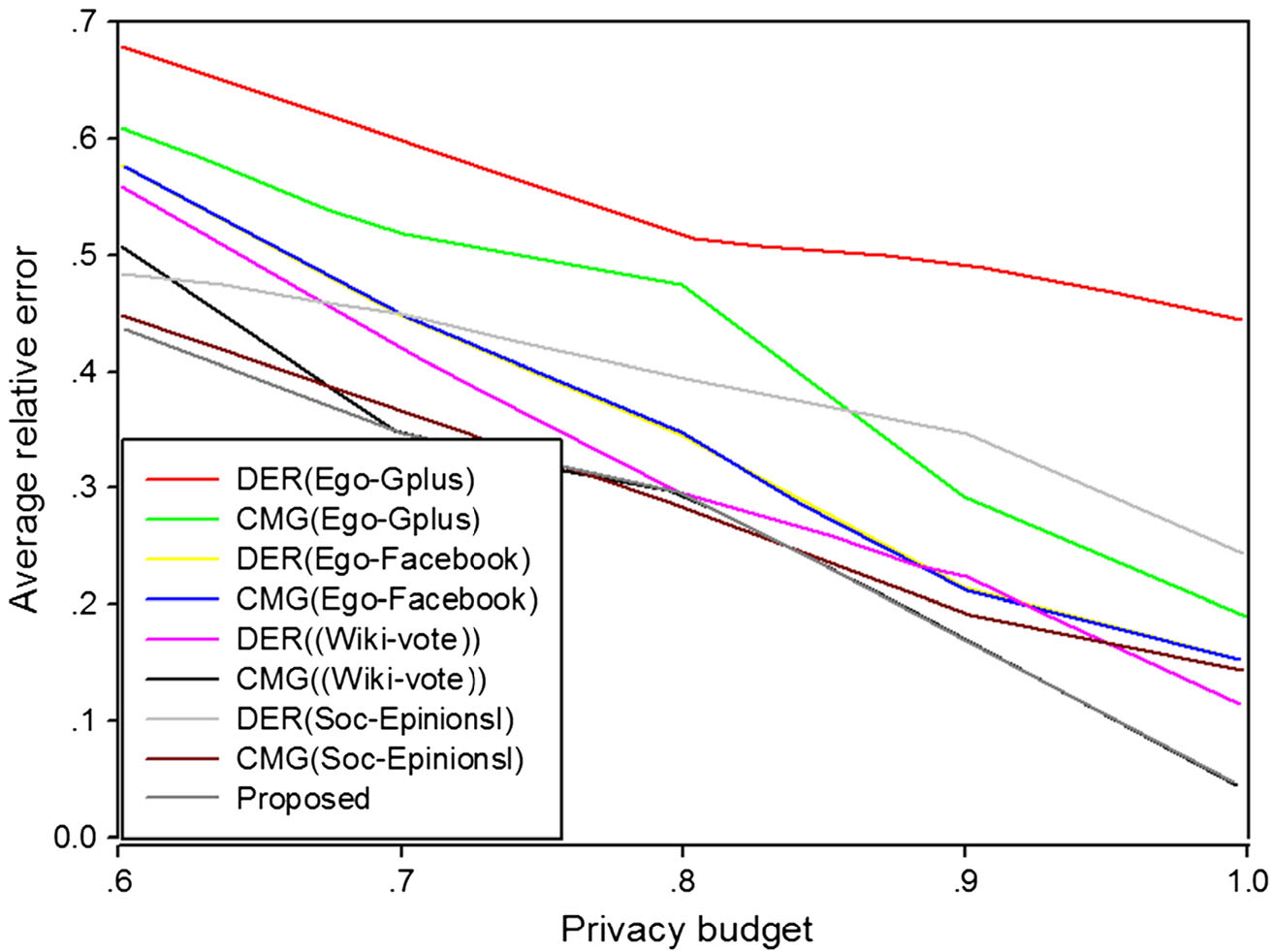 Figure 2: Average relative error of clustering coefficients across multiple datasets.
Critical Analysis & Conclusion
The core value of this work lies in its scalability. By partitioning the graph first, it bypasses the computational nightmare of calculating global sensitivity for massive social networks.
Takeaway: The move toward graph-mode partitioning is essential for any industrial application of Differential Privacy in social media. If you can't maintain the "geometry" of the network, the data is useless for downstream tasks like recommendation or community detection.
Limitations: The model relies on local sensitivity. While more efficient, the authors admit that clustering thresholds are still sensitive and require manual tuning for different types of social networks (e.g., trust networks vs. voting networks). Future research will likely focus on an automated, "parameter-free" version of this partitioning logic.