
Scaling Dynamic Social Networks: The Power of State-Space Stochastic Blockmodels
Dynamic Stochastic Blockmodels for Time-Evolving Social Networks
This paper introduces the Dynamic Stochastic Blockmodel (DSBM), a state-space approach for modeling time-evolving social networks. By combining a static Stochastic Blockmodel (SBM) for snapshot modeling with an Extended Kalman Filter (EKF) and local search for state tracking, it achieves efficient on-line parameter estimation and community detection.
TL;DR
Understanding how social groups evolve over time is notoriously difficult because network snapshots are noisy and high-dimensional. This paper presents the Dynamic Stochastic Blockmodel (DSBM), which uses an Extended Kalman Filter (EKF) to track the hidden "states" of a network. It provides a near-optimal, online way to monitor community shifts and edge probabilities, outperforming traditional Bayesian sampling methods in speed and robustness.
Context: Why Static Models Aren't Enough
In the study of social networks, the Stochastic Blockmodel (SBM) is a classic tool. It groups nodes into "blocks" (communities) where nodes in the same block are stochastically equivalent—meaning they behave similarly toward others. However, world-changing events (like the Enron scandal or the shifts in a student body) are dynamic.
Prior works attempted to solve this with MCMC or Probabilistic Simulated Annealing (PSA). While mathematically elegant, these methods suffer from two major flaws:
- Computational Intensity: They are too slow for real-time monitoring.
- Hyperparameter Fragility: Slight changes in priors can lead to complete model failure.
Methodology: The EKF Meets Network Science
The authors propose a state-space architecture. They treat the log-odds (logit) of edge probabilities as unobserved states .
1. The Observation Model
Each network snapshot is seen as a noisy observation of the underlying block probabilities. For large blocks, the block densities follow a Gaussian distribution (via the Central Limit Theorem), allowing the use of Kalman-based filtering.
2. The Dynamics
The states evolve following a linear system: By linearizing the logistic non-linearity with an EKF, the model can updated on-the-fly as new data arrives.
3. A Posteriori Discovery
When we don't know who belongs to which group, the authors add a "Local Search" (Hill Climbing) step. It re-assigns nodes to classes to maximize the posterior probability, initialized by the previous state to maintain temporal consistency.
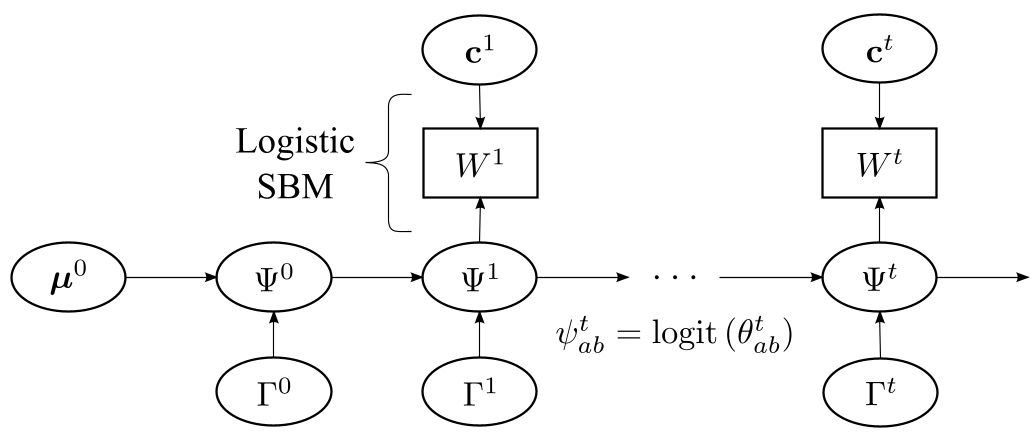 Fig 1: The graphical representation of the hidden state-space model.
Experiments: Precision and Performance
The EKF-based approach was tested against the state-of-the-art PSA algorithm.
- Accuracy: The EKF matched the tracking performance of much heavier Bayesian methods.
- Robustness: Unlike PSA, which failed under certain hyperparameter settings (see Fig 7 in the paper), the EKF remained stable.
- Scalability: The EKF is significantly faster, though its complexity (where is the number of classes) means it is optimized for networks with a moderate number of large communities.
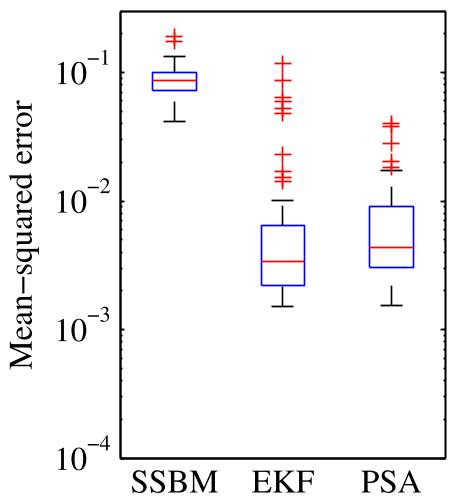 Fig 2: Mean-squared tracking error showing EKF's superiority in a posteriori settings.
Deep Insight: The Enron Case Study
The most compelling evidence for this model is its application to the Enron Email Corpus. Most analysts look at the total volume of emails. But the DSBM looks at who is talking to whom.
The model identified a massive surge in communication specifically between CEOs and Presidents during the week Jeffrey Skilling resigned. Because the overall email volume didn't spike, traditional anomaly detectors missed it. The DSBM's ability to isolate "Block-to-Block" dynamics allows it to see "inside" the corporate hierarchy as it collapses.
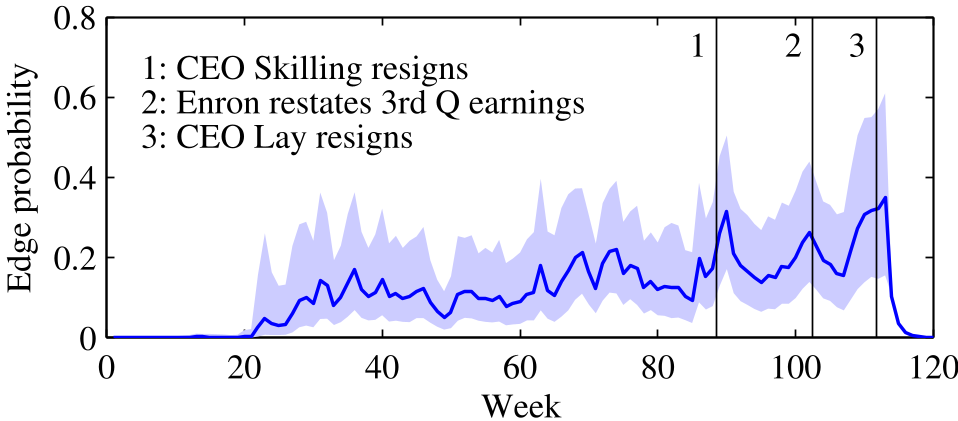 Fig 3: Estimated edge probabilities reveal CEO-to-President discussions peaking during key scandal milestones.
Critical Analysis & Conclusion
Takeaway
The DSBM proves that we don't need complex sampling to track dynamic networks. A properly tuned Extended Kalman Filter provides a "near-optimal" window into the evolving structure of social interactions.
Limitations
The complexity is a bottleneck for networks with many small communities. At classes, the computational cost begins to rival MCMC methods. Future work should explore decoupling the state dynamics (block-diagonal covariance matrices) to scale to hundreds of communities.
Final Thought
This work shifts the focus from "what the network looks like now" to "how the underlying social fabric is changing." For applications like cybersecurity or organizational health, this temporal insight is the difference between hindsight and foresight.