
DTS-SN: Solving Real-Time Social Network Clustering via Dynamic Graph Coloring
Dynamic Tabu Search for Non Stationary Social Network Identification Based on Graph Coloring
This paper introduces Dynamic Tabu Search for Social Networks (DTS-SN), a novel algorithm for identifying and clustering non-stationary social networks. By mapping user relationships into a dynamic graph and solving the Graph Coloring Problem (GCP), the method achieves rapid community detection that adapts to real-time changes in network structure.
TL;DR
Social networks are rarely frozen in time; they are living, breathing entities where relationships fluctuate constantly. This paper presents DTS-SN (Dynamic Tabu Search for Social Networks), an algorithm that maps users to a graph and uses an optimized search strategy to "color" (cluster) the network. Unlike static methods, DTS-SN updates its internal memory as the network changes, allowing it to adapt in real-time with significantly reduced computational overhead.
Problem & Motivation: The Sifting Sands of Social Data
Most social network identification techniques rely on static snapshots. However, in the real world, a user's location, interests, and professional status change, which in turn alters their social "role" or community.
The authors identify two major hurdles in current research:
- Complexity of Weighted Models: Modeling every nuance of a relationship with weights makes clustering mathematically heavy.
- Statelessness: When a single edge in a graph changes, most algorithms start the clustering process from zero, wasting massive amounts of prior "knowledge" about the network's structure.
Methodology: Mapping Social Features to Colors
The core innovation lies in the transformation of social data into a Graph Coloring Problem (GCP).
1. Threshold-Based Mapping
The authors use a set of features (e.g., city, education degree) to calculate a relationship score. If the score exceeds a threshold , an edge is drawn. This results in an unweighted graph, simplifying the math without losing the essence of the connection.
2. The Dynamic Tabu Search
To cluster users who can be grouped together, the algorithm works on the complementary graph. In this view, edges represent "conflicts" (users who cannot be in the same group). The goal is to assign the minimum number of colors such that no two connected nodes share a color.

The "Tabu" element is a memory list that prevents the algorithm from cycling back to previously explored, suboptimal solutions. When the network changes (e.g., a user moves to a new city), the Change_TabuList() function surgically modifies only the affected entries in the memory, allowing the search to continue seamlessly.
Experiments & Results: Efficiency through Adaptation
The authors tested the algorithm on simulated social networks. The results highlight a clear "learning" curve as the network evolves.
- 20-User Benchmark: The initial clustering took ~3,100 steps. As the graph was modified through four iterations (G1 through G4), the steps required to find the optimal solution plummeted to under 400.
- 50-User Benchmark: While the "Chromatic Number" (the absolute theoretical minimum of groups) is harder to reach for larger networks, the algorithm consistently trended towards the optimal solution, showing high accuracy even within limited time steps.
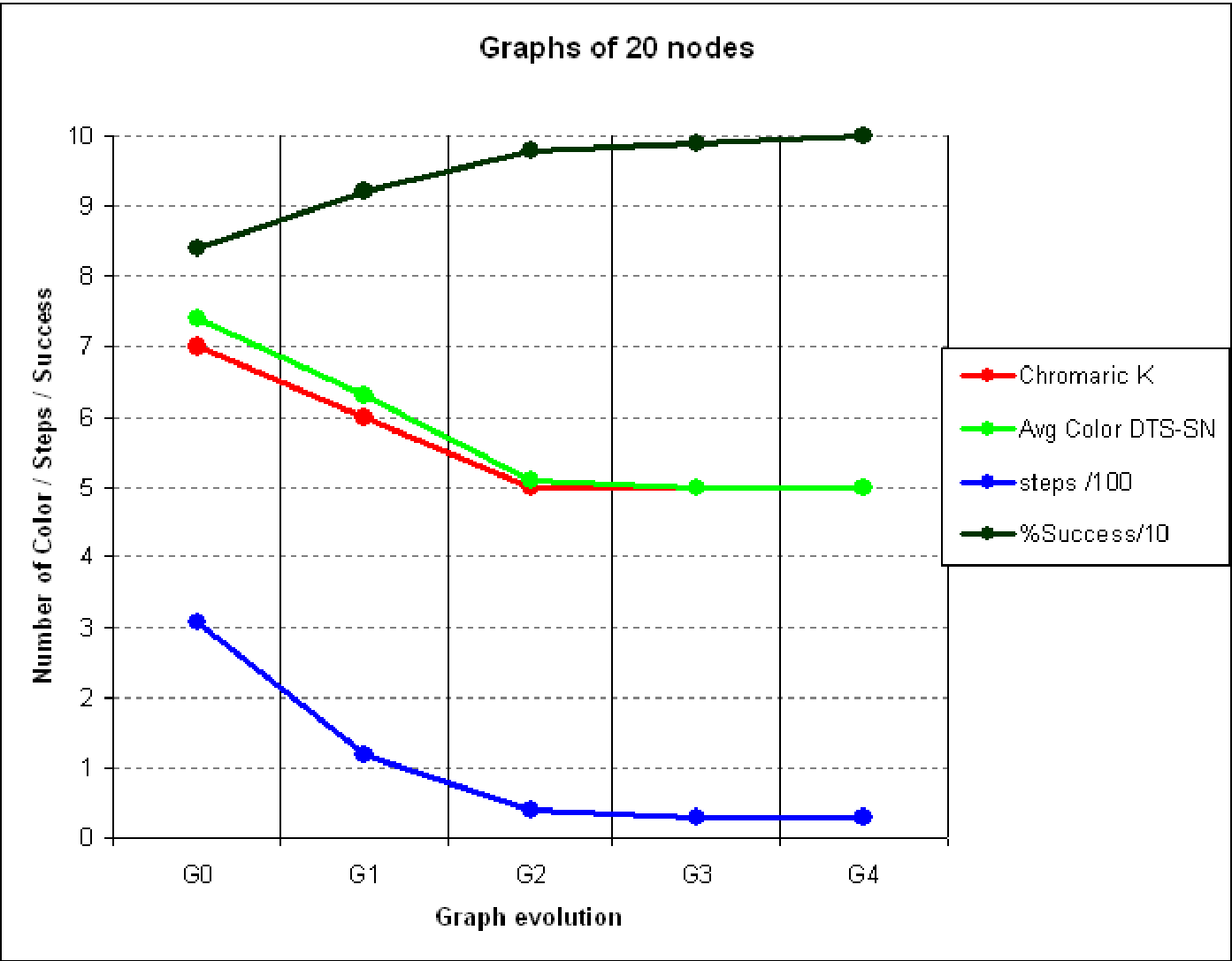 Figure 1: Comparison of the original chromatic number (red) vs. the results obtained by DTS-SN (light green) across graph evolutions.
Critical Analysis & Conclusion
Takeaway
DTS-SN proves that the Graph Coloring Problem isn't just a theoretical exercise for computer scientists—it is a functional tool for community detection. By utilizing a "warm start" (via the Tabu list modification) instead of a "cold start," the researchers have created a blueprint for real-time social monitoring.
Limitations & Future Outlook
While impressive on small-to-medium datasets, the scalability to million-node networks remains an open question. The authors' future intent to use real-world datasets from enterprise management systems will be the true test of this algorithm's performance in "noisy" environments. Additionally, a mathematical proof of the dynamic convergence would further solidify its place in the canon of swarm and search intelligence.
Final Thought: In the race for real-time insights, the ability to adapt memory is more valuable than the ability to calculate faster.