
Dynamics of Conflicting Beliefs: How Cognitive Internal Conflict Shapes Social Consensus
Dynamics of Conflicting Beliefs in Social Networks
The paper investigates multi-dimensional opinion dynamics in social networks using two distinct internal update mechanisms (Model I and II) to handle conflicting beliefs. By extending the Hegselmann-Krause (HK) model, it explores how heterogeneous groups with varying degrees of "tolerance" and "perceived conflict" influence network-wide consensus levels.
TL;DR
This research explores how individuals in a social network resolve the tension between two competing beliefs (like two rival scientific theories). By introducing two internal update strategies—Competitive Elimination (Model I) and Resource Normalization (Model II)—the authors demonstrate that the way we handle internal conflict determines whether a society fragments into echo chambers or converges toward a unified perspective.
Background: Beyond One-Dimensional Opinions
Most social simulations assume opinions are points on a line. But in reality, we hold multiple beliefs simultaneously, and sometimes these beliefs clash. This paper tackles the "Why" behind social polarization by looking at the interaction between social tolerance (who we talk to) and internal conflict (how we resolve contradictions in our own heads).
The Problem: The Missing Link in Opinion Models
Existing models like the Hegselmann-Krause (HK) model do a great job of showing how "Bounded Confidence" (talking only to like-minded people) leads to fragmentation. However, they ignore the internal logic of the agent. If you find two scientific explanations for a phenomenon equally plausible, but you are told they are mutually exclusive, how does that internal realization affect your interaction with the rest of the network?
The authors argue that the "Internal Update" is just as critical as the "Social Update."
Methodology: Two Flavors of Conflict Resolution
The authors employ a two-step update process. First, agents average their opinions with "similar" neighbors (Network Update). Second, they process the conflict between Belief A and Belief B (Internal Update).
Model I: The Elimination Strategy
In this model, if an agent perceives a conflict, they tend to double down on their strongest belief and suppress the weaker one.
- The Intuition: "I can't believe both; I'll stick with what I trust more."
- Social Result: High diversity and multiple distinct clusters.
Model II: The Probability Strategy
Here, the agent treats the two beliefs as a zero-sum game. The degrees of belief are normalized so that the more you believe in A, the less you must believe in B.
- The Intuition: "These are the only two options; their total probability must equal 100%."
- Social Result: Higher levels of consensus.
 Equation 3: The normalization rule for Model II, which forces beliefs to approach a unity sum.
Experiments & Key Insights
The researchers ran 100 simulations with 100 agents each, varying the "fraction" of agents that were tolerant or perceived conflict.
1. The Tolerance Paradox
Interestingly, mixing "Tolerant" and "Intolerant" agents doesn't change much. Because the intolerant agents refuse to listen to anyone different, they form static "islands" that don't influence the wider network. The "Tolerant" group reaches consensus among themselves, ignore the "Intolerant," and the two groups simply coexist in parallel.
2. Conflict as a Catalyst for Consensus?
The most provocative finding comes from Model II. As more agents perceive a conflict between A and B, the "Consensus Threshold" actually drops.
- In Model I, conflict causes "diversity" (fragmentation).
- In Model II, conflict acts as a bridge. If the group can agree on Belief A, the internal math of Model II forces them to also agree on the state of Belief B.
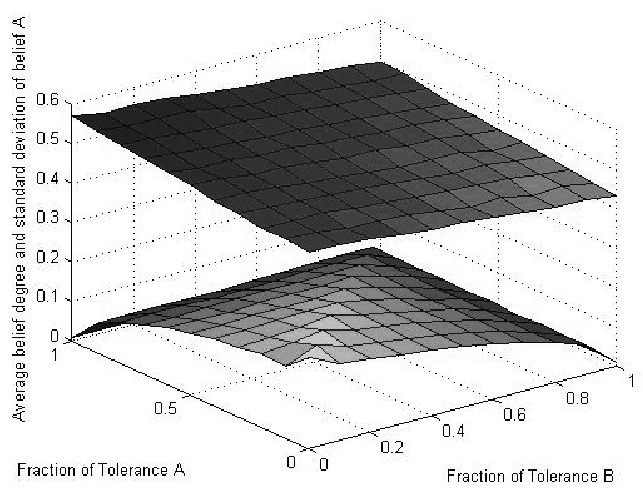 Fig 1: Surface plots showing Model I's tendency to maintain high standard deviation (diversity/fragmentation) compared to Model II's smoother path to consensus.
Critical Analysis & Conclusion
Takeaway
The study highlights that how we frame conflict matters more than our inherent tolerance. If we view competing ideas as "one must win and the other must die" (Model I), we get a fractured society. If we view them as "two parts of a whole" (Model II), consensus becomes mathematically easier to achieve.
Limitations & Future Work
- Complete Networks: The study used a complete graph (everyone can potentially talk to everyone). Real-world social networks are "small-world" or "scale-free," which might change how clusters form.
- External Info: The model lacks "external shocks" like news or propaganda.
The authors plan to extend this to non-complete topologies and incorporate external information streams, which will be vital for understanding how algorithmic feeds might be pushing us toward Model I-style eliminations rather than Model II-style integrations.