
The Physics of Public Opinion: How Online Interaction Reshapes Social Consensus
Dynamics of Public Opinions in an Online and Offline Social Network
The paper proposes a novel public opinion dynamics model that integrates online and offline social networks. It combines the linear DeGroot model for offline agents and the nonlinear Hegselmann-Krause (HK) bounded confidence model for online agents to study consensus formation in hybrid social contexts.
In an era where a tweet can spark a global movement and a face-to-face conversation remains the bedrock of local community, the boundary between "online" and "offline" has blurred. Yet, most mathematical models of opinion dynamics—the study of how beliefs evolve in a population—treat these two worlds as one. A seminal paper by Yucheng Dong et al. breaks this mold, providing a rigorous framework to understand the interplay between these two distinct but interacting social layers.
TL;DR: The Digital Bridge
The paper introduces a hybrid opinion dynamics model. It posits that offline agents interact primarily with their direct social neighbors, while online agents can "jump" social boundaries to interact with anyone holding a similar view. The core finding? Online agents act as social glue. They significantly shorten the time needed for a society to reach a stable state and can even force a consensus in communities that are otherwise completely disconnected offline.
The Problem: One Size Does Not Fit All
In traditional models like the DeGroot model, opinion change is linear: you average the views of your neighbors. In Bounded Confidence models (HK), you only listen to those whose views are already close to yours.
The authors argue that neither is sufficient alone. Offline agents are constrained by physical and social "topology"—you talk to your neighbors regardless of their opinions. Online agents, however, are empowered by search and recommendation algorithms, allowing them to form "confidence sets" across the entire network. The missing link was a model that explains how a society composed of both types behaves as a single system.
Methodology: A Hybrid Social Calculus
The authors define a graph where is split into and .
- Offline Agents: Follow the DeGroot rule—their next opinion is a weighted average of their social neighbors.
- Online Agents: Use a dual-trigger system. They listen to their neighbors (social ties) AND other online agents within a confidence threshold (ideological ties).
Mathematical Intuition
The system is represented as: Where is a stochastic matrix. The researchers used Matrix Ergodicity theory to prove that if the "Digital layer" provides enough connectivity between offline components, the entire matrix remains "Primitive," ensuring that everyone eventually agrees on a single value (Consensus).
(Note: This represents the interaction between the topology-constrained offline layer and the opinion-constrained online layer.)
Experimental Insights: Online Agents as Catalysts
Through simulations using Erdős-Rényi, Small-World, and Scale-Free networks, the authors uncovered three critical phenomena:
- Time Compression: As the percentage of online agents () increases, the time to reach a stable state drops sharply.
- Cluster Reduction: High online participation () collapses the number of fringe opinion clusters, merging them into a dominant majority.
- The "Attractor" Effect: Purely online clusters are almost never observed in the long run. Online agents effectively "recruit" offline neighbors into their consensus, whereas isolated offline agents are the most likely to be left in "opinion silos."
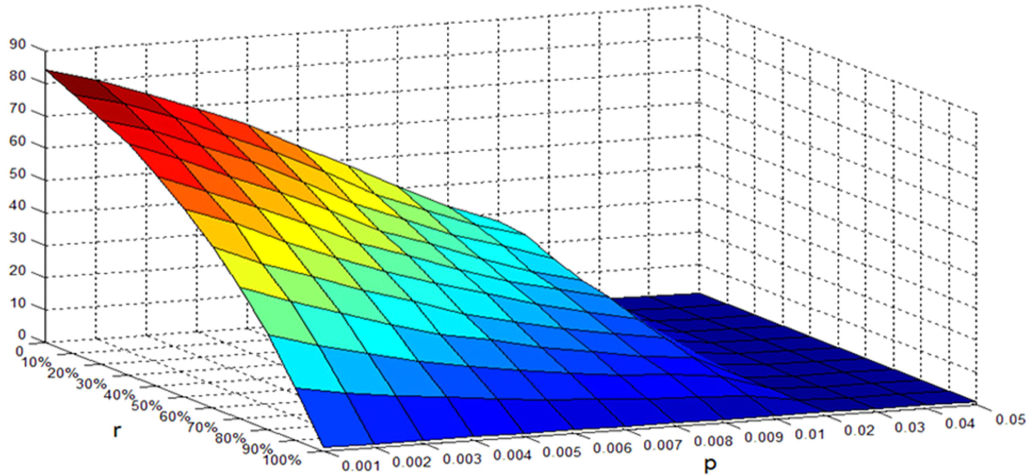 Fig 2: The average number of opinion clusters (SNC) decreases as the online agent ratio (r) and network density (p) increase.
Critical Analysis: The Strength and The Shadow
The value-add of this work is its structural realism. By acknowledging that online agents have a higher "degree of freedom" in who they influenced, the model explains why digital platforms accelerate social shifts.
However, there is a limitation: The model assumes a "beneficial" bounded confidence level where agents seek similar views to form a consensus. It does not explicitly model Echo Chambers or Antagonism, where online interaction might lead to divergence or "backfire effects." Future iterations would benefit from including "stubborn agents" who refuse to move toward the mean.
Final Takeaway
For policymakers and tech architects, this paper is a reminder: the architecture of online platforms is not just a tool for communication; it is a thermostat for social stability. By facilitating interactions based on opinion similarity rather than just social proximity, digital networks act as a high-speed "mixing layer" that can drive a fragmented society toward common ground—or, if left unmanaged, a monoculture.
Keywords: Opinion Dynamics, Social Networks, Consensus Analysis, Big Data, Online-Offline Hybrid.