
Hybrid Social Dynamics: How Online Interaction Bridges the Offline Divide
Dynamics of Public Opinions in an Online and Offline Social Network
This paper proposes a novel hybrid opinion dynamics model that integrates online and offline social network interactions. By combining the linear DeGroot model for offline neighbor communication with the nonlinear Hegselmann-Krause (HK) bounded confidence model for online interactions, the authors achieve SOTA insights into how digital connectivity accelerates social consensus.
Executive Summary
In the era of Big Data, public opinion is no longer confined to face-to-face interactions or traditional media. This paper defines a new frontier in social physics by proposing a Hybrid Online-Offline Opinion Dynamics Model. By mathematically synthesizing the DeGroot model (representing stable offline relationships) and the Hegselmann-Krause (HK) model (representing volatile, similarity-based online interactions), the authors provide a rigorous framework to explain why the "digital age" feels faster and more connected—and sometimes more volatile.
Positioning: This work is a theoretical and simulation-heavy expansion of classic opinion dynamics, moving from single-network homogeneity to a more realistic dual-context topology.
The Core Friction: Why Offline and Online Differ
The authors identify a fundamental structural asymmetry:
- Offline Agents: These individuals interact primarily with neighbors (friends of friends). Their network is often rigid and can easily become disconnected into isolated "components."
- Online Agents: These users are not bound by physical proximity. They exhibit Bounded Confidence—interacting with anyone whose opinion is "close enough" to their own, regardless of network distance.
The pain point of previous research was the failure to explain how these two systems interact. Can a few online "bridges" force a consensus in an otherwise fractured offline society?
Methodology: The Hybrid Update Rule
The paper formalizes the opinion profile through a transition matrix that is both time-varying and opinion-dependent.
1. The Interaction Mechanisms
- Offline Rule: Update based on fixed adjacency matrix .
- Online Rule: Update based on a dynamic confidence set .
2. The Model Architecture
The updated opinion for any agent is a weighted sum of their own previous opinion and the average of their hybrid confidence set:
 Note: The model accounts for the "Self-Confidence" parameter , representing how much an individual clings to their own view.
Mathematical Proof of Consensus
One of the paper's strongest contributions is the formal proof using Theorem 1 and 2. Using the properties of stochastic and ergodic matrices, the authors prove that:
- If the social network is connected, consensus is guaranteed.
- In disconnected networks, consensus can still be achieved if online agents from different components fall into each other's confidence sets. This mathematically defines the "bridging" power of the internet.
Key Experimental Insights
The authors performed 1,000 independent simulations across ER Random, WS Small-World, and BA Scale-Free networks.
Finding 1: The "Online Speedup"
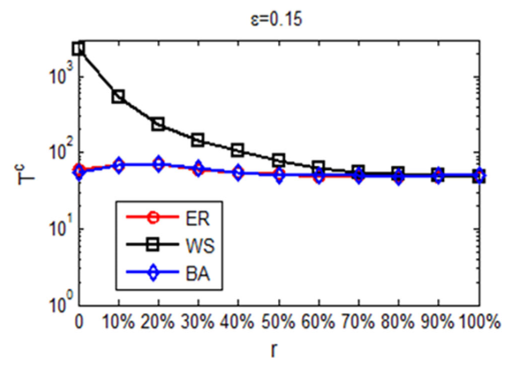
As the ratio of online agents () increases, the Steady-State Time () drops dramatically. Online agents act as a catalyst, smoothing opinion changes and shortening the path to social stability.
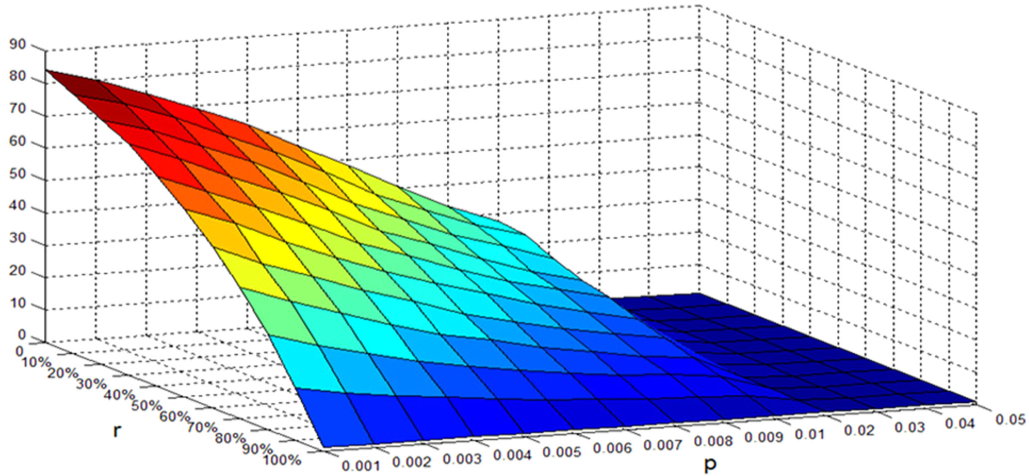 Figure: The Average SNC (Number of Opinion Clusters) decreases as both network density (p) and online agent ratio (r) increase.
Finding 2: The "Attraction" Effect
A fascinating result of the simulation is that pure online clusters are almost never observed. Online agents are so "effective" at communicating that they invariably pull offline agents into their orbit. Conversely, pure offline clusters (isolated groups of people not using the internet) are common, highlighting a potential source of social exclusion.
Finding 3: Small-World and Scale-Free Dynamics
In Watts-Strogatz (WS) Small-World networks, which usually have a high "Clustering Coefficient" that slows down consensus, online agents are particularly effective at breaking down local "echo chambers" by providing shortcuts across the network.
Critical Analysis & Conclusion
This paper provides a robust mathematical foundation for the common intuition that the internet "shrinks" the world. By proving that online agents can force consensus in disconnected offline components, the authors offer a tool for governments and firms to manage crisis and public sentiment.
Limitations: While the model is sophisticated, it assumes a homogeneous confidence level () for all online agents. In reality, human psychology suggests "confirmation bias" might make some agents have extremely narrow confidence levels, leading to the polarization (echo chambers) that this paper suggests we might avoid.
Future Outlook: The logical next step is to apply this to non-cooperative behaviors or adversarial agents (e.g., bots) to see how they exploit this online-offline bridge to spread misinformation.