
Dynamics of Relative Agreement: How Context-Switching Drives Social Consensus
Dynamics of Relative Agreement in Multiple Social Contexts
This paper introduces an agent-based model (ABM) that integrates the Relative Agreement (RA) interaction rule with a context-switching mechanism across multiple concomitant social networks. It demonstrates that social meta-structures—specifically agents moving between different relational contexts like work and family—significantly accelerate consensus formation compared to single-network models.
TL;DR
Why do some societies reach consensus while others remain polarized? This paper argues that the secret lies not just in how we talk, but where we go. By combining the Relative Agreement (RA) interaction model with a multi-context social framework, the authors demonstrate that agents switching between different social circles (like "work" and "family") reach stable opinions faster and more frequently than those trapped in a single network.
Contextualizing the Problem: The Single-Network Trap
Most classical models of opinion dynamics treat society as a single "flat" graph. Whether it's a grid or a complex network, agents are usually tethered to a fixed set of neighbors. However, real-world human behavior is multi-dimensional. We occupy different "contexts"—we might be conservative at family gatherings but progressive in professional academic circles.
The authors argue that ignoring this multi-contextual existence overlooks a critical mechanism of social self-organization: Permeability.
Methodology: Relative Agreement meets Context Switching
The paper fuses two sophisticated concepts:
- Relative Agreement (RA) Interaction: Unlike binary models (0 or 1), RA uses continuous opinions () and uncertainties (). An interaction only changes an agent's mind if there is a significant "overlap" in their confidence intervals.
- Context Switching: Agents exist in different social networks simultaneously but are only "active" in one at a time. After an interaction, an agent might switch to another network with a probability .
The Interaction Logic
The opinion update isn't just a simple average; it’s proportional to the "Agreement" (overlap) divided by the uncertainty of the influencer.
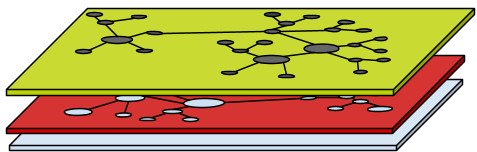 Figure 1: Illustration of an agent belonging to multiple concomitant social layers.
The Mathematical Intuition
The overlap between two agents determines the strength of the influence. If the overlap is greater than the influencer's uncertainty, the listener shifts their opinion and narrows (or expands) their uncertainty:
Experimental Results: The Power of Social Mobility
The authors tested the model across Regular, Small-World (WS), and Scale-Free (BA) networks.
1. The High-Switching Advantage
In regular networks (highly clustered), the researchers found an "optimal zone" for convergence. When the switching probability is high (0.8–1.0), the number of meetings required for the population to reach a consensus drops significantly.
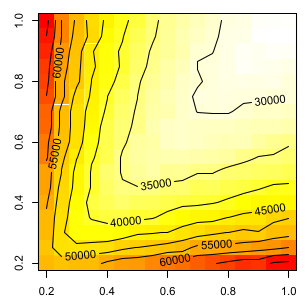 Figure 3: 3D landscape showing that low switching probabilities in even one context can drastically delay or prevent opinion stabilization.
2. Topology Matters (But Switching Matters More)
- Small-World Networks: The "Six Degrees of Separation" effect helps, but it is the combination of short path lengths and context switching that achieves the fastest global consensus.
- Scale-Free Networks: Interestingly, while these networks are usually dominated by "hubs," context switching allows even sparsely connected forests () to reach consensus, a feat nearly impossible in isolated, single-context scale-free networks.
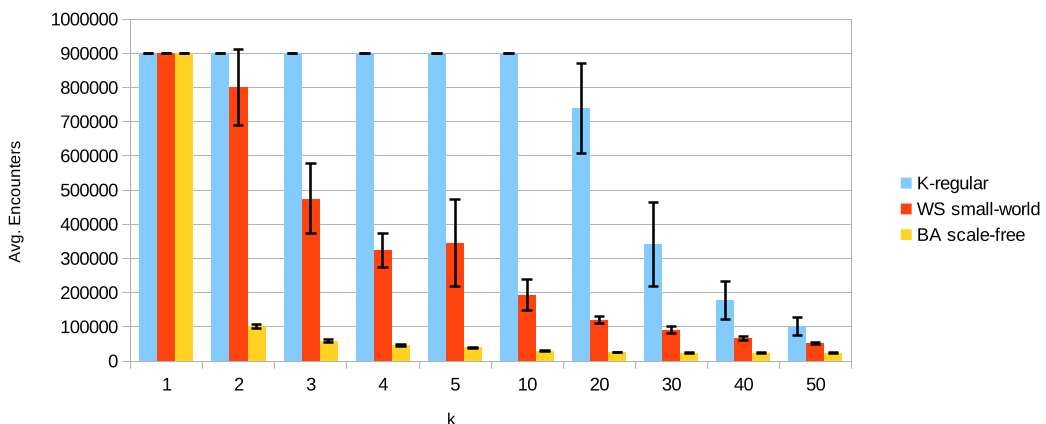 Figure 7: Comparison of convergence speed across different network types. Scale-free networks (BA) generally converge faster as connectivity () increases.
Critical Analysis & Conclusion
The Takeaway
The core contribution of this work is the validation that social structure is not just about links, but about transitions. By moving between contexts, agents act as "opinion carriers" that bridge disconnected clusters. This "permeability" breaks local echo chambers and forces the global system toward a unified state.
Limitations and Future Path
While the results are robust, the model assumes static social networks. In reality, social links are dynamic (we make and break friends). Furthermore, the uncertainty () is initially homogeneous in these tests.
Future Work will likely explore:
- Heterogeneous Uncertainty: What happens if "extremists" (low uncertainty) are introduced into these multi-context worlds?
- Co-evolving Networks: Exploring how opinions might eventually change the structure of the networks themselves.
This paper provides a vital roadmap for understanding how complex, multi-layered social environments naturally resist or facilitate the spread of ideas.