
Dynamics of Uncertain Opinions: Why Experts and Like-Mindedness Shape Consensus Differently
10392_Dynamics of Uncertain and Conflicting Opinions in Social Networks.
The paper investigates opinion evolution in social networks using Subjective Logic (SL) to model "uncertain" binomial opinions. It proposes two novel update mechanisms—Uncertainty-Based Trust (UT) and Similarity-Based Trust (ST)—to analyze how informed vs. uninformed agents influence consensus across ER, BA, and Facebook topologies.
TL;DR
In an era of digital echo chambers and information overload, how do we actually change our minds? This paper by Jin-Hee Cho utilizes Subjective Logic (SL) to model how uncertainty affects opinion dynamics. It compares two fundamental human behaviors: Uncertainty-based Trust (UT), where we listen to the most confident "experts," and Similarity-based Trust (ST), where we only listen to those who already agree with us. The results show that "expert-following" leads to compromise, while "similarity-following" leads to polarization and extreme consensus.
Background: Beyond Binary Opinions
Traditional models like the Deffuant-Weisbuch model often simplify opinions into a single number. However, humans aren't just "pro" or "con"; we are often "unsure." This paper introduces Informed Agents (IAs)—the stubborn, confident influencers—and Uninformed Agents (UIAs)—the open-minded individuals looking for guidance. By using Subjective Logic, an opinion is represented as a triple: representing belief, disbelief, and uncertainty, where .
Two Logics of Interaction
The core innovation lies in the two trust attitudes developed to dictate how agents update their opinions upon interaction:
1. Uncertainty-Based Trust (UT)
- Intuition: "I trust you because you seem to know what you're talking about."
- Mechanism: A UIA updates its opinion based on how certain the other agent is. If the other agent has very low uncertainty (), the UIA heavily weights that agent’s belief into its own update.
- Impact: It acts as a bridge-builder, pulling diverse opinions toward a weighted middle ground.
2. Similarity-Based Trust (ST)
- Intuition: "I trust you because we think alike."
- Mechanism: This utilizes a Trust Revision Operator. An agent evaluates the "Projected Distance" between its belief and the partner's belief. If they are too far apart, the trust is discounted.
- Impact: It creates "echo-chamber" effects where agents only move when they find common ground.
 Equation 4: The SL Consensus Operator forming the basis of the update logic.
Convergence Analysis: The Battle of Network Topologies
The author tested these models across Erdős–Rényi (ER), Barabási–Albert (BA), and real-world Facebook networks.
Key Findings from Experiments:
- Speed of Consensus: UT is significantly faster. Because UT agents are willing to listen to anyone confident, information flows and aggregates quickly. ST agents stagnate until they find a "like-minded" neighbor.
- The "Stubborn Agent" Paradox:
- In UT, adding more Informed Agents (IAs) actually slows down consensus. Why? Because competing experts with low uncertainty pull the UIAs in opposite directions, creating a stalemate.
- In ST, more IAs accelerate consensus. They provide a "gravity well" of similarity that eventually pulls uncertain agents toward one extreme.
- Centrality Matters: On the Facebook network, IAs with high centrality (many connections) in a UT setting often cause more dissonance because they force UIAs to reach zero uncertainty too fast, essentially "locking" their opinions before they can reach consensus with the whole group.
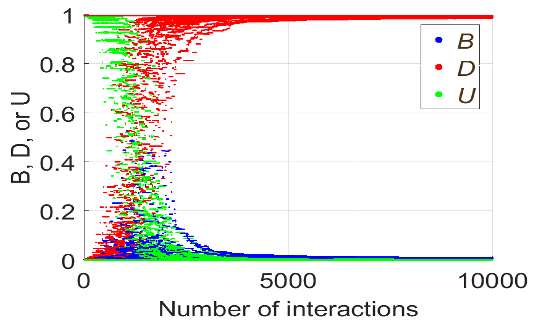 Fig. 2: Under UT (Uncertainty-based), opinions converge to a compromise value (e.g., 0.5).
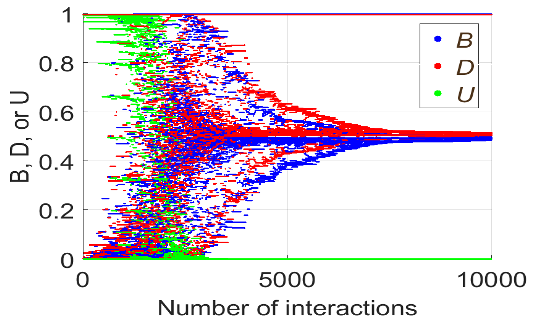 Fig. 7: Under ST (Similarity-based), opinions are polarized and eventually "snap" to 0 or 1.
Critical Analysis & Takeaways
This paper provides a rigorous mathematical bridge between subjective belief theory and social network dynamics.
Academic Insight: The proof that ST-based updates do not always decrease uncertainty () is a crucial finding. It explains why some social groups remain in a state of "perpetual confusion" or chaos until a critical mass of similarity is reached.
Real-world Implication: If you want a society to reach a compromise, empower "experts" (UT model). If you want to radicalize a society toward one extreme, flood the network with "like-minded" stubborn influencers (ST model).
Limitations: The models assume agents are either totally informed or totally uninformed. Real humans exist on a spectrum. Additionally, the study does not account for "malicious" agents who might intentionally project false confidence.
Conclusion
Dr. Jin-Hee Cho’s work highlights that how we trust is just as important as who we trust. In the future, exploring "path dependency"—whether the order in which you meet people changes your final world view—will be the next frontier in understanding the shifting sands of public opinion.