
E-Cognocracy: Extracting the 'Why' Behind Public Opinion
A new e-learning tool for cognitive democracies in the Knowledge Society
This paper introduces a novel e-learning tool for e-cognocracy, a cognitive democracy model designed for the Knowledge Society. The tool utilizes combined pattern-based linguistic rules and Frequent Nouns (FN) analysis to extract policymaking arguments from public discussion forums, facilitating the democratization of knowledge and informed collective decision-making.
TL;DR
In the era of the Knowledge Society, democracy must evolve from simple voting to Cognitive Democracy. This paper presents a new e-learning tool that goes beyond sentiment analysis to extract actual arguments from public forums. By combining linguistic pattern matching with frequent noun analysis, the system identifies the core reasons citizens support or oppose major public projects with 83% precision, providing a roadmap for more transparent and educated governance.
Context: From 'Hands' to 'Mind'
The transition from an Industrial Society to a Knowledge Society shifts the value of production from physical labor to human talent and intelligence. In this context, the authors argue that our democratic models are outdated. We don't just need e-voting; we need e-cognocracy—a system where citizens and representatives engage in a continuous learning process.
The bottleneck? Processing the vast, messy landscape of public discourse to find the high-value knowledge (the arguments) buried in forum posts.
The Problem: Sentiment is Not Knowledge
Most "Opinion Mining" tools tell you what people feel (Polarity: Positive/Negative). However, for policy making, the what is useless without the how and the why.
- The Problem: Opinions on complex projects (like the "Gran Scala" leisure complex case study) are abstract and laden with ideology.
- The Challenge: Informal forum language is rife with typos, implicit reasoning, and non-linear logic, making standard Information Extraction (IE) difficult.
Methodology: The Hybrid Extraction Engine
The authors propose a "Cognitive Democracy" tool that treats the discussion stage as an e-learning environment. The extraction engine uses two key strategies:
1. Pattern-Based Linguistic Rules
The system looks for "Opinion Markers" (I believe, I think) and "Argument Markers" (Opportunity for, I agree because).
- Universal Markers: Phrases like "I think that..." followed by a future or conditional verb tense.
- Domain-Specific Markers: For the case study, terms like "Opportunity for [Project]" were prioritized.
2. The Frequent Nouns (FN) Module
Recognizing that people often skip formal markers in web comments, the system tracks the most frequent nouns (e.g., "water," "jobs," "environment"). If a sentence contains a frequent noun and a verb, it is flagged as a potential argument.
 The process flow of e-cognocracy: merging communication, decision-making, and knowledge democratization.
Experimental Results
The tool was tested on the Gran Scala project—a massive proposed leisure complex in Aragon, Spain.
| Metric | Result |
|---|---|
| Precision | 83% |
| Recall | 50% |
| Agreed Arguments | 432 |
While the 83% precision is impressive (meaning when the tool says it found an argument, it’s usually right), the 50% recall highlights the difficulty of modern NLP: half of the human arguments were too "hidden" or poorly phrased for the current patterns to catch.
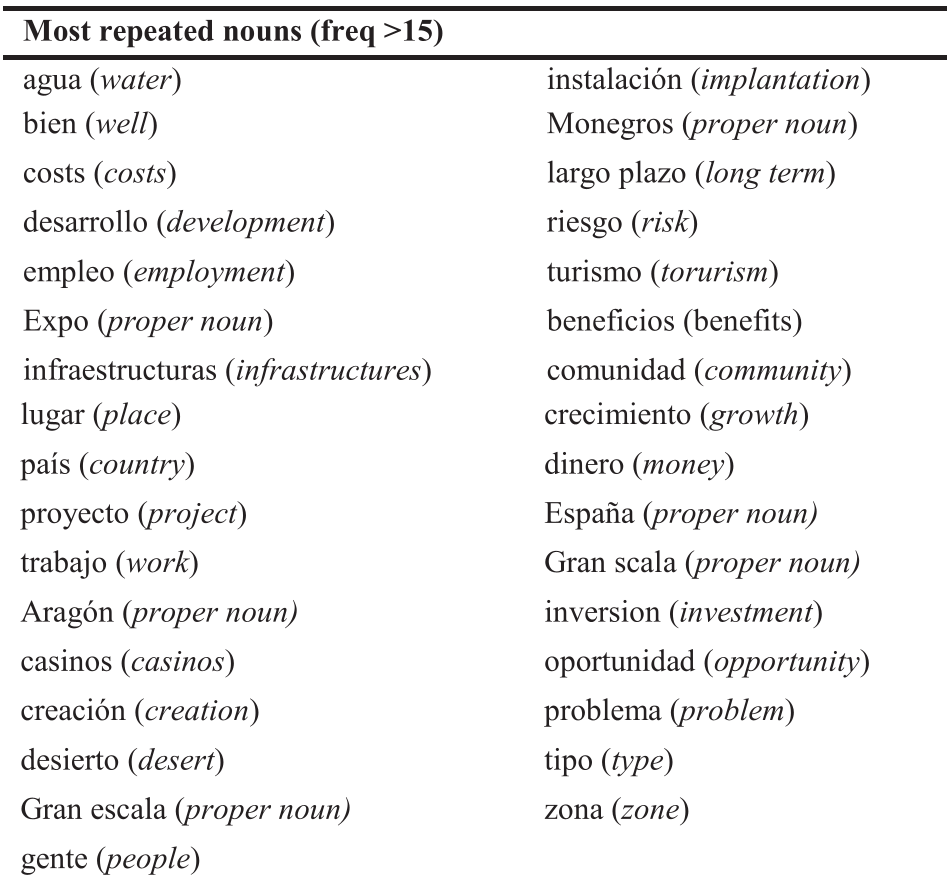 Table showing top nouns like 'water', 'employment', and 'risk' used to anchor argument extraction.
Critical Insight: The Value of Argument Mining
This work represents a shift from Quantitative (counting votes) to Qualitative (extracting intelligence) democracy. The core contribution is the realization that an argument is a function of a marker and an opinion sense: .
By isolating these arguments, administrators can:
- Address specific public fears (e.g., water usage).
- Identify shared values across different political ideologies.
- Educate the public by reflecting the collective's rationale back to them.
Conclusion & Future Outlook
The authors have moved beyond "Thunbs up/Thumbs down" sentiment analysis. While the linguistic rules were effective in 2013, the foundation laid here—connecting Argument Mining to Multi-Criteria Decision Making—is the precursor to modern AI-driven citizen assemblies. The future involves improving recall through more sophisticated semantic parsing, ensuring that every citizen's "why" is heard and categorized.