
E-Shadow: Bridging the Digital-Physical Divide in Social Interaction
E-Shadow: Lubricating Social Interaction Using Mobile Phones
The paper introduces E-Shadow, a distributed local social networking system that uses mobile phones to broadcast "electronic shadows" of users. It utilizes a multi-layered communication strategy (WiFi SSID, Bluetooth name, and Service Discovery) and a human-assisted, direction-driven localization algorithm to facilitate seamless face-to-face interactions.
TL;DR
Historically, social networking has been split between high-utility online platforms and the missed opportunities of physical proximity. E-Shadow bridges this gap by turning your smartphone into a digital "aura" that broadcasts your identity in layers. By leveraging clever hacks in WiFi and Bluetooth protocols, it enables "unobtrusive" discovery and a human-centric way to find people in a crowd without needing GPS or centralized servers.
The Problem: The "Familiar Stranger" Paradox
We often find ourselves in crowds—conferences, job fairs, or cafes—surrounded by people with shared interests, yet we remain "familiar strangers." Current solutions fail because:
- Privacy vs. Utility: Revealing too much at a distance is risky; revealing too little is useless.
- The "Handshake" Barrier: Manually pairing Bluetooth or joining WiFi networks to see someone's profile is socially awkward and technically slow.
- Localization Failure: GPS is useless indoors, and standard signal-strength (RSSI) positioning is notoriously inaccurate due to environmental noise.
Methodology: Layered Publishing and Directional Cues
The core innovation of E-Shadow lies in its two-pronged approach: Spatial/Temporal Layering and Directional Matching.
1. Spatial Layering: The "Electronic Aura"
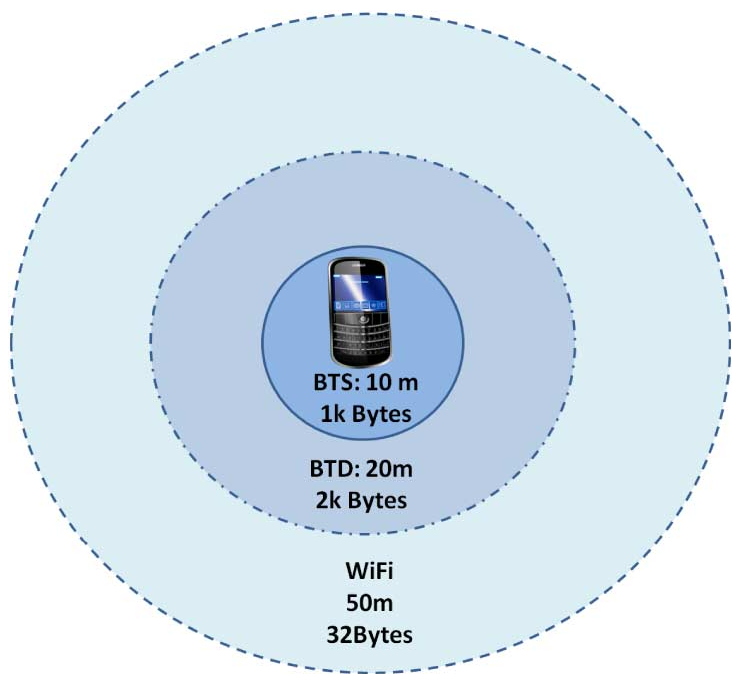
Instead of a single broadcast, E-Shadow mimics a shadow that changes with the distance of the sun. It uses three distinct wireless layers to balance range and information density:
- The WiFi Layer (Outer Circle, 50m): Data is "abused" in the WiFi SSID names (32 bytes). This is the fastest to scan (under 2s) and serves as the initial "hook."
- The Bluetooth Name Layer (Middle Circle, 20m): More detailed data (up to 2KB) is embedded in the Bluetooth Device Name.
- The Bluetooth Service Layer (Inner Circle, 10m): Richer descriptions and contact info are placed in the Service Discovery Protocol (SDP) fields.
2. Direction-Driven Matching: The "How-To-Find" Logic
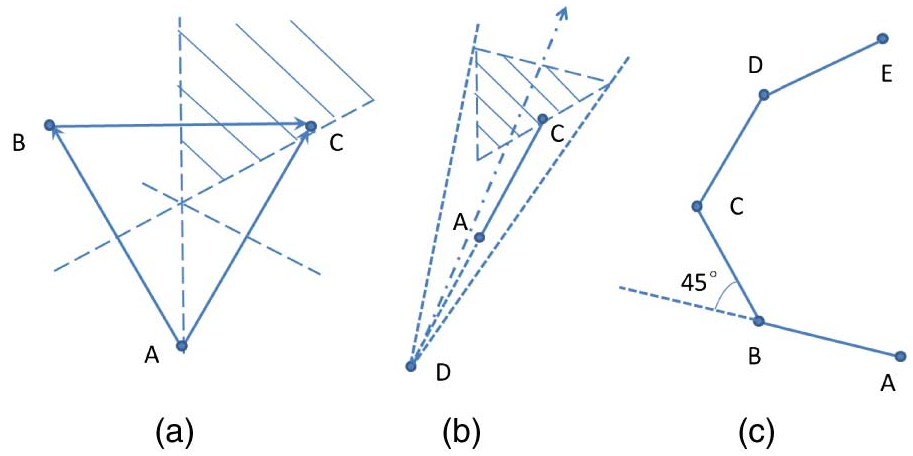
The authors realized that in a crowd, you don't need a latitude/longitude coordinate; you need a direction.
Traditional trilateration (measuring distance from 3 points) fails because signal noise makes absolute distance calculation impossible. Instead, E-Shadow uses Relative Magnitude Comparison. By comparing RSSI at different points along a user's walking path, the system performs "Space Partitioning." If the signal is stronger at Point B than Point A, the target must be in the half-plane closer to B. Multiple comparisons carve out a "Target Region."
Experiments and Reality Check
The system was tested using Windows Mobile devices in real-world environments like classrooms and bookstores.
- Scanning Speed: WiFi is the king of speed, remaining constant regardless of the number of nearby devices. Bluetooth, however, suffers from a linear increase in delay as the crowd grows.
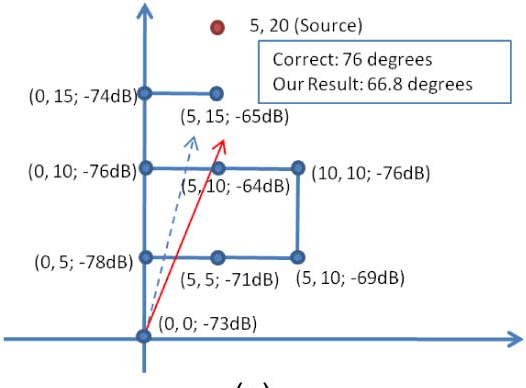
- Localization Accuracy: In both outdoor open fields and complex indoor layouts (like a library with shelves), the directional error was consistently within 30-40 degrees. For a human user, this is sufficient to look up, scan the faces in that direction, and identify the target.
Critical Insight: Why This Works
The brilliance of E-Shadow isn't in high-fidelity math; it's in its Inductive Bias toward social behavior.
- Human-in-the-loop: It doesn't find the person for you; it guides your eyes.
- Protocol Abuse for Good: By using SSIDs and Device Names, the system avoids the "Do you want to pair with device XYZ?" pop-up that kills spontaneous interaction.
- Elastic Privacy: The closer you get, the more "shadow" is revealed, naturally mimicking how human intimacy develops in physical space.
Future Outlook and Limitations
While E-Shadow provides a robust framework, it faces challenges with modern OS restrictions (like randomized MAC addresses and restricted SSID broadcasting) that have been implemented since this research to prevent tracking. However, the core philosophy—Directional over Absolute positioning and Layered Content over All-or-Nothing sharing—remains the gold standard for designing pervasive social hardware.