
Crowdsourcing the Clinic: Can the Internet Help Quantify Lung Disease?
Early Experiences with Crowdsourcing Airway Annotations in Chest CT
The paper explores the feasibility of using Amazon Mechanical Turk (Crowdsourcing) for pulmonary airway annotation in chest CT scans. It introduces a pipeline to generate 2D slices from 3D coordinates and compares untrained "knowledge workers" (KWs) measurements of lumen and wall areas against expert-derived SOTA ground truths.
Executive Summary
TL;DR: Respiratory diseases remain a leading cause of global mortality, requiring precise CT-based quantification of airway abnormalities. This study investigates whether untrained Amazon Mechanical Turk workers can replace (or assist) expert radiologists in measuring airway lumen and walls. The verdict: Unconstrained tasks fail, but with the right tools and aggregation, the "crowd" achieves a surprisingly high correlation with expert ground truths.
Positioning: This work serves as an "experience report" and a pilot study within the medical imaging domain, bridging the gap between high-stakes clinical diagnosis and the scalability of crowdsourced data labeling.
The Bottleneck: 16 Hours for One Scan
In the world of pulmonology, identifying bronchiectasis (the permanent widening of airways) is crucial for treating Cystic Fibrosis. The gold standard involves calculating the Airway-to-Vessel Ratio (AVR). However, manually annotating a single scan can take a radiologist up to 16 hours.
Machine Learning (ML) is the obvious solution, but ML is data-hungry. To train a model that works across diverse populations, we need thousands of scans—translated to tens of thousands of expert man-hours. The authors ask: Can we trade expertise for scale?
Methodology: Simplifying 3D Complexity for the Crowd
The researchers didn't just throw raw 3D CT volumes at the workers. They prepared the data to minimize "search stress":
- 2D Slice Generation: Using centerlines from a propagation algorithm, they extracted 2D slices perpendicular to the airway.
- Multi-view Presentation: Workers were shown original, sagittal, coronal, and axial views to help confirm the airway's structure (a dark circle with a light ring).
- Tool Evolution: They initially used a "freehand" tool, which resulted in chaotic, unusable shapes. They quickly pivoted to an Ellipse Tool, forcing workers into a geometry that naturally matches airway cross-sections.
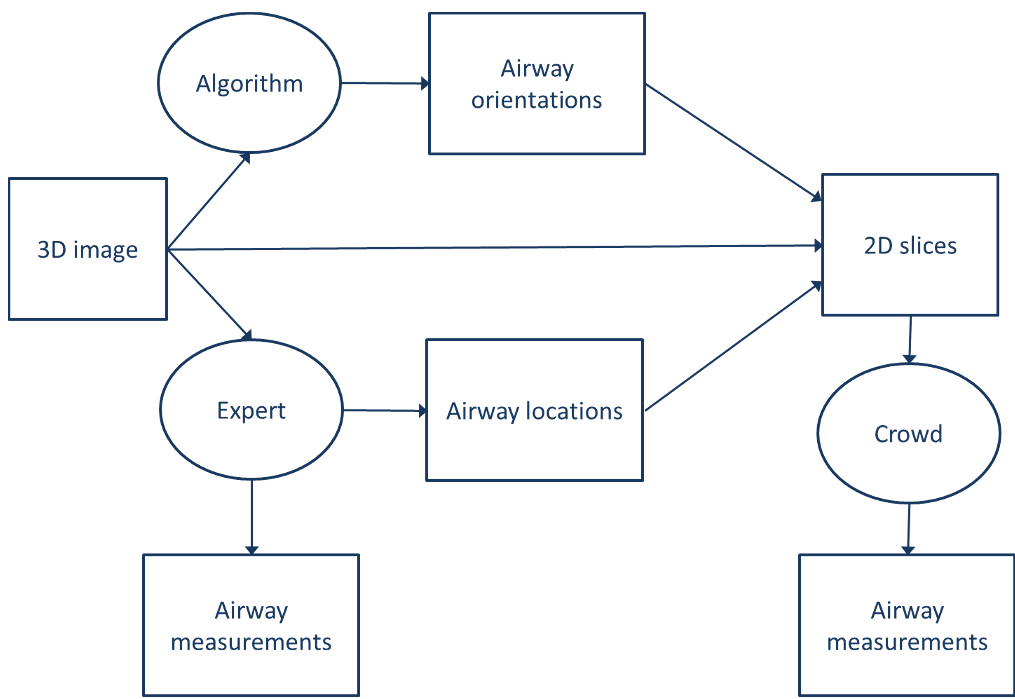 Caption: The workflow extracts 2D slices from known 3D locations, allowing untrained workers to focus purely on boundary delineation.
The Struggle with Instructions
The biggest takeaway from the "Early Experiences" was not a mathematical failure, but a human one.
- The Single Contour Problem: Workers often drew only one ellipse (the lumen) and ignored the wall, or vice-versa.
- The Vessel Confusion: Untrained workers frequently annotated the adjacent blood vessels (which appear as solid white circles) instead of the hollow airways.
Out of 900 annotations, only 290 were usable. This high attrition rate highlights that in medical crowdsourcing, instruction design is as important as the underlying algorithm.
Results: The Power of Aggregation
Despite the high noise, the signal was strong among diligent workers. When the authors filtered for "usable" annotations (pairs of ellipses) and aggregated them using the median, the results aligned impressively with experts.
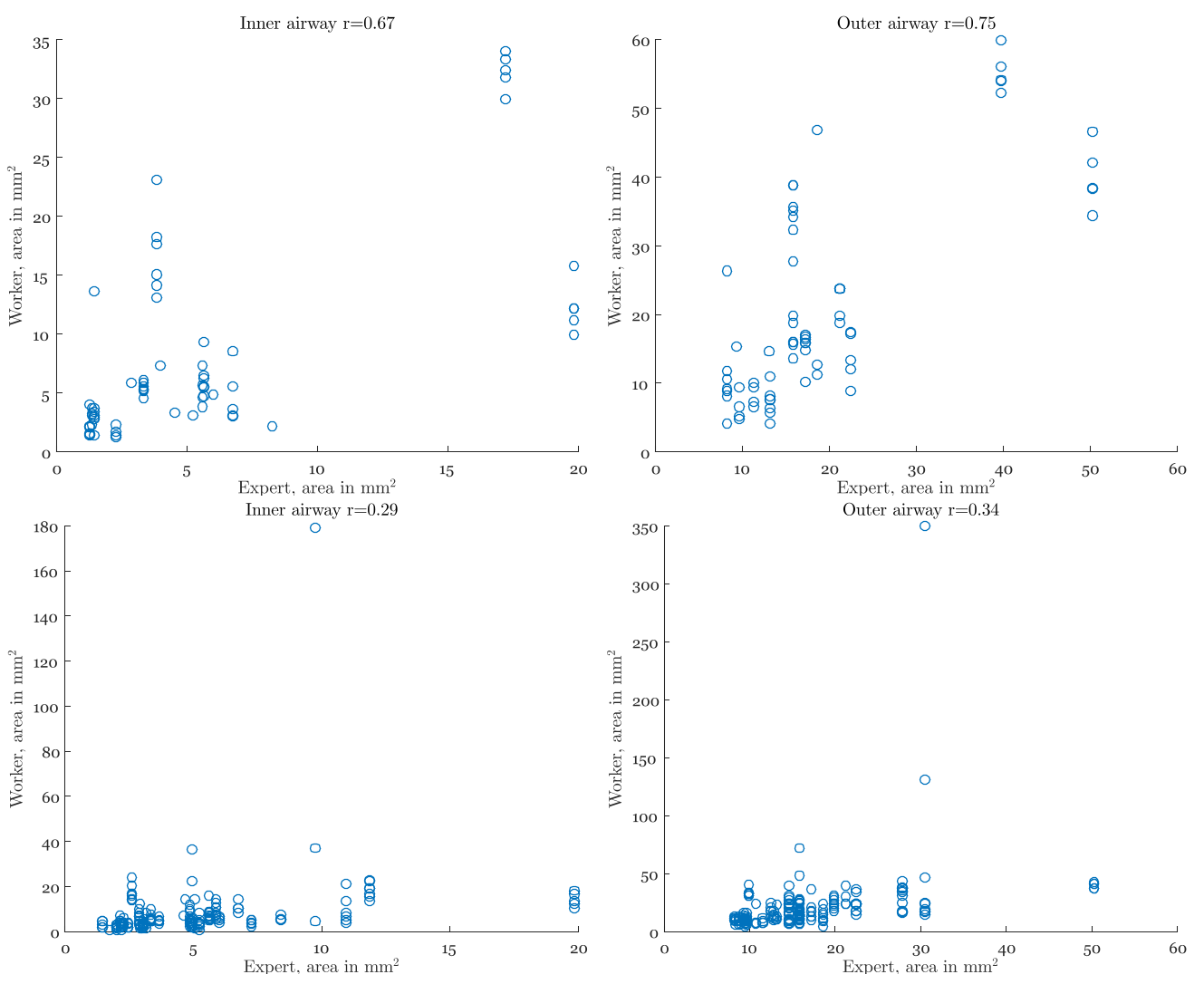 Caption: Scatter plots showing individual worker measurements vs. experts. While individuals vary, the Pearson correlation (r) remains positive and significant.
The paper demonstrates that when you gather at least 3 usable annotations per image, the correlation (r) for the airway lumen reaches high levels, suggesting these labels are sufficient for training robust deep learning segmentation models.
Critical Insight: Future Outlook
This study proves that the "Wisdom of the Crowd" applies even to specialized medical tasks, provided the interface acts as a "guardrail."
Key Takeaways for Future Researchers:
- Constraint is King: Don't let workers draw freely; use shape-specific tools (ellipses/rectangles).
- Automated Filtering: Build real-time validation into the UI (e.g., "You must draw two circles to submit").
- Aggregation over Individual Accuracy: You don't need one perfect worker; you need five average ones.
Limitations: The study relied on pre-localized 3D points. The next frontier—and a much harder task—is asking the crowd to find the airways in a massive 3D volume, not just measure them.
Final Conclusion
The paper concludes that while crowdsourcing isn't a "magic button" for medical data, it is a viable path forward for the "Big Data" era of radiology. By simplifying instructions and improving task interfaces, we can unlock the potential of thousands of workers to accelerate the fight against lung disease.