
Toward Early and Order-of-Magnitude Cascade Prediction in Social Networks
Toward early and order-of-magnitude cascade prediction in social networks
The paper proposes a novel framework for predicting viral information cascades in social networks (Sina Weibo) using measures of "structural diversity." By focusing on the variety of social contexts (communities) of early adopters and exposed users, the authors achieve a precision of 0.69 in predicting order-of-magnitude growth (from 50 to 500 reposts), significantly outperforming state-of-the-art baselines.
TL;DR
Predicting which tweet or video will go "viral" is notoriously difficult because true virality—an order-of-magnitude jump in reach—is a rare statistical outlier. This paper introduces a robust prediction model using Structural Diversity measurements. By analyzing how information spreads across different social communities rather than just counting clicks, the authors successfully predict viral cascades (50 to 500+ reposts) with high precision, even in extremely imbalanced real-world datasets.
Problem & Motivation: The Power-Law Wall
In social network science, cascade sizes follow a power-law distribution: millions of posts die in obscurity, while only a tiny handful reach "viral" status.
Previous research (e.g., Cheng et al., 2014) often simplified the problem by trying to predict if a cascade would "double" in size. However, doubling an existing 50 reposts to 100 is significantly easier—and less valuable—than predicting if it will explode to 500 or 5,000. Furthermore, many studies "cheat" by balancing their data (50% viral, 50% non-viral), which doesn't reflect the real world where viral events represent less than 2% of the total volume.
The authors' core Insight: Information doesn't go viral just because of "influencers," but because it manages to jump across "structural holes" between different communities.
Methodology: The Power of Structural Diversity
The authors define a social network partitioned into communities. They categorize neighbors of a cascade into Recently Exposed () and Past Exposed () based on a temporal threshold (30 minutes).
Core Metrics
- Gini Impurity (): Measures how uniformly adopters are spread across communities. High impurity means the cascade is not confined to one "echo chamber."
- Overlap (): Calculates the number of shared communities between adopters () and the recently exposed ().
The intuition for Overlap is powerful: If and share many communities, individuals in the exposed set are receiving "multiple signals" from different acquaintances within their social context, which dramatically increases their probability of adoption.
Experiments & Results
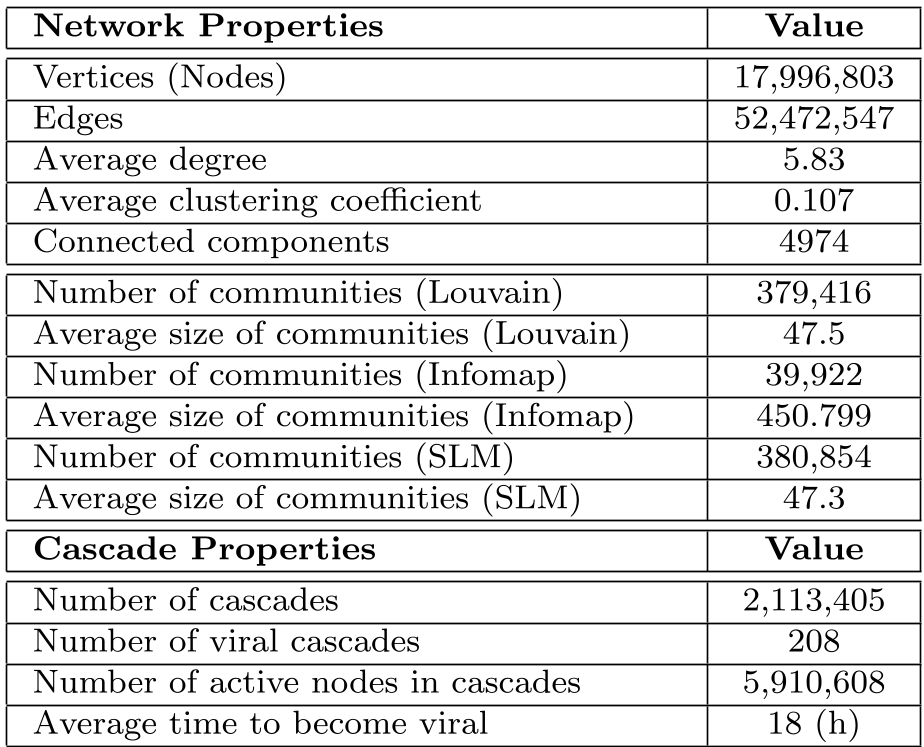
The authors tested their features on a massive Sina Weibo dataset (over 9 million reposts) using Random Forest classifiers.
Size vs. Time-based Prediction
- Size-based (m=50): Can we predict 500+ reposts when we hit 50?
- Time-based (t=60 min): Can we predict 500+ reposts after one hour?
SOTA Comparison
The proposed features ( / ) significantly beat the previous state-of-the-art ( / ) by Weng et al., particularly in Precision. While counts of adopters are useful, the structural "bridge" metrics (Overlap) provided the necessary discriminative power to identify the rare 2% of viral samples correctly.
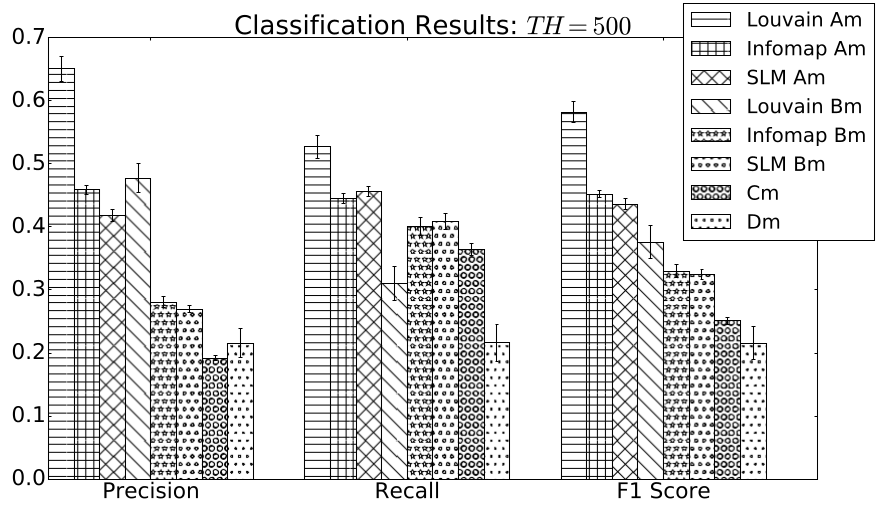 Fig: Performance of vs other feature sets. Note the superior F1 and Precision across different community algorithms.
Critical Analysis & Conclusion
Takeaways
The study proves that Network Topology alone (without looking at the text, images, or sentiment of a post) contains enough signal to predict virality. The key is in the "social context"—if your message is only popular within a single clique, it will likely stagnate. If it bridges overlaps, it has viral potential.
Limitations & Future Work
One limitation is the use of static communities. In reality, social groups are dynamic and overlapping. The authors utilized non-overlapping partitions (Louvain/Infomap) for simplicity. Future work integrating Dynamic Community Detection or Content Features (e.g., using LLMs to see if the "vibe" of the content matches the destination community) could push precision even higher.
This research provides a groundwork for platforms to identify trending content or misinformation hours before it reaches its peak, allowing for better moderation and recommendation strategies.