
Decoding the Heart: Challenges in Subject-Independent ECG Emotion Recognition
ECG-Based Human Emotion Recognition Across Multiple Subjects
This paper explores the feasibility of electrocardiogram (ECG)-based emotion recognition across multiple subjects using Logistic Regression (LR) and Artificial Neural Networks (ANN). The study aims to classify three emotional states—Neutral, Fear, and Disgust—by extracting statistical features from R-peak amplitudes and RR intervals of 25 volunteers.
TL;DR
Recognizing human emotions through heartbeat patterns (ECG) is a frontier in affective computing. This study investigates whether machine learning models can identify Neutral, Fear, and Disgust states across 25 different people. Using Logistic Regression and Neural Networks, the authors reach a critical conclusion: while the heart doesn't lie, its "language" varies so much between individuals that subject-independent recognition remains a significant technical hurdle.
Background: Why the Heart?
Traditional emotion recognition relies on facial expressions or voice. However, these can be faked or suppressed. The Electrocardiogram (ECG) measures the heart's electrical activity—an unconscious biological response that is nearly impossible to conceal.
The core challenge addressed here is Subject-Independent Modeling. Most systems work well when trained and tested on the same person (Subject-Dependent), but they fail when applied to a new user due to individual physiological differences (e.g., resting heart rate, physical fitness, and stress response).
Methodology: From Raw Pulse to Emotional Insights
The researchers recorded ECG data from 25 volunteers watching films designed to trigger specific emotions. The workflow involved:
- Temporal Segmentation: Dividing the signal into baseline, pre-video, mid-video, and last-video segments.
- Feature Extraction: Focusing on the R-peak (the highest spike in an ECG cycle) and the RR interval (the time between spikes).
- Statistical Analysis: Computing 8 key features, including Beats Per Minute (BPM) and standard deviations of intervals.
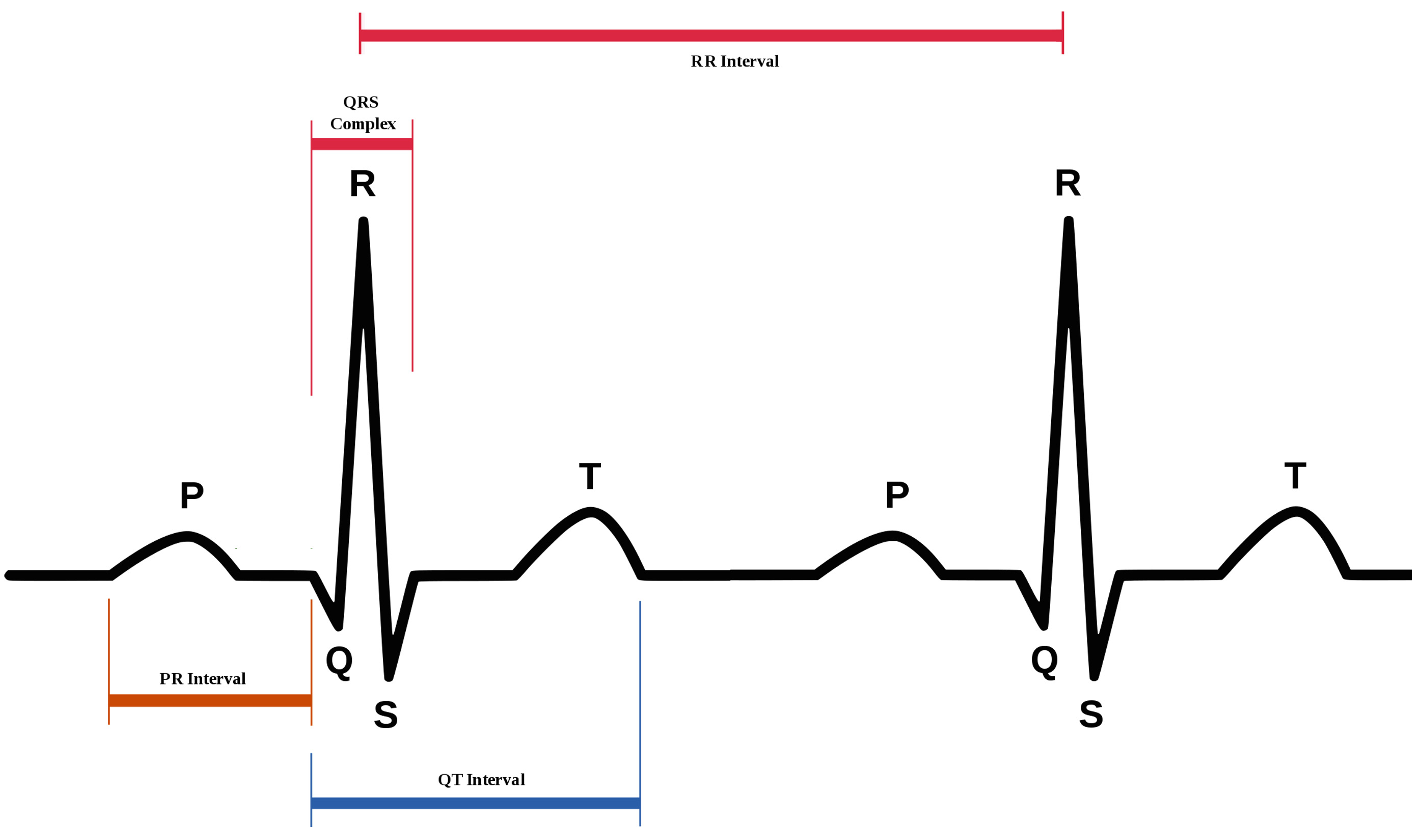 Visualizing the P-wave, QRS-complex, and T-wave used for quantitative analysis.
The Classifier Showdown: LR vs. ANN
The authors compared two distinct approaches:
- Logistic Regression (LR): Performed better with non-normalized data and showed superior generalization (less gap between training and testing).
- Artificial Neural Networks (ANN): Capable of achieving 90% training accuracy but highly prone to overfitting, requiring strict L2 regularization to be functional.
Experimental Results & Insights
The study found that the "pre-video" and "mid-video" segments (the first 20 minutes of exposure) contained the most discriminative data.
- Leading Features: Through Recursive Feature Elimination (RFE), the Standard Deviation of R-peak amplitude and Average R-peak amplitude were identified as the most critical markers for distinguishing emotions.
- Accuracy Gap: The testing accuracy (around 35-40%) was significantly lower than training accuracy. This "Generalization Gap" highlights the difficulty of creating a "one-size-fits-all" emotion model.
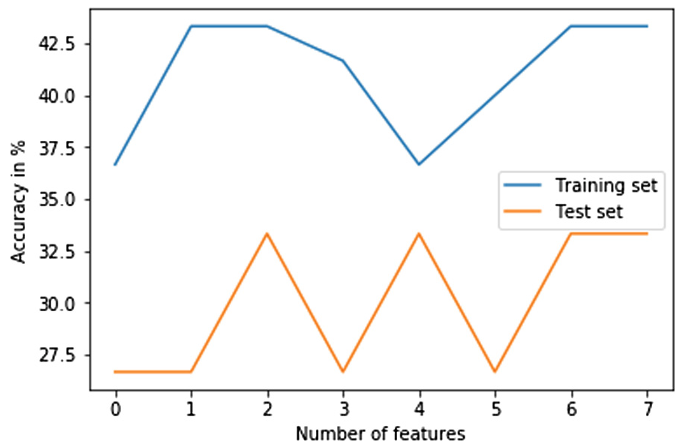 Example of LR performance convergence based on the number of features used.
Critical Analysis & Future Outlook
The primary takeaway is that ECG variability is a "feature," not just noise. The fact that a Neural Network can hit 90% on training data but drops significantly on new subjects suggests that the model is memorizing subject-specific heart signatures rather than universal emotional patterns.
Limitations
- Sample Size: 25 subjects is a start, but deep learning typically requires thousands to generalize across a population.
- Emotion Diversity: The study only looked at three emotions. Expanding to complex states like "frustration" or "joy" would increase complexity.
The Path Forward
To move toward real-world applications (like a car that detects a driver's fear or a medical monitor detecting distress), the authors suggest a Multimodal Approach. Combining ECG with facial landmarks or skin conductance could bridge the accuracy gap that heart data alone currently faces.
Conclusion: While we are not yet at a stage where a watch can perfectly read your feelings, this research provides the statistical "blueprint" for which heart-rate features matter most in the quest for empathetic machines.