
Regulating the Grid: Why More Rules Can Mean Less Cybersecurity
10252_Economic Impacts of Rules- versus Risk-Based Cybersecurity Regulations for Critical Infrastructure Providers.
This paper presents a game-theoretic model to analyze the effectiveness of rules-based versus risk-based cybersecurity regulations for Critical National Infrastructure (CNI). Validated with National Grid (UK), it identifies critical "phase transitions" where excessive regulation can inadvertently cause operators to abandon deep risk assessment in favor of superficial compliance.
TL;DR
Critical National Infrastructure (CNI) operators are caught between two regulatory fires: rules-based compliance (follow the checklist or get fined) and risk-based assessment (manage your own risks or face the consequences of a breach). This research develops a game-theoretic model to show that pushing for stricter rules can actually backfire, leading firms to stop thinking about real security risks and focus solely on avoiding audit penalties—a phenomenon known as a "phase transition" in regulatory behavior.
Problem & Motivation: The Monopoly Paradox
Securing the power grid is inherently different from securing a retail website. CNI operators are often "rent-seeking monopolists" whose budgets are capped by the government. Because the cost of a blackout is borne by the public, but the cost of defense is borne by the firm, there is a natural tension.
Historically, the US has favored Rules-based regulation (NERC-CIP), which provides a clear "floor" for security but can lead to "gold-plating"—investing in expensive, visible compliance theater that doesn't necessarily stop a sophisticated attacker like Stuxnet. On the other hand, the UK has favored Risk-based regulation, giving operators flexibility but potentially allowing "under-investment" if the operator is risk-neutral or short-sighted.
Methodology: The Three-Way Game
The authors don't just look at the defender and the attacker. They add a third player: The Policymaker.
The security interaction is modeled as a Nash Equilibrium where:
- The Firm chooses (compliance) and (actual risk mitigation).
- The Attacker chooses intensity based on potential reward vs. cost.
- The Policymaker sets the "Or-else" (fines) and "Subsidies" (rate caps).
By using the Institutional Analysis and Development (IAD) framework, the authors translate legal jargon into mathematical variables. They assume a hyperbolic relationship: the more you invest, the less marginal benefit you get from each additional dollar.
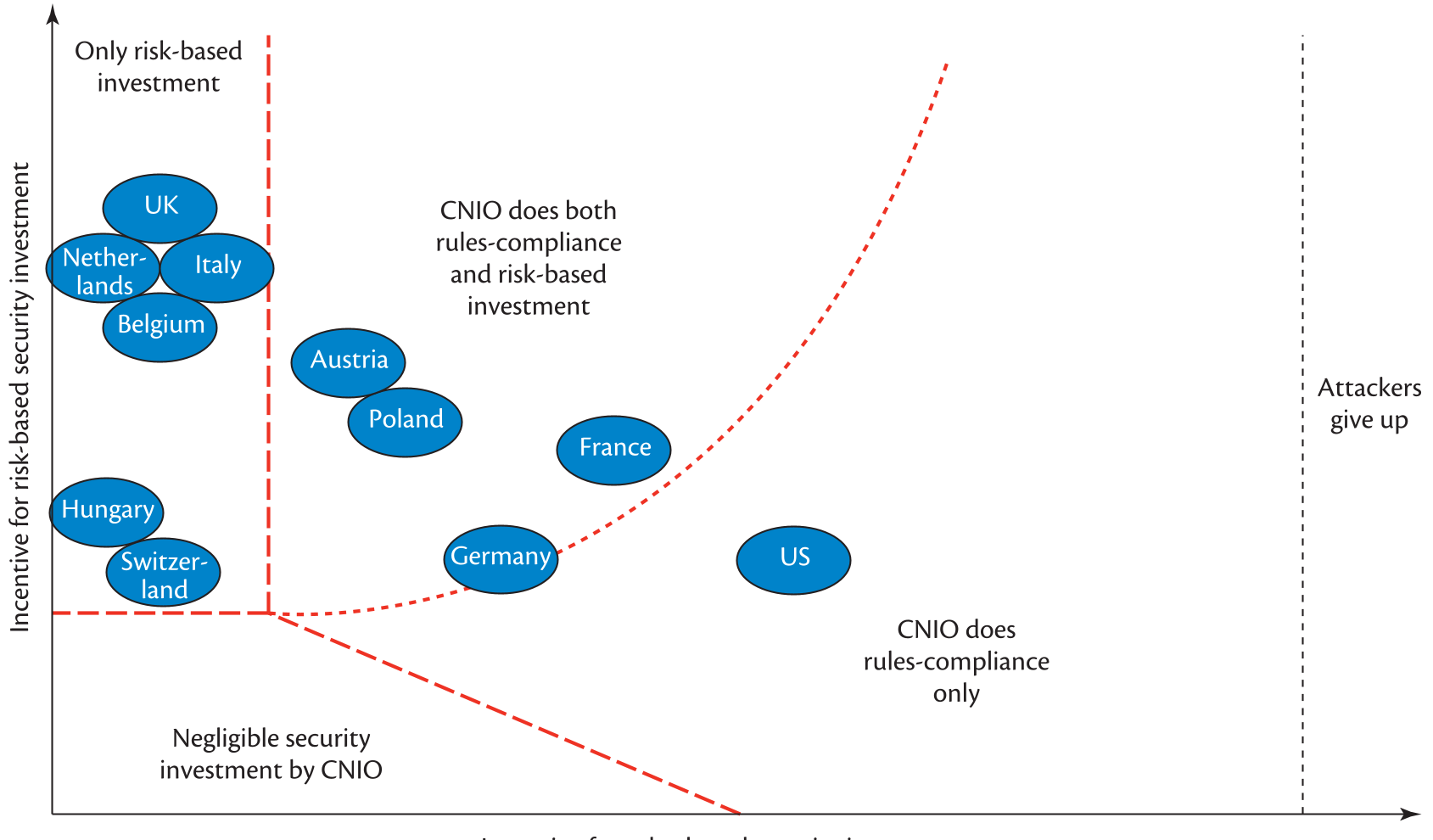 Figure 1: The phase diagram showing regions of behavior (No Action, Compliance Only, and Risk-Based Mitigation).
Experiments & Results: The Unintended Consequences
The most striking finding is the Phase Transition. Looking at Figure 1a and 1b:
- The Compliance Trap: If a regulator adds more requirements (like moving from point 1 to point 4 in the diagram), they expect to move closer to the "No Attack" zone. However, if the firm hits a budget constraint (the blue line in 1b), the firm might jump from a healthy mix of security to a "Compliance Only" state (Zone 6).
- Externalities: Since different countries have different maturity levels, a "one-size-fits-all" European directive (like the NIS Directive) might help less mature countries but stifle innovation in more mature ones like the UK.
 Table 1: Historical context of attacks (Stuxnet, BlackEnergy) used to calibrate the model's threat parameters.
Critical Analysis & Conclusion
The paper provides a sobering warning for policymakers: Assurance is not Security. If a regulator values assurance (having proof that rules were followed) more than the absence of incidents, they will naturally gravitate toward rules-based systems. However, this creates a "check-box" culture.
The Key Takeaway: The most effective regulatory regime is a Hybrid Maturity Model.
- Low Maturity Firms: Need strict, rules-based checklists to establish a baseline.
- High Maturity Firms: Should be allowed to innovate under a risk-based framework, focusing on the outcome (resilience) rather than the process (compliance).
Future work must address the "Information Asymmetry"—the fact that operators usually know more about their vulnerabilities than regulators ever will.