
Monetizing the Social Edge: Economic Incentives for Local-Aware ICN
Economic incentives for deploying local-aware ICN-based content delivery
This paper proposes a "Local-aware ICN-based Content Delivery" framework primarily for Online Social Networks (OSNs). It introduces a name-based routing scheme that leverages social graph data to cache and route content locally within ISP boundaries, significantly reducing transit costs and improving performance.
TL;DR
Information Centric Networking (ICN) has long promised a more efficient Internet, but its adoption has been stalled by a lack of clear business cases. In this paper, researchers from Orange Labs propose an evolutionary business model and a technical framework—NDN for OSN Delivery (NoD). By leveraging social graph locality, the system routes content requests directly between local neighbors or from local ISP caches, slashing transit costs and rewarding ISPs for being content-aware.
The "Conversational" Burden of Content
The fundamental mismatch in today's Internet is that we use a conversation-based architecture (IP) to serve content-centric demands. When Joe's local followers on Twitter request a video he just uploaded, those requests often travel all the way to a centralized data center and back through expensive transit links—even if the followers are in the same neighborhood.
Current Content Delivery Networks (CDNs) solve part of this, but they are often external entities that create complex billing relationships for ISPs. The authors argue that ISPs should evolve through four business stages: starting with ICN for their own internal services and eventually becoming full-scale ICN Service Providers.
Methodology: Social-Aware Routing (NoD)
The core of the proposal is the NoD (NDN for OSN Delivery) framework. It bridges the gap between the application layer (Social Graph) and the network layer (Routing).
1. The Architecture
The system utilizes a centralized NDN controller that talks to OSN servers to understand who follows whom. It then pushes routing updates to NDN-capable routers using SDN interfaces (like OpenFlow).
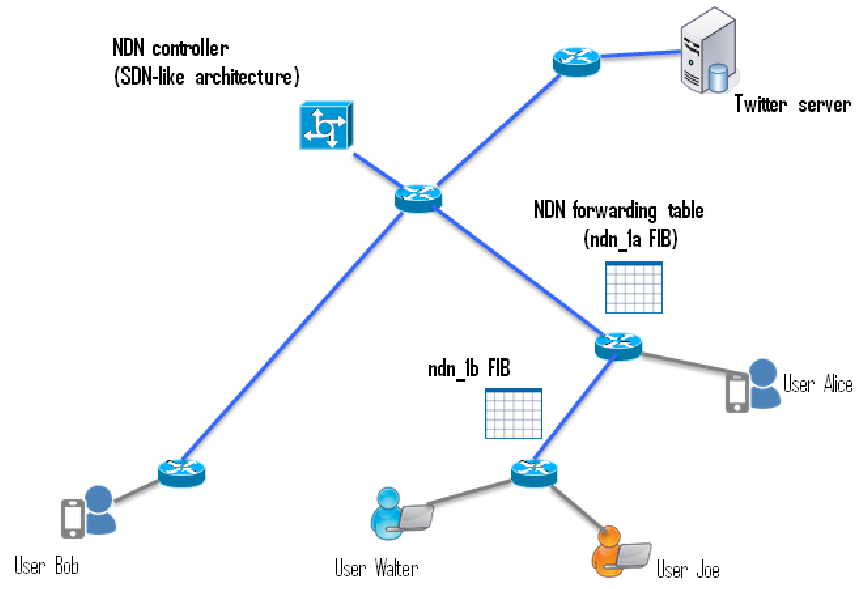
2. Local-Aware Retrieval
- Hierarchical Naming: Content is named as
/OSNapp/UserID/contentID. - The Hops Rule: If a follower (Alice) is within 2 hops of the source (Joe), the controller ensures her "Interest" packet is routed directly to Joe’s device or a local router cache.
- Fallback: If the user is non-local (Bob), the request defaults to the standard
/OSNappprefix, reaching the origin server.
Economic Incentives: The Stakeholder Win-Win
The paper provides a rigorous quantitative model to prove that this isn't just a technical curiosity but a financial necessity.
For the OSN Provider
By serving local traffic through ISP-localized ICN, the OSN provider reduces the load on its origin servers and cuts the "cache miss" fees paid to transit providers. The formula accounts for processing costs () and transit fees (), showing a linear reduction as the locality ratio () increases.
For the Access ISP
The ISP traditionally pays for transit to fetch content for its "eyeballs." With NoD, they keep traffic "in-house."

As shown in the contour plots above, the "Dark Zone" represents the highest benefit for the ISP. This occurs when both:
- Content Popularity () is high (allowing for effective caching).
- Locality () is high (allowing for direct neighbor-to-neighbor delivery).
Critical Insight & Vision
The brilliance of this work lies in the evolutionary path (Business Models 1 through 4). It acknowledges that a "clean slate" ICN deployment is a fantasy. Instead, the authors suggest a pragmatic shift:
- Phase 1: ISP uses ICN for internal IPTV/VoD.
- Phase 2: Transparent caching for external content.
- Phase 3: Formal contracting with OSN providers like Twitter/Facebook to act as their local delivery arm.
Limitations
While the economic model is sound, the paper assumes OSN providers are willing to share their sensitive "Social Graph" data with ISPs. This metadata is often the "crown jewel" of social platforms, and privacy or competitive concerns might limit the "Interface between NDN controller and OSN server."
Conclusion
This study serves as a bridge between high-level networking theory and the pragmatic reality of telecommunications. By proving that locality is the key to profitability, Truong and Mathieu provide a compelling roadmap for the next generation of content delivery.