
Scaling Robustness: Efficient EMPC for Sparse Storage Networks
Economic model predictive control for robust optimal operation of sparse storage networks
The paper proposes a Tube-based Robust Economic Model Predictive Control (TREMPC) framework tailored for large-scale, sparse linear storage networks. It introduces a novel projection-based constraint tightening algorithm that maintains recursive feasibility and stability under bounded disturbances while significantly reducing computational complexity for high-dimensional systems.
TL;DR
Controlling large storage networks (like power grids or supply chains) requires a delicate balance between economic efficiency and operational robustness. Standard Economic Model Predictive Control (EMPC) often breaks down under real-world noise. This paper introduces a projection-based Tube REMPC that exploits network sparsity to make robust control computationally feasible for high-dimensional systems, providing rigorous guarantees of stability and feasibility where nominal models fail.
Problem: The Fragility of Efficiency
In the world of supply chains and water networks, inventory levels are managed to minimize costs. While Nominal EMPC is Great at squeezing out every cent of profit, it is dangerously fragile. A small spike in demand can cause a "feasibility crash" where the controller simply cannot find a valid solution within its hard constraints.
Traditional Robust MPC tries to fix this by creating a "buffer" (a tube) around the planned path. However, calculating this buffer for a system with hundreds of states involves high-dimensional geometry (Minkowski additions of polytopes) that is NP-hard. For a complex supply chain, your computer would run out of memory long before it finished the calculation.
Methodology: The Power of Sparsity and Projection
The authors' core insight is that while a network might have 1,000 states, any single constraint (like the capacity of one warehouse) usually only depends on a handful of variables.
1. Exploiting Sparsity
Most storage networks are "sparse"—a warehouse in Austin doesn't directly affect the local inventory of a retail shop in Berlin in a single time step. The system matrices and are full of zeros.
2. Projection-Based Tightening
Instead of calculating a massive, high-dimensional uncertainty set, the authors project the global uncertainty onto the local subspaces where the constraints actually live.
- The Logic: Why calculate a 200-dimensional "tube" if you're only worried about a 1D capacity limit?
- The Result: Complex set arithmetic is replaced by efficient, low-dimensional operations.
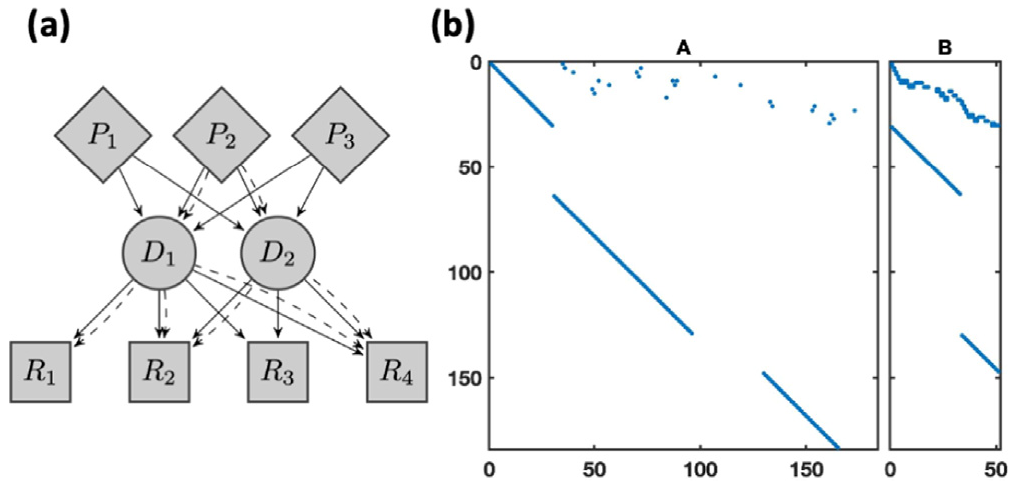 Above: The multi-echelon supply chain and the highly sparse A and B matrices that make this projection method possible.
Experiments: Robustness in Action
The authors tested their framework on a multi-product supply chain with 183 states and 51 inputs.
- Feasibility: Nominal EMPC failed (became infeasible) in 78 out of 100 simulations. The proposed Robust EMPC remained 100% feasible.
- Performance: The robust controller naturally converged to a "robust steady state"—essentially an optimal safety stock level that is calculated mathematically rather than guessed by heuristics.
- Bullwhip Mitigation: One of the most striking results is the reduction of the "bullwhip effect." The Robust EMPC reduced order variability at the producer level by 25% compared to NEMPC, leading to much smoother manufacturing schedules.
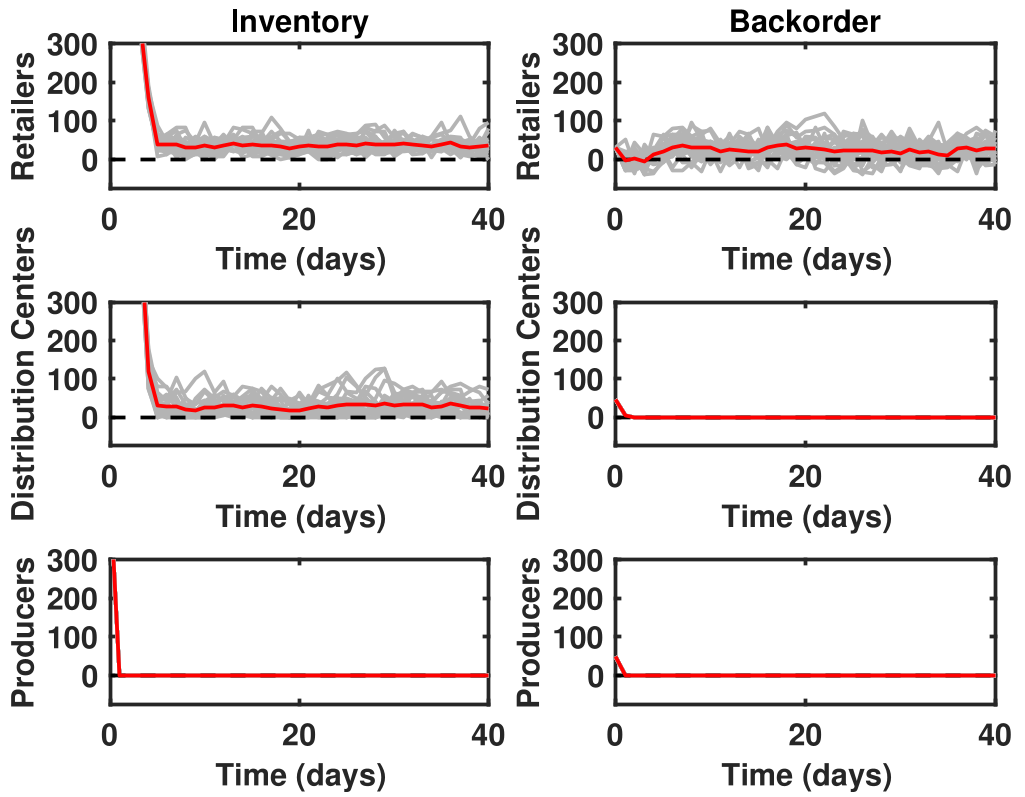 Figure: Comparison showing how nominal EMPC trajectories (gray) often drift or fail, whereas the robust approach maintains stable, feasible operation.
Critical Analysis
Why this works
The beauty of this paper lies in the bridge between Control Theory and Network Topology. By acknowledging that "not everything is connected to everything," the authors take a theoretically sound but practically impossible method (Tube MPC) and make it an industrial-strength tool.
Limitations
- Centralization: The model assumes a "centralized" controller. In real-world global supply chains, different companies might not want to share all their internal inventory data.
- Linearity: The current framework relies on linear dynamics. While many storage systems are linear (mass balance), expanding this to non-linear flow dynamics (like water pressure) remains a challenge.
Conclusion
This work provides a blueprint for deploying robust, economically optimal controllers in large-scale infrastructure. By leveraging sparsity, we no longer have to choose between a controller that is "fast but fragile" or "robust but impossible to compute."