
Engineering Trust: The Hidden Economics of Feedback Systems
The Economics of Reputation and Feedback Systems in E-Commerce Marketplaces
This paper explores the economic foundations and practical challenges of reputation and feedback systems in e-commerce marketplaces. It introduces the "Effective Percent Positive" (EPP) metric to mitigate reporting bias and demonstrates how platform engineering and machine learning can enhance trust and buyer retention.
TL;DR
Online marketplaces like eBay and Airbnb rely on reputation systems to facilitate trade between strangers. However, these systems are often broken by "politeness bias" and fear of retaliation. This paper analyzes why feedback is often inflated and how a new metric—Effective Percent Positive (EPP)—along with machine learning, can uncover a seller's true quality and drive platform growth.
Background: The Digital Trust Game
At its heart, every anonymous e-commerce transaction is a Trust Game. In a one-off encounter, a rational seller has an incentive to take the money and run (or ship a sub-par product). Traditional game theory suggests that without the "shadow of the future," trade would collapse. Feedback systems transform these one-off encounters into repeated games, where a seller’s future profits depend on their current integrity.
The Problem: The Bias of Silence and Retaliation
If reputation systems work perfectly, why do almost all eBay sellers have a 99% positive rating? The paper identifies three critical "bugs" in modern feedback loops:
- Fear of Retaliation: In two-sided systems where sellers can also rate buyers, unhappy buyers fear a "revenge" negative rating, so they stay silent.
- Pro-social Bias: Leaving feedback provides a public good but costs the user time. Most users only bother if they are exceptionally happy or if the platform forces an incentive.
- The Sound of Silence: A lack of feedback is often a "polite" way of signaling a bad experience, yet most platforms treat "no feedback" as a neutral or non-event, which artificially inflates seller scores.
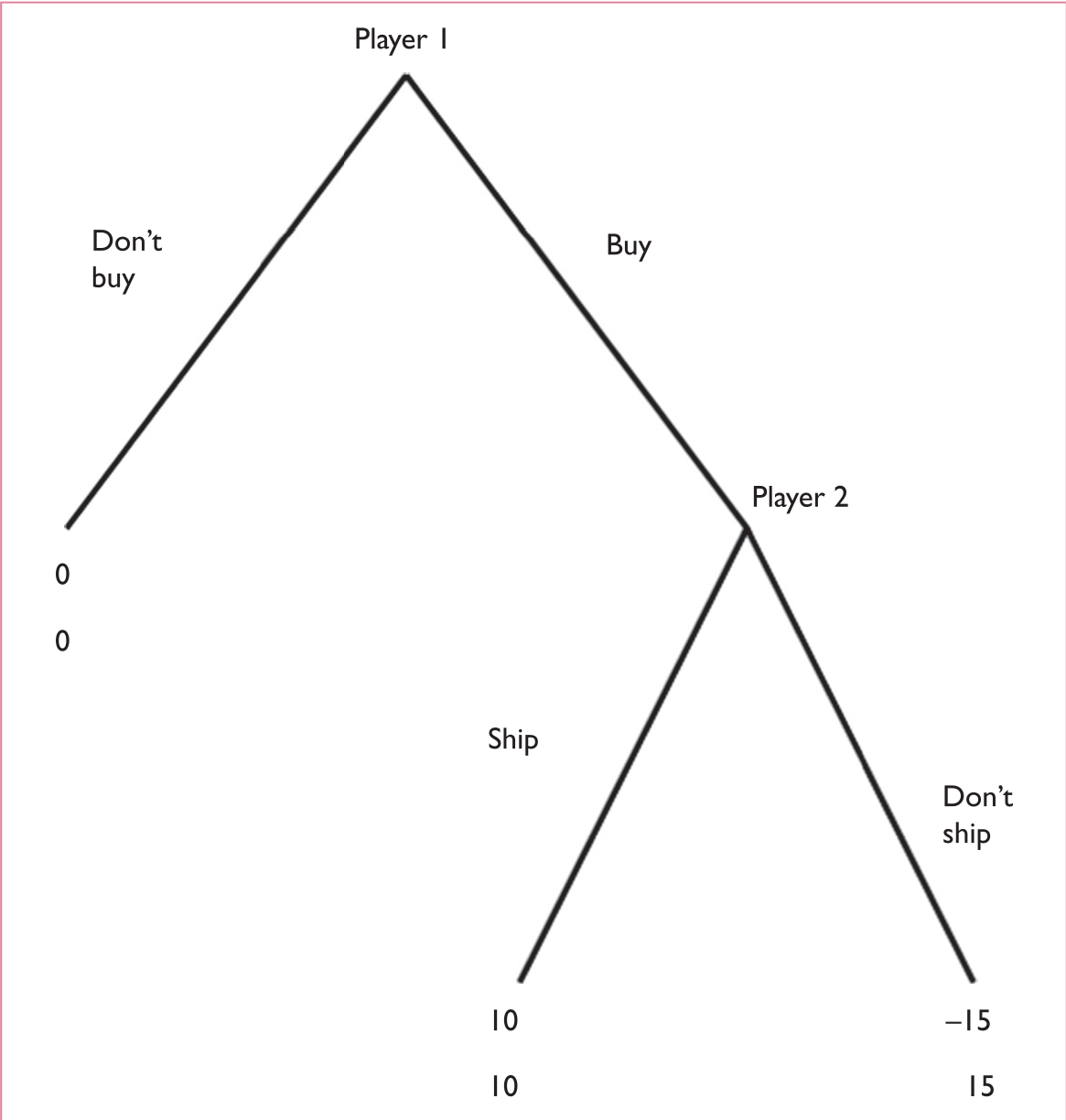 Figure 1: The Trust Game. Without reputation, the Subgame-Perfect Nash Equilibrium is "No Trade".
Methodology: From "Percent Positive" to "Effective Percent Positive"
The author critiques the standard "Percent Positive" (Positive / (Positive + Negative)) because it ignores the denominator of total transactions.
The EPP Metric
The proposed Effective Percent Positive (EPP) is calculated as: This simple shift treats "no feedback" as a potential signal of mediocrity.
Beyond Metrics: Mining Latent Data
The paper also highlights the "Canary in the Coal Mine" approach:
- NLP on Messages: Using text-mining on pre-transaction and post-transaction messages to detect frustration even when the buyer never leaves a formal review.
- Strategic Search Ranking: Rather than just showing ratings, the platform "engineers" the market by demoting sellers with low EPP or poor messaging sentiment in the search results.
Experimental Results: Does Better Data Drive Trade?
The effectiveness of the EPP metric was tested via a large-scale field experiment on eBay. By altering the search-ranking algorithm to favor sellers with high EPP, the researchers observed a significant increase in buyer retention.
 Figure 2: A typical eBay feedback profile. The paper argues that the "99.5%" score is often less informative than the underlying transaction volume and ratio.
Key findings:
- Standard Rating Mean: ~99% (Highly Skewed)
- EPP Mean: ~64% (High Variance, allowing for better differentiation)
- Outcome: Buyers exposed to high-EPP sellers were much more likely to return to eBay, proving that "silent" bad experiences are a major cause of platform churn.
Deep Insights: The Future of Reputation
The paper concludes that reputation is an externality. A single bad seller doesn't just lose their own future business; they "poison the well" for the entire platform.
Future Directions
- Cross-platform Reputation: The potential for using Blockchain technology to create a "Meta-Profile" that aggregates your trust score from Airbnb, eBay, and Uber.
- Information Display: Investigating whether showing a distribution of stars (like Amazon/Yelp) vs. a simple average (like Uber) leads to better consumer decision-making.
Conclusion
The "simple economics" of feedback has evolved into a complex engineering challenge. For the next generation of marketplaces, the winner won't just be the one with the most users, but the one with the most honest data. We must learn to listen to the "sound of silence" to truly understand the health of a digital ecosystem.