
Ecsy-Recsy: Decoding the Economics and Time Dynamics of Sybil Attacks
Ecsy-Recsy: Considering Sybil attack with time dynamics and economics in recommender system
This paper introduces Ecsy-Recsy, an anomaly detection scheme for Recommender Systems (RS) that incorporates attacker economics and time dynamics. By defining two novel metrics—"stickiness" and "persistence"—the authors achieve near-perfect Sybil attack detection (up to 100% accuracy) on real-world datasets like Rotten Tomatoes.
TL;DR
Ecsy-Recsy is a novel detection framework that catches "Sybils" (fake accounts) in recommender systems by treating them as economic actors. Instead of just looking at network structures, it monitors Stickiness and Persistence—metrics that measure how rating patterns "stick" to certain values and how they "persist" over time. On real-world movie data, it achieved a 100% detection rate against several common attack types.
Background: The Myth of the Infinite Attacker
In the world of academic security research, we often model attackers as "god-like" entities with infinite time and computing power. However, real-world nefarious actors operate on a budget. If it costs more to manipulate a movie's rating than the profit gained from that manipulation, the attacker will stop.
Furthermore, Recommender Systems (RS) are time-sensitive. A push attack on a movie that came out five years ago is useless; attackers target "fresh" items where honest user consensus hasn't yet stabilized. This paper bridges this gap by introducing Attacker Economics and Time Dynamics into the detection loop.
The Core Intuition: Stickiness and Persistence
The authors adapt two concepts from social network information diffusion to the RS domain:
- Stickiness: Measures concentration. If a specific rating score (e.g., "10/10") or a specific item suddenly accounts for a disproportionate ratio of the total weekly activity, the "stickiness" spikes, signaling a potential injection.
- Persistence: Measures the decay of rating patterns. Honest reviews usually follow a specific decay curve as interest fades. Sybil attacks interfere with this natural decay, making the influence of ratings "persist" longer than they naturally should.
Methodology: How Ecsy-Recsy Works
The system uses a sliding window (typically one week) to monitor these metrics. It calculates the mean () and standard deviation () of stickiness and persistence over four weeks. If the current week's metric falls outside the "normal region" (calculated as ), an alert is triggered.
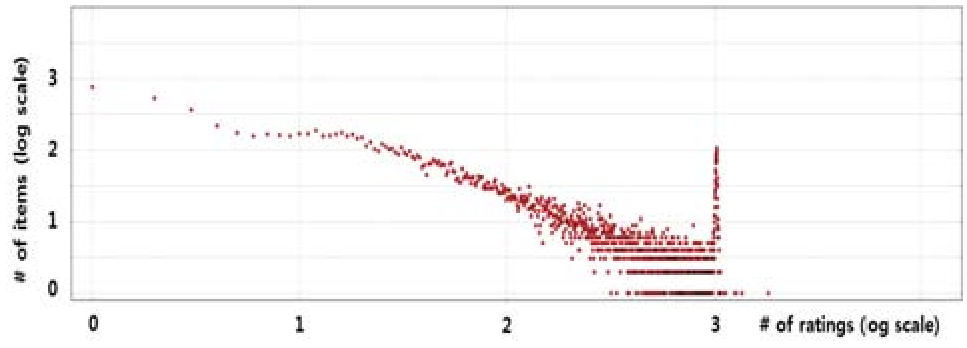 Figure 1: The long-tail distribution of ratings in the Rotten Tomatoes dataset. Most items have few ratings, creating a "clean" baseline that Sybil attacks easily disrupt.
Experimental Results: Near-Perfect Detection
The researchers crawled Rotten Tomatoes data spanning from 2006 to 2012, involving over 400k users. They simulated three attack scenarios:
- Naive Attack: Spammers give maximum scores to the target and all filler items.
- Random Attack: Spammers give maximum scores to the target and random scores to fillers.
- Average Attack: Spammers mimic the average rating of items to look more "human."
Key Findings
- Score Stickiness was the most effective for detecting Naive attacks (100% accuracy), as the influx of maximum scores is highly anomalous.
- Item Persistence proved to be the "silver bullet," achieving 100% accuracy across all attack types. This suggests that the way Sybils manipulate items fundamentally breaks the temporal "decay" signature of honest human behavior.
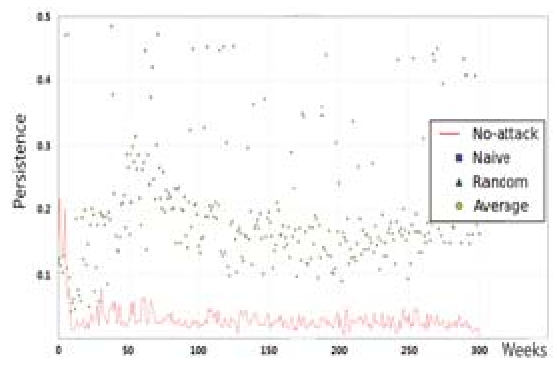 Figure 2: Visualizing Stickiness across Users, Items, and Scores. Note the clear separation in Score Stickiness (c) compared to the more volatile User Stickiness (a).
Critical Analysis & Conclusion
The genius of Ecsy-Recsy lies in its simplicity. By ignoring the complex (and often hidden) social graph and focusing on the outputs of the system—the ratings themselves—it creates a lightweight monitoring layer that is extremely difficult to subvert without the attacker spending significantly more resources.
Limitations: While effective, the method relies on a stable baseline. In "Black Swan" events (like a movie going viral unexpectedly), the system might trigger false positives. Future work should investigate how to distinguish between "organic viral growth" and "adversarial manipulation."
The Takeaway: Security is not just about building taller walls; it's about making the cost of climbing them too high. By leveraging time and economics, Ecsy-Recsy shifts the battlefield in favor of the defenders.