
The Physics of Distrust: Boosting Link Prediction with the Inverse Square Metric
Edge-centric multi-view network representation for link mining in signed social networks
The paper introduces the Inverse Square Metric (ISM), a novel edge representation method for multi-task link mining in signed social networks. It addresses sign, direction, and link prediction by measuring the interaction intensity between nodes as a function of their degrees and the square of their shortest path distance across 16 derived network views.
TL;DR
Signed social networks contain both positive (friend/trust) and negative (foe/distrust) links, yet most algorithms ignore the "dark matter" of negative interactions. This paper introduces the Inverse Square Metric (ISM), a physics-inspired approach that treats node interactions like gravitational forces. By analyzing 16 different "views" of a network, the authors achieved a massive 24.3% performance boost in predicting whether a connection will be friendly or hostile.
Background: Beyond "Friends of Friends"
In a standard social network, we assume Homophily: birds of a feather flock together. If A is friends with B, and B is friends with C, A and C are likely to connect. However, in signed networks (like Slashdot or Wikipedia elections), the logic "an enemy of my enemy is my friend" doesn't always hold. Negative links behave differently—they are sparse, non-transitive, and carry high-stakes information about social status and conflict.
The authors argue that existing theories (Balance and Status) are too focused on local triangles and ignore the global topological distance and node importance simultaneously.
Methodology: Gravity in a Social Vacuum
The core innovation is the Inverse Square Metric (ISM). Just as the force between two charges decreases as distance grows, the likelihood and "strength" of a social link are modeled as:
The 16-View Architecture
A single link in a signed, directed graph is complex. Node can have positive out-degrees, negative in-degrees, etc. The authors decompose the original graph into 16 derivative views. For example:
- View 1: Links between nodes based on Positive In-degree and Positive Out-degree.
- View 16: Links based on Negative In-degree and Negative In-degree.
By calculating the shortest path in each of these 16 specific sub-graph "universes," they create a 16-dimensional feature vector that captures the "multi-view" personality of every potential edge.
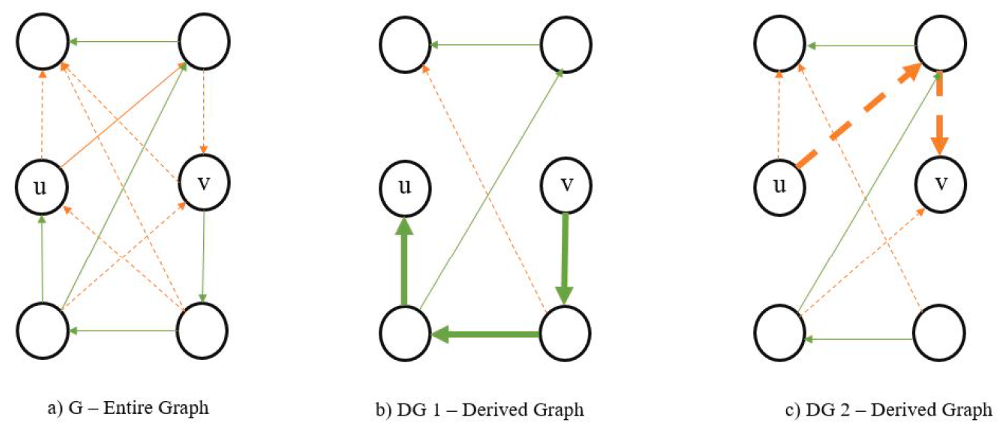 Figure 1: Extracting derived graph views from the original signed network to calculate specific ISM variants.
Experiments & Breakthrough Results
The authors tested their framework on six massive datasets, including Amazon, Epinions, and Wikipedia. They tackled four distinct tasks:
- Sign Prediction: Will the link be or ?
- Direction Prediction: Is the influence flowing from or ?
- Binary Link Prediction: Will a link form at all?
- Unified Prediction: Predicting both the existence and the sign simultaneously.
Performance Comparison
The results on balanced datasets were particularly striking. In the Wikipedia dataset, which is notorious for being difficult due to its electoral nature, the ISM metric outperformed standard Status Theory and Local Features by a staggering margin.
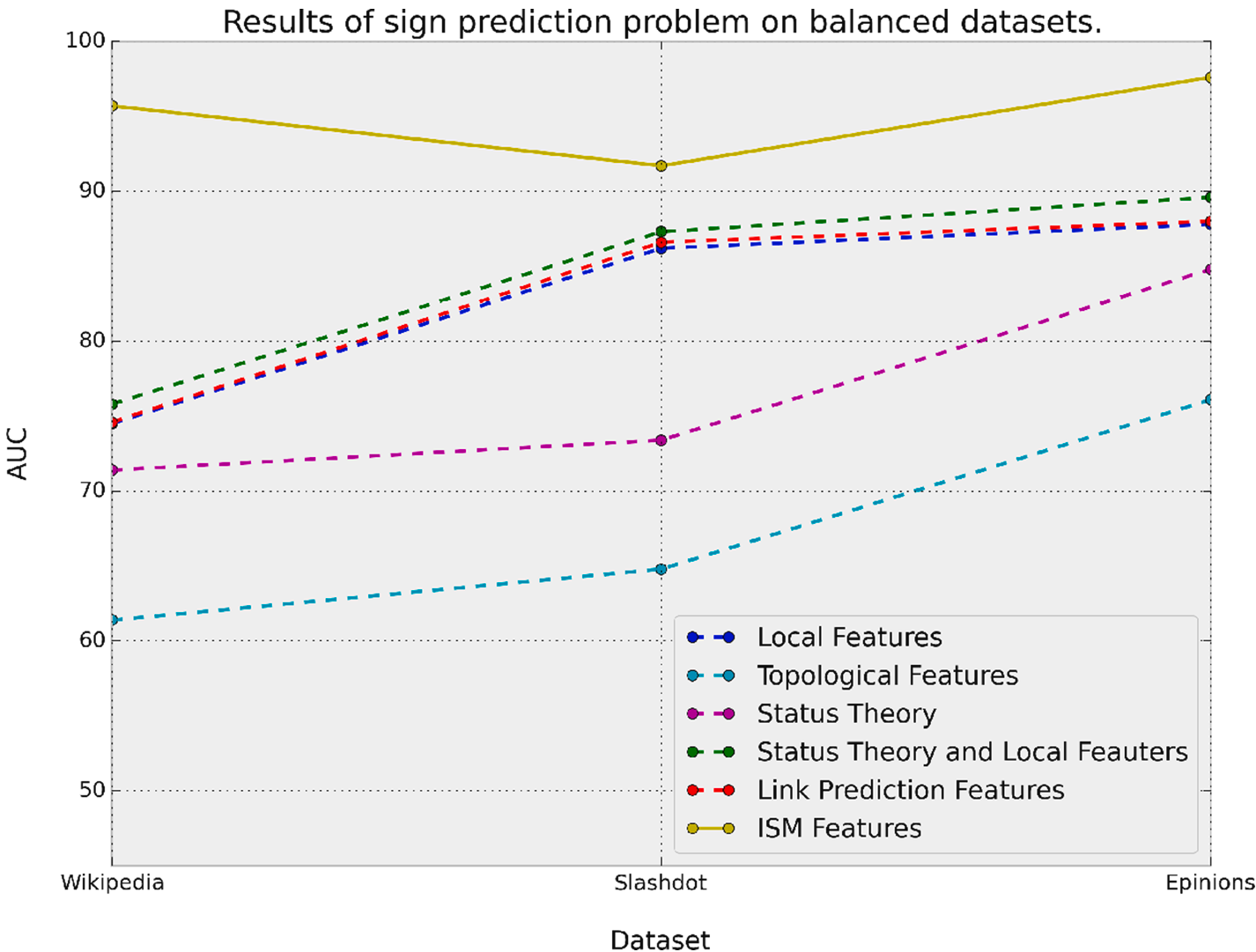 Figure 2: Performance (AUC) comparison for sign prediction. ISM (dark blue bar) consistently dominates across Epinions, Slashdot, and Wikipedia.
Why It Works: The Insight
The success of ISM lies in the penalty of distance. While previous methods only looked at common neighbors, ISM looks at the shortest path across 16 different types of social connectivity. This captures "bottlenecks" in the social structure. If two nodes are "far apart" in the "distrust network," they are unlikely to develop a negative link, even if they have high node degrees.
Deep Insight & Conclusion
This work shifts the paradigm of social network analysis from purely discrete "triadic closures" to a continuous field-based approach.
Takeaways for Practitioners:
- Negative Data is Gold: If your platform allows "dislikes" or "blocks," don't just use them for moderation. They are high-signal features for recommendation engines.
- Distance Matters: Shortest path algorithms, though computationally more expensive than neighbor counting, provide the necessary "global context" to understand link gravity.
Limitations: The computational cost of calculating shortest paths across 16 views for every node pair can be high for billion-scale graphs. Future work likely needs to explore Graph Neural Networks (GNNs) to approximate these ISM features more efficiently.
Main Reference: Ahmadalinezhad, M., & Makrehchi, M. (2020). Edge-centric multi-view network representation for link mining in signed social networks.