
Edge-Dual Graph: Solving the Sparseness Bottleneck in Signed Social Networks
Edge-Dual Graph Preserving Sign Prediction for Signed Social Networks
This paper introduces an Edge-Dual Graph Preserving model for sign prediction in signed social networks. By converting the original graph into an edge-dual graph, the task is transformed from edge sign prediction to node sign classification, utilizing an SVM classifier with Jaccard coefficient-based kernels to achieve SOTA performance.
TL;DR
Signed social networks (where links represent trust/distrust) are notoriously sparse, making it difficult to predict relationships accurately. This paper introduces a Graph Reconstruction approach that converts edges into nodes (an edge-dual graph), increasing the network density by up to 800% and boosting prediction accuracy by over 10%.
The Sparseness Trap in Signed Networks
Most social network analysis relies on "triads" (triangles of nodes) or similarity scores. However, real-world signed networks are scale-free; they follow a power-law distribution where a few "celebrities" have many links, but the vast majority of users are isolated or have 1-2 connections.
This "Data Sparseness" is a death sentence for traditional algorithms:
- Triad Theories: If a node doesn't belong to a triangle, Structural Balance Theory cannot predict its sign.
- Similarity Metrics: If two nodes share no common neighbors, metrics like Jaccard Coefficient or Adamic-Adar return zero, providing no signal for a classifier.
Methodology: The Edge-Dual Transformation
The researchers' "Aha!" moment was realizing that while nodes might be sparse, the connections between edges carry untapped structural information.
1. Graph Reconstruction
They transform the original graph into an edge-dual graph . In this new universe:
- Vertices: Every edge in the original graph becomes a node.
- Edges: If two edges in the original graph shared a vertex, they are now connected by an edge.
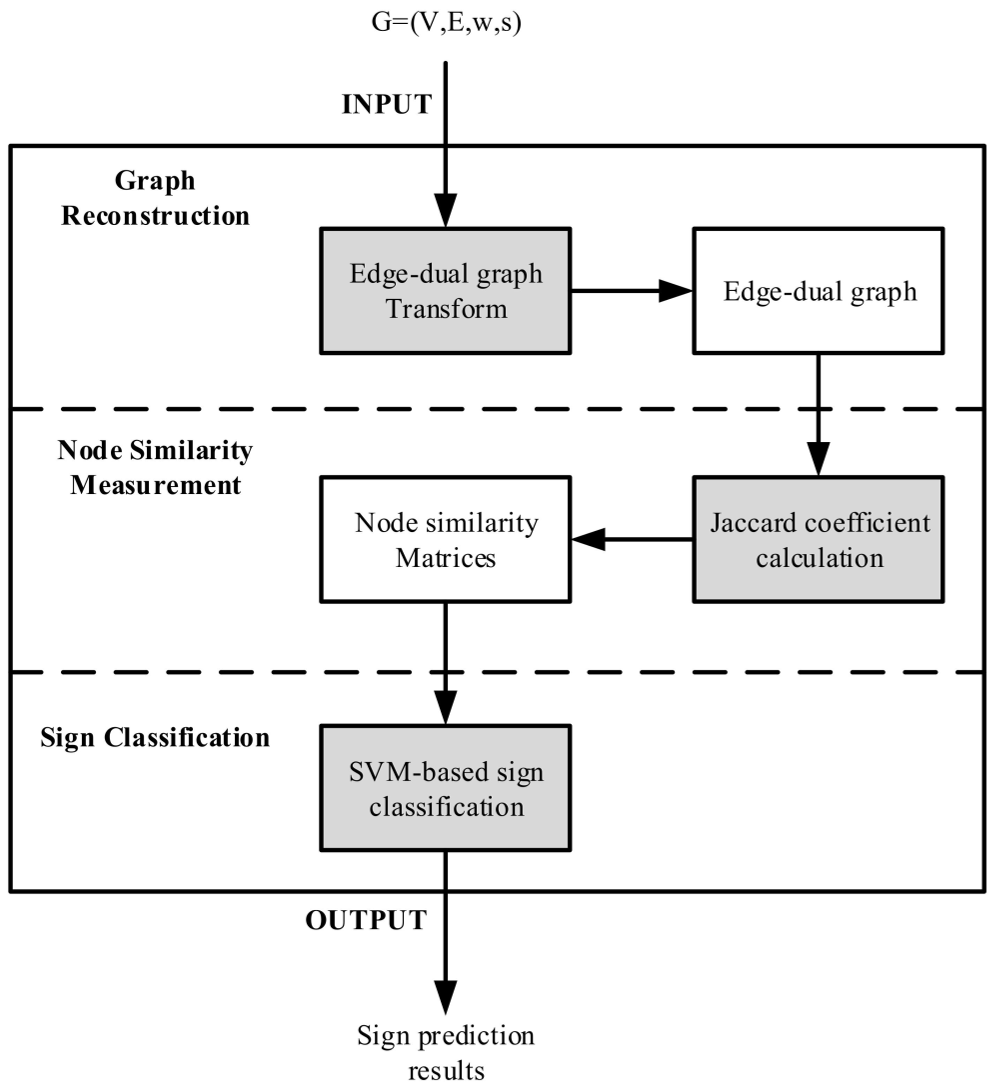 Figure 1: The proposed workflow—from original graph reconstruction to node classification in the dual space.
2. Mathematics of Sparseness Reduction
The paper mathematically proves that the average degree in the dual graph () is significantly higher than the original (). For a power-law graph, the improvement is proportional to the maximum degree , which is usually very large.
3. Classification via SVM
Once in the dual space, the problem becomes a binary node classification task (Positive vs. Negative). The authors use a Support Vector Machine (SVM) equipped with a kernel derived from the Jaccard Coefficient. They rigorously prove through Mercer's Theorem that this Jaccard-based function is a valid semi-definite kernel.
Experimental Validation
Using the Epinions dataset, the authors generated 10 sub-networks to test the model.
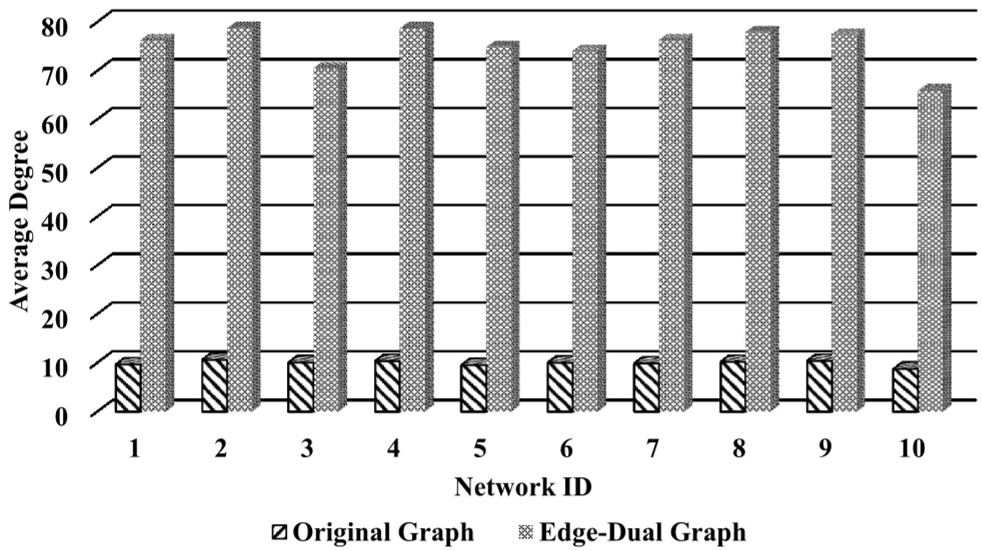 Figure 2: The dramatic increase in average degree (density) after dual conversion.
Key Findings:
- Density Boost: The average degree jumped from ~10 to nearly ~80.
- Accuracy: Prediction accuracy reached ~75%, a massive jump from the ~60% seen in traditional JC-based methods.
- Negative Link Prediction: This is the "hardest" part of the task. The proposed method improved the F1-score for negative links by up to 14%, proving that structural information is more critical for detecting distrust than trust.
Critical Insight
The brilliance of this work lies in its Inductive Bias. Instead of trying to find more data, it reframes the existing data to maximize the "surface area" available for feature extraction. By moving to the edge-dual space, the model creates more "synthetic" interactions that allow machine learning algorithms to find patterns that were previously invisible in the sparse original graph.
Conclusion
This paper provides a robust framework for dealing with sparse networks. While the current model focuses on the Jaccard Coefficient, the future of this research lies in embedding these dual graphs into Latent Spaces using Deep Learning (Graph Neural Networks) to further refine the nuances of human trust and distrust online.