
eDomus: Bridging the Gap Between Social Networks and Named Data Networking in Smart Homes
eDomus: User-home interactions through Facebook and Named Data Networking
The paper introduces eDomus, a smart home framework that combines Named Data Networking (NDN) and Facebook to facilitate user-home interactions. It leverages NDN for efficient content-centric sensing within the home network and a Facebook "SocialButler" for user-friendly remote access.
TL;DR
The eDomus framework redefines smart home interaction by replacing complex IP-based protocols with Named Data Networking (NDN) for local communication and Facebook as the remote interface. By turning the home gateway into a "Social Butler," users can monitor their homes via simple social media posts, bypassing the friction of dedicated apps and complex networking configurations.
Background & Motivation: Why IP is Often the Wrong Choice for IoT
In the traditional Internet of Things (IoT) landscape, the industry has pushed to bring the TCP/IP stack to every tiny sensor. This approach, while standardized, introduces significant overhead:
- Resource Constraints: Tiny sensors struggle with the memory and processing required for IP address management and maintenance.
- Naming Mismatch: Users want to know "What is the temperature?" (Content), not "What is the data at 192.168.1.5?" (Address).
- Complexity: Remote access usually requires VPNs, port forwarding, or heavy cloud proxies.
The authors argue that Named Data Networking (NDN) is a better fit because it addresses data by name, natively supports caching, and works efficiently over low-power links without the burden of global IP addresses.
Methodology: The "Social Butler" and the NDN Engine
The core of eDomus is the eButler—a gateway that acts as a dual-stack translator.
1. The Human Interface (Facebook)
The eButler manages a private Facebook profile. To interact with the home, the owner simply posts a comment like: "Measure the temperature in the living room." The gateway uses the Facebook Graph API to polling and parse these requests.
2. The Network Layer (NDN)
Once the request is received, the Parsing Manager converts the human request into a hierarchical NDN name: temperature/livingroom.
- The eButler broadcasts an Interest Packet with this name over the ZigBee network.
- The sensor (Constrained Device) recognizes the name, performs the sensing, and returns a Data Packet.
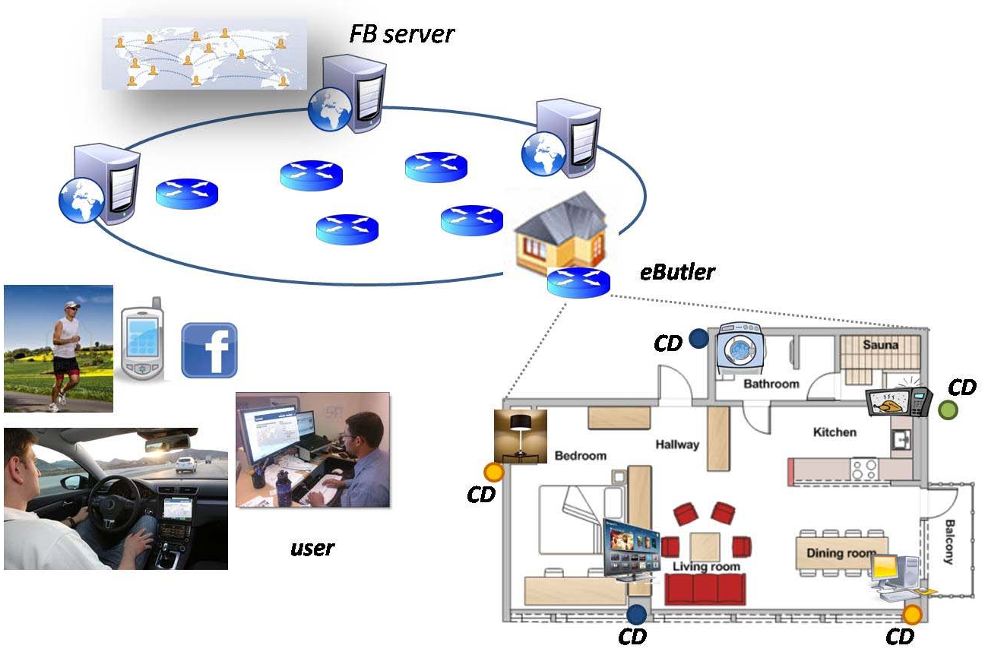 Fig 1: The architecture showing the flow from the Facebook Cloud to the local NDN WSN.
3. Implementation Details
The authors implemented the eButler on a Raspberry Pi running a custom lNDN (lightweight NDN) engine. The sensors were built using Arduino microcontrollers equipped with XBee (ZigBee) shields.
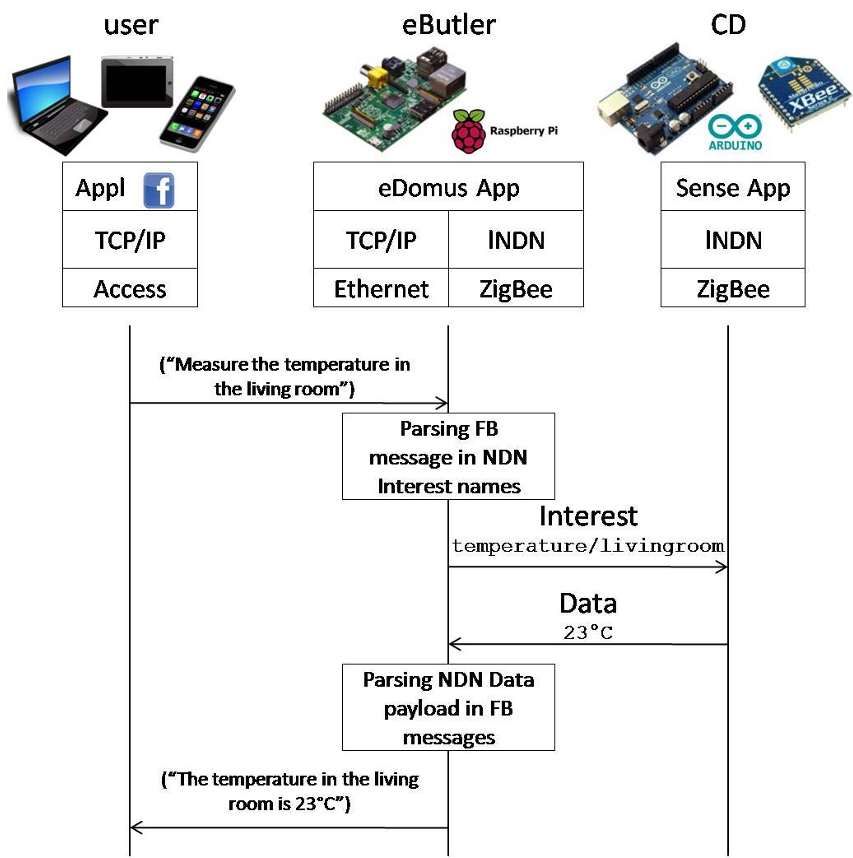 Fig 2: Protocol stacks illustrating the transition from TCP/IP (Ethernet) to lNDN (ZigBee).
Experiments & Results
The prototype confirms that the semantic mapping (translating Facebook posts to NDN names) is a viable way to hide technical complexity from the user.
- Retransmission Logic: Since NDN is receiver-driven, the eButler is responsible for retransmitting Interests if a sensor is sleeping or if there is packet loss, ensuring robustness in the unreliable wireless environment.
- Scalability: By using an XML-based dictionary for parsing, new devices and "human-to-name" rules can be added dynamically without rewriting the core networking code.
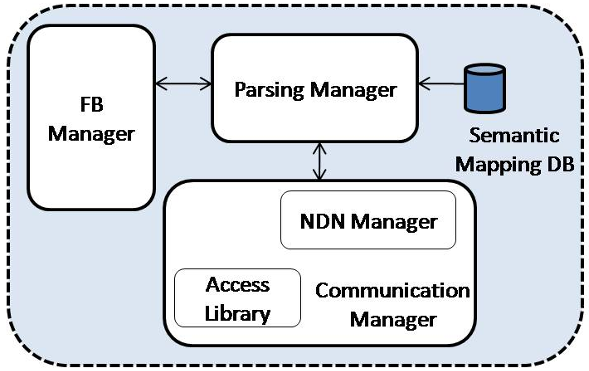 Fig 3: The internal software structure of the gateway, highlighting the FB Manager and Parsing Manager.
Critical Analysis & Conclusion
Takeaways
The brilliance of eDomus lies in its Inductive Bias toward human-centric naming. By leveraging existing social infrastructure (Facebook), the system inherits institutionalized security (Post permissions) and a UI that billions already understand. NDN provides the perfect technical backbone for this, as its naming structure is naturally hierarchical and readable.
Limitations & Future Work
- Latency: Relying on Facebook's API introduces latency (polling delays), making this unsuitable for real-time safety-critical systems (e.g., fire alarms).
- Privacy: While the posts are "Friends only," the data still resides on Facebook's servers, which might be a concern for privacy-conscious users.
- Actuation: Current work focuses on sensing. The authors propose extending this to Actuators (e.g., "Facebook-post to turn on A/C"), which introduces more complex security challenges.
In conclusion, eDomus proves that the "Internet of Things" can become a "Social Internet of Things," where the line between chatting with a friend and checking your home's humidity begins to blur.