
PredictED: Boosting Exam Performance through Automated Learning Analytics
Using Educational Analytics to Improve Test Performance
The paper presents "PredictED," an automated early-warning system that uses predictive learning analytics to forecast first-year University students' final exam performance. By applying Support Vector Machines (SVM) to Moodle Virtual Learning Environment (VLE) access logs, the system provides weekly personalized email interventions, achieving a significant improvement in final grades.
TL;DR
Researchers at Dublin City University developed PredictED, a system that mines student behavior on Moodle to predict final exam results. By sending automated, weekly "nudge" emails to students based on these predictions, they achieved a 2.67% average increase in grades, proving that early, automated intervention can significantly aid the transition into University life.
Background: The "First-Year Gap"
The jump from highly supervised secondary education to the independent environment of University is a known catalyst for academic failure. In large modules with hundreds of students, a lecturer cannot possibly know who is "falling through the cracks" until the first major assessment—which is often too late. PredictED aims to turn the Virtual Learning Environment (VLE) from a mere resource repository into a diagnostic tool.
The Core Insight: Behavior as a Signal
The authors hypothesized that how and when a student interacts with course material is as important as what they are looking at. Instead of relying on demographic data (which can be biased), they focused on behavioral features:
- Frequency: How many times resources were accessed.
- Intensity: Average time spent per session.
- Timing: The ratio of weekend vs. weekday study.
- Location: On-campus vs. off-campus access (determined via IP).
Methodology: Building the Early Warning System
The system utilizes a Support Vector Machine (SVM) classifier with a linear kernel. The technical brilliance lies in the Weekly Retraining approach:
- Periodicity Filtering: The team first analyzed five years of historical data to find modules with consistent annual patterns.
- Cumulative Classifiers: They trained 12 separate models (one for each week). Week 1 uses only 4 features; by Week 12, the model uses 48 features.
- Threshold Logic: Alerts were only sent once the model's ROC AUC (Area Under Curve) score consistently topped 0.5 (better than random), typically around Week 3 or 4.
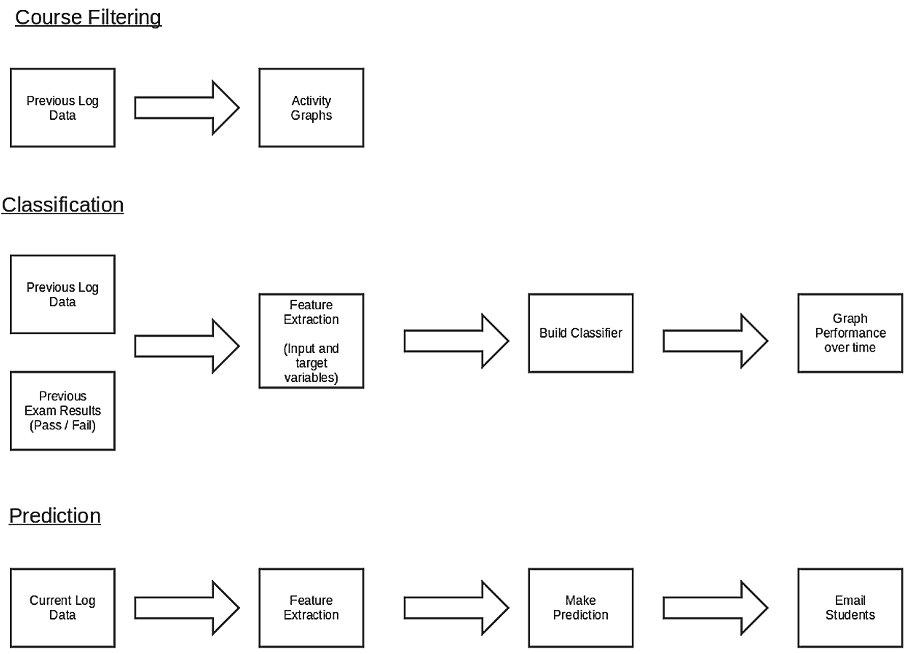 The three-stage process: Filtering modules, training historical models, and live intervention.
The Intervention: The Power of a Nudge
Of the 1,558 eligible students, 75% opted in to receive the alerts. Students were categorized into four groups based on prediction confidence: "Bad," "Poor," "Good," and "Great."
- Those predicted to struggle received emails with links to support services and study resources.
- High-performers received positive reinforcement to maintain their momentum.
Results and Impact
The results were striking. By comparing the entry profiles (using LC Mathematics and CAO points) of those who opted in versus those who opted out, the researchers confirmed there was no pre-existing academic advantage for the "opt-in" group.
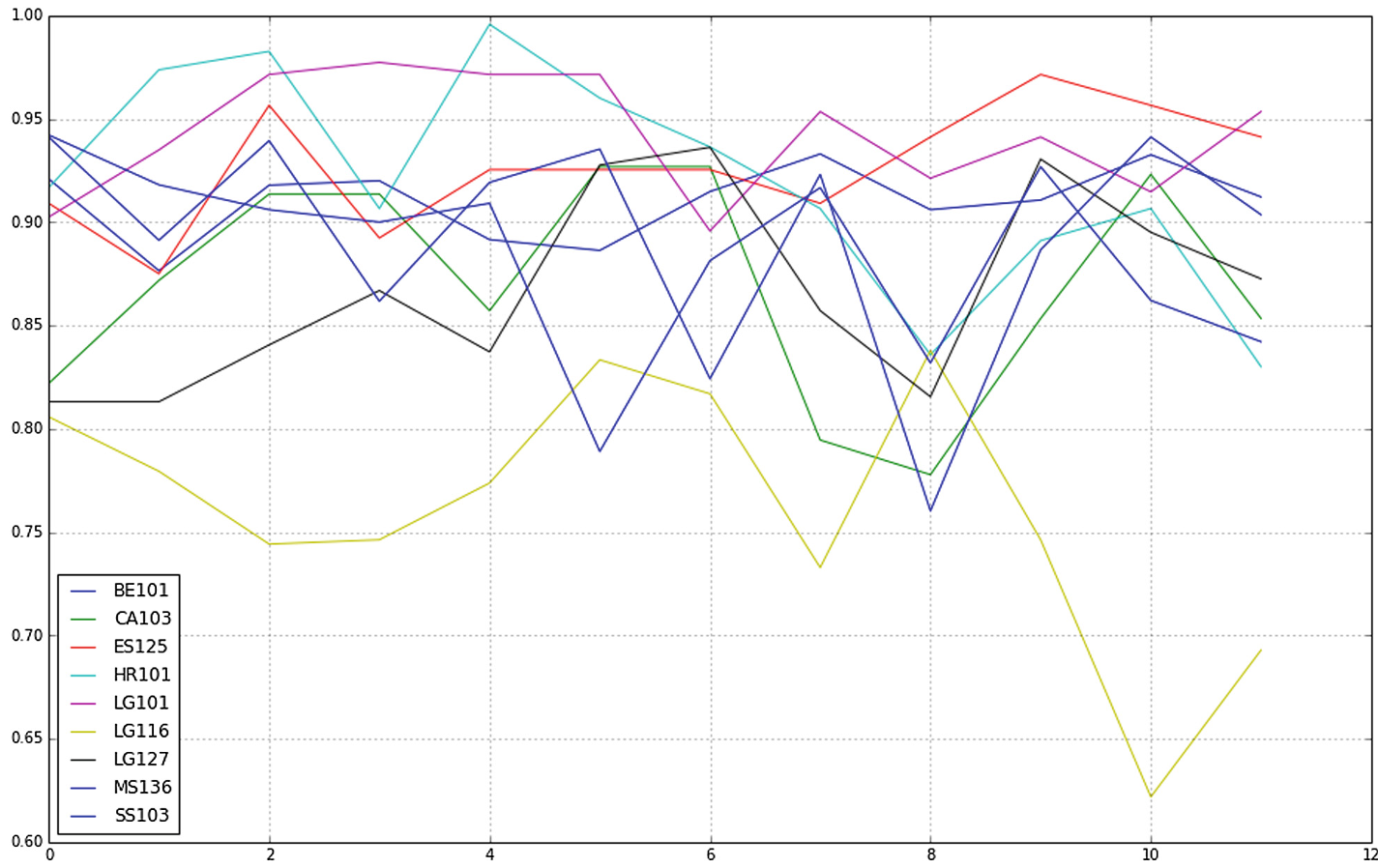 F1-scores remained high throughout the semester, validating the model's predictive power.
Key performance metrics included:
- Grade Increase: An average jump from 58.4% to 61.2% for participants.
- Subject-Specific Success: In the "Mathematics for Economics & Business" module, grades increased by nearly 9%.
- Consistency: 8 out of 10 modules saw performance improvements.
Critical Analysis & Conclusion
PredictED proves that we don't need "Big Brother" levels of surveillance to support students. Simple metadata from VLE logs is enough to identify "at-risk" students with high confidence weeks before an exam.
Limitations: The current model requires at least one year of historical data before it can be applied to a module, making it difficult to use for brand-new courses. Furthermore, the "opt-in" nature of the study introduces potential "motivation bias"—students who sign up might be naturally more inclined to act on the feedback.
Future Outlook: The next step for this technology lies in Generative AI integration, where the content of the intervention emails could be tailored even further to address specific student queries or provide customized study schedules based on exactly which resources they missed.