
Temperament as Fate? Predicting Academic Risk through Educational Data Mining
Educational Data Mining for Prediction of Academically Risky Students Depending on Their Temperament
This paper presents an Educational Data Mining (EDM) approach to predict "at-risk" first-year university students by integrating psychological temperament types (Jung/Eysenck typology) with academic performance data. Using Decision Trees and kNN methods, the study successfully classifies students into "Good", "Medium", and "Bad" risk categories, achieving 84% predictive accuracy.
TL;DR
Can a student's personality predict their likelihood of failing out of an IT program? Researchers at HSE-Nizhny Novgorod utilized Educational Data Mining (EDM) to prove that psychological temperament—ranging from "hot-tempered" Cholerics to "sensitive" Melancholics—significantly impacts academic success. By applying Decision Tree models, they reached an 84% accuracy in identifying "risky" students before they officially failed their exams.
Background: The 30% Dropout Dilemma
In highly selective IT programs, entry scores are rarely the problem. Students arrive with high Unified State Exam results, yet nearly 30% vanish after the first year. This research identifies a critical "blind spot": the social and psychological isolation of IT students (often introverts) who struggle to navigate the high-pressure environment of Mathematical Analysis and Linear Algebra.
The Core Insight: Mapping Mind to Mark
The authors moved beyond simple grade tracking. They hypothesized that temperament provides the foundational "Inductive Bias" for how a student handles stress and workload. Using the Eysenck Personality Questionnaire, they mapped students across two axes: Extraversion-Introversion and Stability-Instability.
The Four-Quadrant Personality Framework:
- Choleric: Energy-rich but potentially unstable; often show lower GPAs due to impulsivity.
- Sanguine: Hard-working and cheerful; lowest rate of retaken exams.
- Phlegmatic: Slow but persistent; high perseverance leads to higher marks.
- Melancholic: Deeply emotional and sensitive; highest risk of academic failure.
Methodology: Decision Trees vs. kNN
The researchers compared two primary machine learning architectures to classify students into three risk tiers: Good (Safe), Medium (At Margin), and Bad (High Risk).

- Stage 1: Feature Selection: Correlations revealed that "Perseverance" (0.19) and "Ability to Prioritize" (0.29) were the strongest predictors.
- Stage 2: Model Training: While kNN (k-Nearest Neighbors) reached 77% accuracy, it struggled with "noisy" psychological data.
- Stage 3: The Winner: The Decision Tree model achieved 84% accuracy by prioritizing specific trait combinations (e.g., Lack of Perseverance + Melancholic Temperament = High Risk).
Experimental Results & Validation
The model was put to the ultimate test: predicting the outcomes of 40 first-year students before the summer session.
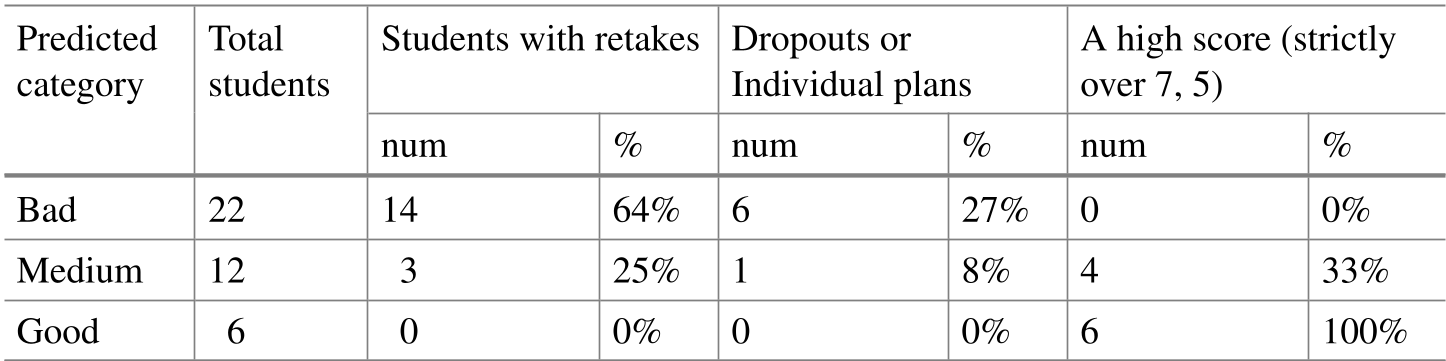
The results were striking:
- 64% of predicted "Bad" students faced actual retakes.
- 27% of that group dropped out or were placed on Individual Learning Plans.
- 0% of the predicted "Good" students had any academic debt.
Critical Insight: Why This Matters
The study concludes that "hot-tempered" Cholerics and "sensitive" Melancholics are structurally disadvantaged in traditional IT curricula. Cholerics may crash due to high-intensity bursts followed by burnout, while Melancholics may succumb to the pressure of failure (the "retake loop").
Recommendations for Educational Offices:
- Early Warning Systems: Implement surveys in October to flag "risky" profiles.
- Targeted Support: Provide additional tutoring exclusively for the "Bad" and "Medium" risk categories.
- Human-in-the-Loop: Educational offices should conduct personal interviews with predicted "Bad" category students before the first exam session.
Limitations & Future Work
The sample size (140 students) is relatively small for "Big Data." However, the high precision of the Decision Tree suggests that even with "Small Data," psychological features provide a powerful signal. Future research directions include applying Process Mining to see how these temperaments navigate the Learning Management System (LMS) in real-time.
Takeaway
Success in STEM isn't just about IQ; it's about the interaction between one's nervous system and the curriculum. By quantifying temperament, universities can transform from reactive "testing centers" into proactive "support ecosystems."