
Educational Services Recommendation: The Power of Social Topology
Educational Services Recommendation Using Social Network Approach
This paper proposes a social network-based framework for educational course recommendation. It introduces a collaborative filtering approach that discovers dense user groups through topological analysis and utilizes the Clique Percolation Method (CPM) to handle overlapping communities, achieving high predictive accuracy in a university enrollment system.
TL;DR
Researchers at the Wrocław University of Technology have developed a recommendation engine that predicts which university courses a student will take, not by looking at their grades, but by analyzing their social "cliques." By treating course enrollment as a social network problem and applying the Clique Percolation Method (CPM), the system achieved a remarkable 81% accuracy in predicting future enrollments.
Background: Beyond Static Profiles
In the world of academic administration, recommendation is often treated as a matching problem—matching a student's major and grades to a curriculum. However, the authors of this paper argue that students are inherently social actors. They don't just choose courses in a vacuum; they choose them because their friends are in the same class. This "social signal" is often stronger than any demographic attribute.
The Problem: The Overlap Challenge
Existing recommendation methods (like standard collaborative filtering) often ignore the "who-knows-who" factor. Furthermore, standard clustering algorithms assume a person belongs to exactly one group. In reality, a student might belong to a study group for math, a social group from a dorm, and a sports team simultaneously. Capturing these overlapping communities is the core technical challenge addressed here.
Methodology: Mapping the Student Network
The authors define the strength of a relationship between two students, and , based on how many courses they attend together.
If , the students behave identically. From this, they build a massive directed graph.
1. The Core Architecture
The system identifies "dense" groups using the Clique Percolation Method (CPM). A k-clique is a fully connected subgraph of k nodes. By finding chains of these cliques that share members, the researchers can identify stable, overlapping social structures.
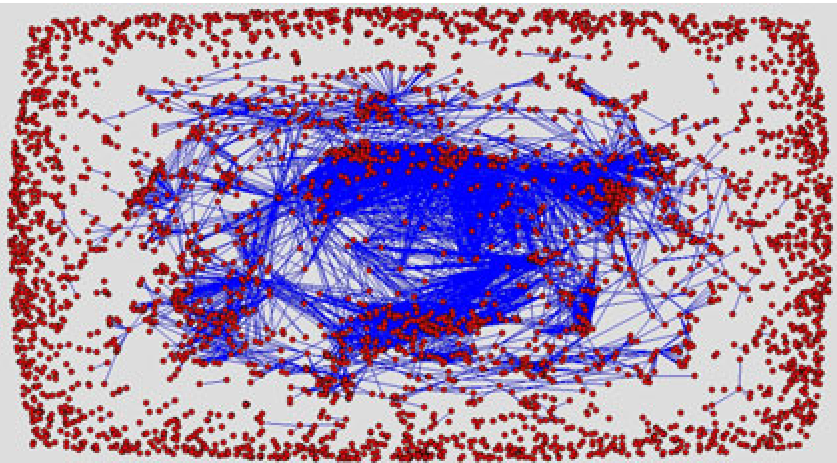 Figure 1: A sample student network where nodes are students and edges represent shared enrollments. Dense clusters represent stable social groups.
2. The Recommendation Algorithm
When a student needs a recommendation:
- The system identifies all social clusters the student belongs to.
- It selects the "densest" cluster (the one with the highest value).
- It recommends courses that other members of that cluster have already enrolled in for the upcoming semester.
Experimental Results: Stability and Accuracy
The authors analyzed data from the Edukacja.CL system, involving over 4,000 students. To prove the method's effectiveness, they measured the "autocorrelation" of clusters—essentially asking, "Do these groups stay together over time?"
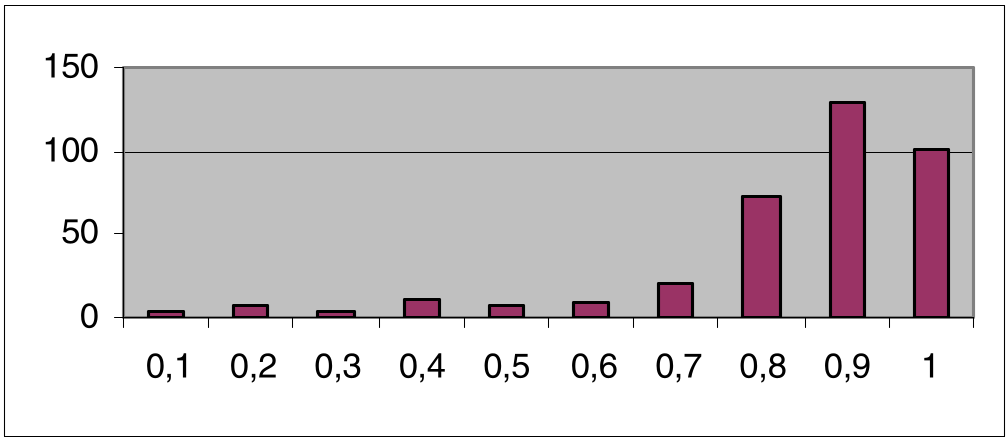 Figure 1 (from original text): Autocorrelation of detected clusters, showing high stability across semesters.
Key findings include:
- High Predictive Power: In 81% of cases, students actually chose the courses the system recommended based on their social ties.
- Cluster Density: The network contained clusters as large as 19 students who were all fully connected (all taking the same classes).
- Stability: Most clusters showed high overlap between consecutive semesters, confirming that student social groups are durable features of the university landscape.
Critical Insight & Conclusion
While most modern AI focuses on "content-based" features (like the syllabus a student might like), this work highlights that topology is signal. By focusing on the structure of interactions rather than the content of the profiles, the system bypasses the need for sensitive personal data while increasing accuracy.
Limitations: The primary challenge remains "isolated nodes"—students who don't have strong co-enrollment history. For these users, the authors suggest a hybrid approach combining this social method with classic content-based filtering.
This research serves as a precursor to modern Graph-based Recommender Systems, proving that even simple topological metrics can outperform complex demographic models when social influence is the primary driver of behavior.