
Deciphering the Mind: High-Precision Emotion Recognition for Next-Gen BCI
Investigation of EEG Signals for Emotion Recognition of People for Brain-Computer Interface
This paper presents a robust EEG-based emotion recognition system for Brain-Computer Interfaces (BCI) using the DEAP dataset. It proposes a classification framework that evaluates eight emotional states across four dimensions (Valence, Arousal, Dominance, Liking), achieving peak average accuracies of 99.84% and 99.53% for valence and arousal using a 1D Convolutional Neural Network (CNN).
TL;DR
Researchers have developed a highly accurate EEG-based emotion recognition framework achieving up to 99.84% accuracy on the DEAP dataset. By combining Wavelet-based preprocessing with a optimized 1D Convolutional Neural Network (CNN), the system can distinguish between eight nuanced emotions (joy, relax, sad, fear, sleepy, calm, happy, excited) across four psychological dimensions.
Academic Positioning: This work moves beyond traditional binary valence/arousal classification, setting a new benchmark for multi-dimensional emotional state detection in Brain-Computer Interface (BCI) environments.
The Motivation: Why is Emotion Detection so Hard?
Human-Machine Interaction (HMI) has long sought to understand the "hidden" state of the user. While facial expressions can be masked, EEG (Electroencephalogram) signals provide a direct, non-invasive window into the cerebral cortex. However, EEG data is notoriously "messy"—contaminated by eye blinks (EOG noise) and muscle movements.
Prior works (as shown in the literature review) often hovered between 50% and 80% accuracy. The authors identified two main gaps:
- Limited Dimensions: Most studies only look at Valence (pleasantness) and Arousal (intensity).
- Feature Inefficiency: Traditional linear classifiers cannot capture the non-linear, non-static temporal patterns of brain waves effectively.
Methodology: From Raw Waves to Emotional Insights
The proposed system follows a rigorous four-stage pipeline: Preprocessing → Feature Extraction → Dimensionality Reduction → Classification.
1. Preprocessing & The Alpha-Band Priority
The researchers focused on the 4 Hz to 45 Hz range. Utilizing the Second-order Daubechies Wavelet (DB4), they isolated the Alpha-band, which is physiologically linked to emotional realization.
2. The Architecture: 1D CNN
Unlike 2D CNNs used for images, the 1D CNN here is designed for sequential data analysis.
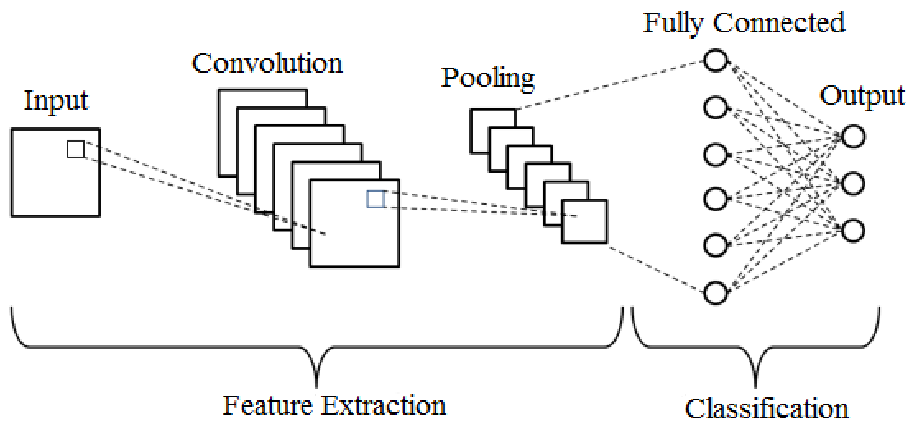 Fig 1: The structure of the CNN used to detect patterns across 32 EEG channels.
Key Design Choices:
- ReLU & ELU Activation: Used to accelerate convergence and avoid the "vanishing gradient" problem.
- Max-Pooling: Reduces dimensionality and prevents overfitting.
- Softmax Output: Classifies the final state into Valence, Arousal, Dominance, or Liking.
Experimental Results: Setting New Standards
The model was tested against several classic machine learning algorithms, including SVM, Random Forest (RF), KNN, and Naïve Bayes (NB).
Performance Comparison
The results were decisive. While KNN and Naïve Bayes struggled (accuracies below 50%), the CNN achieved near-perfect scores across all labels.
| Dimension | CNN Accuracy | SVM Accuracy | RF Accuracy |
|---|---|---|---|
| Valence | 99.84% | 98.06% | 98.98% |
| Arousal | 99.53% | 97.89% | 98.51% |
| Dominance | 96.88% | 98.13% | 98.20% |
| Liking | 98.61% | 98.28% | 98.28% |
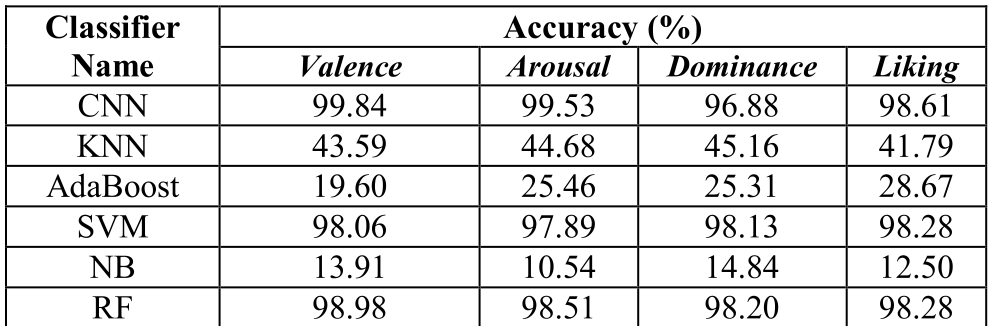 Table 1: Quantitative results showing the superiority of CNN in Valence and Arousal.
Comparative Analysis with Prior SOTA
When placed in the context of previous research (e.g., Li et al., 2016 or Tripathi et al., 2017), this work shows a massive leap. Most previous CNN implementations on the DEAP dataset peaked around 81.41%. The 99%+ accuracy reported here suggests that the specific combination of PCA-based feature refinement and 1D temporal convolution is highly effective for this signal type.
Critical Analysis & Future Outlook
Why is this effective?
The success stems from the temporal segmentation (dividing 60-second trials into 5-second batches) and the Wavelet-PCA combination. By reducing the feature space while retaining the joint time-frequency resolution, the CNN is fed "high-signal" data rather than raw, noisy sequences.
Limitations
The authors honestly note that the study utilizes the DEAP secondary dataset. Real-world BCI applications face "domain shift"—the difference between laboratory-recorded data and real-time, "in-the-wild" EEG.
Implementation Value
This methodology has profound implications for:
- Assistive Technology: Helping non-verbal or autistic individuals communicate their emotional needs.
- Mental Health: Real-time monitoring of depression or anxiety through emotional response patterns.
- Adaptive UX: Software that adjusts its interface based on the user's stress or "sleepy" state.
Conclusion
By reaching the 99% accuracy threshold, this research proves that EEG-based emotion recognition has moved from a "proof-of-concept" to a "production-ready" technology for the BCI environment. The 1D CNN remains a powerhouse for rhythmic biological signal processing.