
Beyond Labels: Uncovering Emotional Brain States with Unsupervised AMICA
Examining the Relationship between EEG Dynamics and Emotion Ratings during Video Watching using Adaptive Mixture Independent Component Analysis
This study utilizes Adaptive Mixture Independent Component Analysis (AMICA), an unsupervised learning framework, to decode emotional states from EEG data in the DEAP dataset. The researchers successfully identified distinct EEG patterns that correlate with subjective emotion ratings, achieving a significantly higher alignment with individual self-reports than with "objective" crowd-sourced labels.
TL;DR
Researchers from UCSD have shifted the paradigm of EEG emotion recognition from supervised "label-chasing" to unsupervised "state-discovery." By using Adaptive Mixture Independent Component Analysis (AMICA), they demonstrated that the brain's internal dynamics naturally cluster into distinct states that correlate with human emotion. The study finds that decentralized, data-driven models are better at capturing your personal feelings than the "average" consensus of a crowd.
Context: The Trouble with Labels
Most affective computing research treats EEG signals as a direct mapping to emotion labels (like "Happy" or "Sad"). However, the brain is never just emotional. While you watch a video, your EEG is a cocktail of:
- Sensory processing (visual and auditory stimuli).
- Internal states (fatigue, boredom, attention).
- Artifacts (eye blinks, muscle tension).
Supervised models often struggle because they force all these "confounding" signals into an emotion category. This study asks a different question: Can we let the data speak for itself and see if any of the discovered patterns happen to match how the person feels?
Methodology: The Power of AMICA
The core of this research is AMICA. Unlike standard ICA, which assumes the brain is a static source of signals, AMICA assumes the brain is non-stationary. It learns a mixture of multiple ICA models, where different models become "active" at different times.
The Workflow
- Decomposition: High-density EEG is broken down into a mixture of 2 to 5 distinct models.
- Model Probabilities: The algorithm calculates the likelihood of each model being active at any given moment (as seen in the probability time courses).
- Correlation: These probabilities are then compared against the subject's ratings of Valence and Arousal.
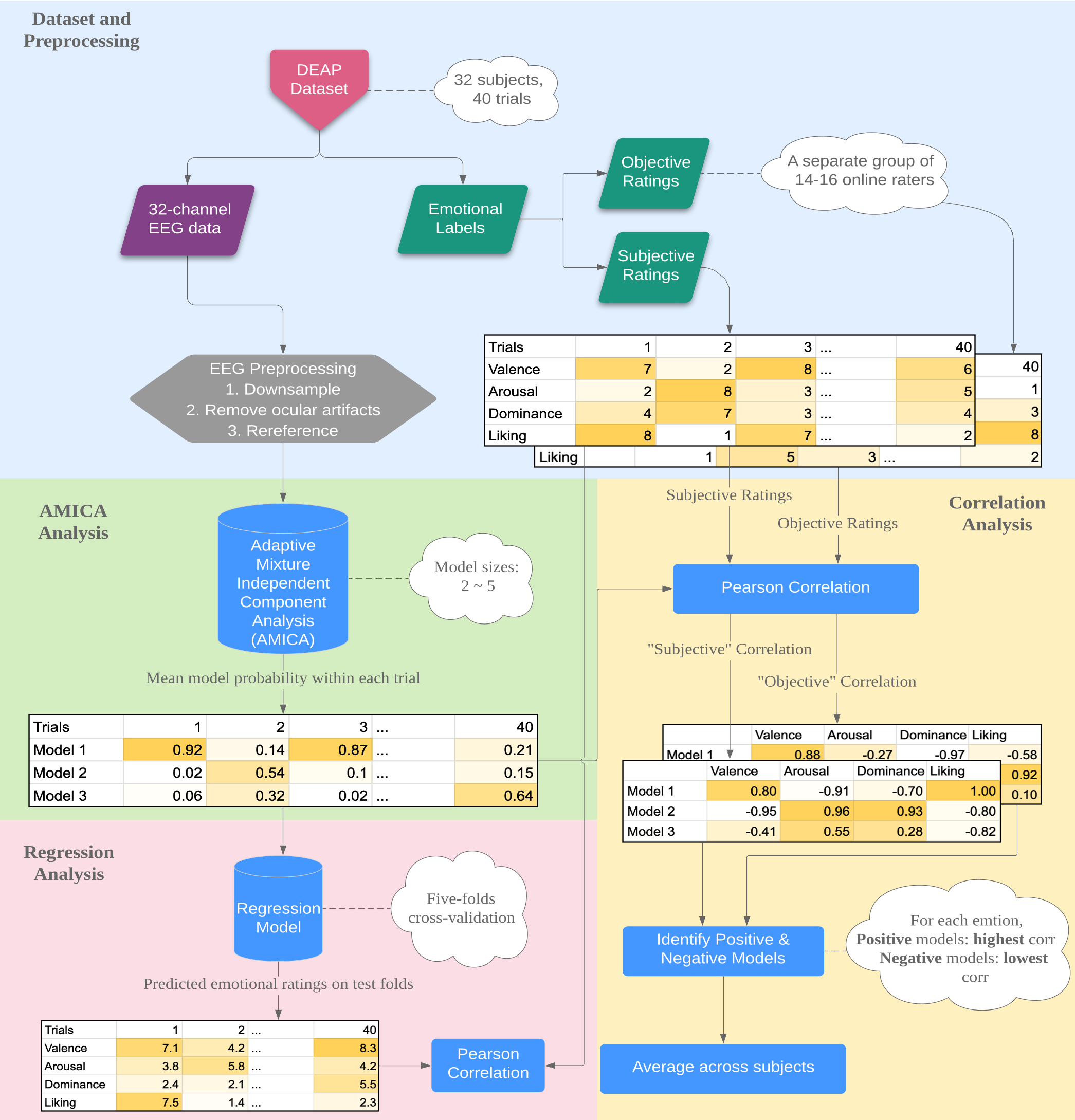 Fig 1: The architecture of the AMICA post-hoc analysis, transitioning from raw EEG to model likelihoods.
Key Insights: Valence vs. Arousal
One of the most striking findings is the visualization of model transitions. As shown in the experiment, certain ICA models "switch on" precisely during specific stimuli or trials, forming a "fingerprint" of the brain state.
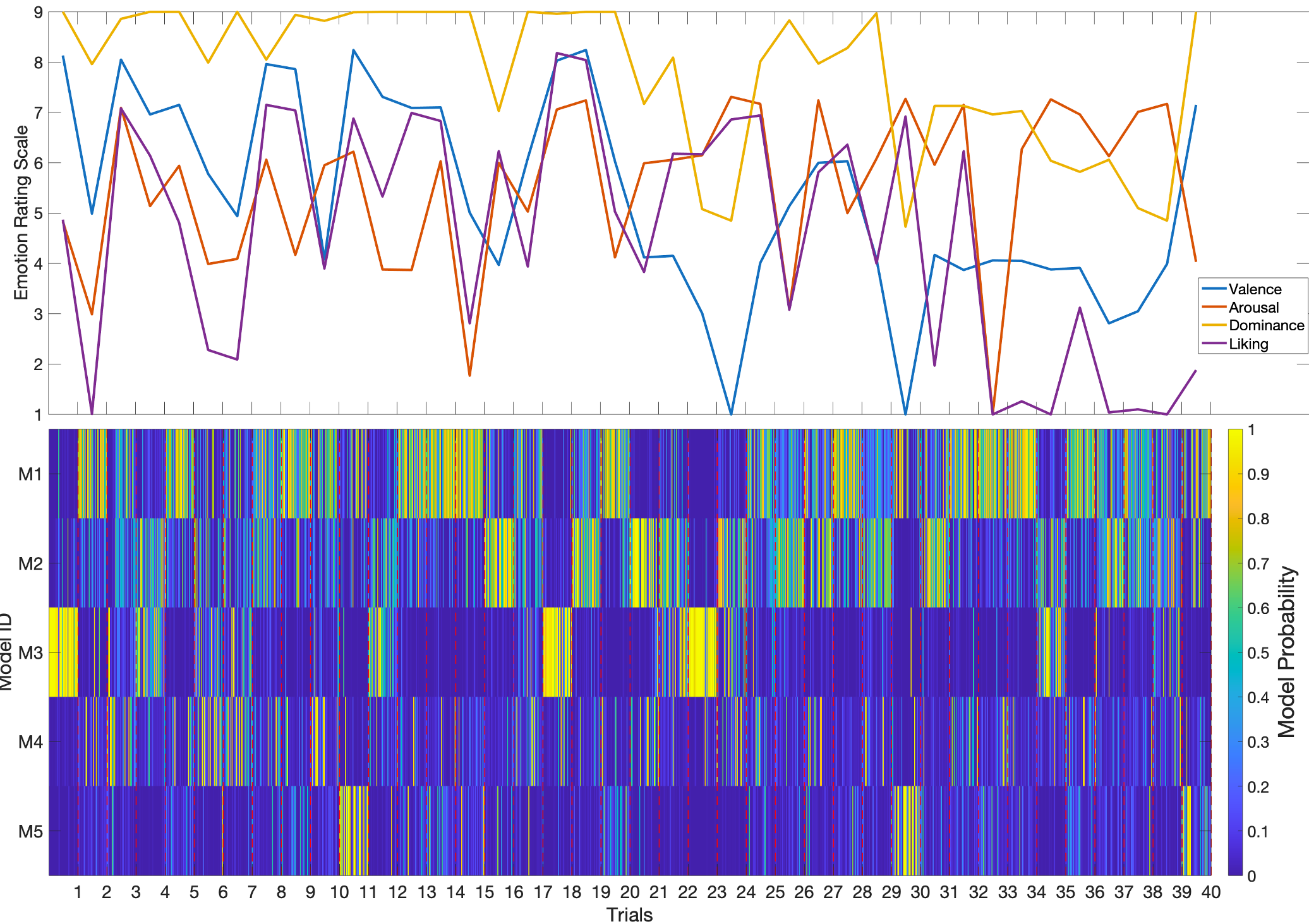 Fig 2: (Top) Subjective ratings over 40 trials. (Bottom) The color-coded "Model Probabilities" showing which AMICA model is dominant over time.
1. Subjective Over Objective
The study proved that EEG dynamics correlate significantly higher with subjective ratings (what the person actually felt) than with objective ratings (what a separate group of raters thought the video should make someone feel). This confirms that EEG is a highly personalized medium for emotion.
2. The Valence Advantage
The team built a regression model using the model probabilities as features. They found that Valence (pleasure/displeasure) was decoded with much higher accuracy than Arousal (calm/excited). This suggests that the brain's internal "switching" of states is more closely tied to how much we like or dislike a stimulus than how intense that stimulus is.
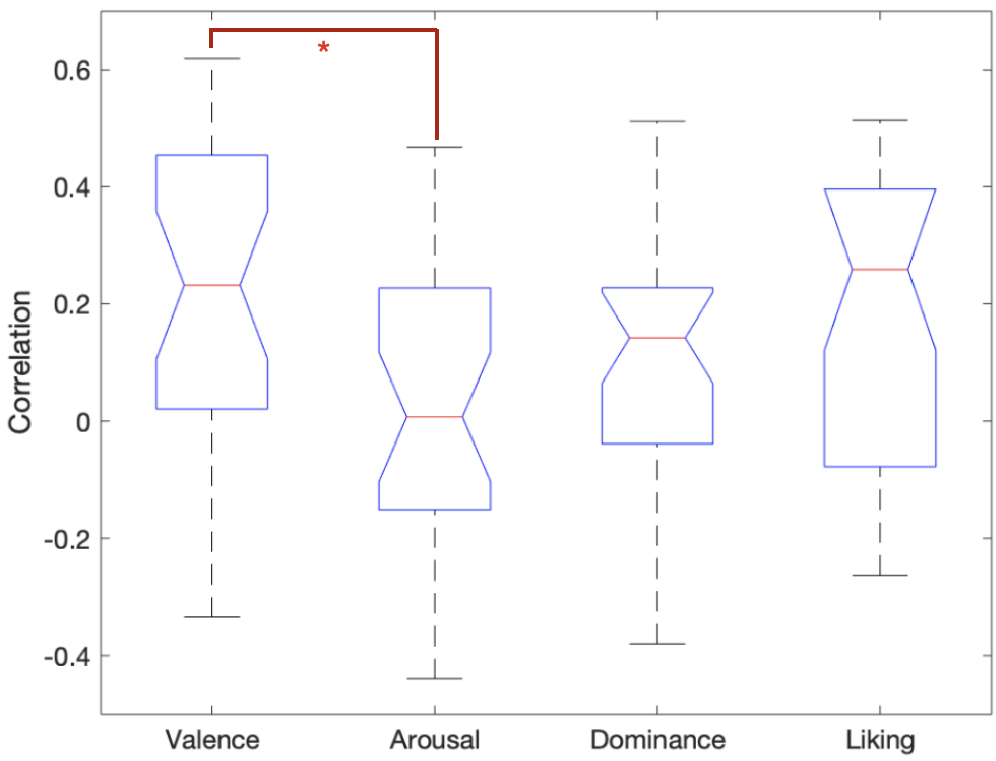 Fig 3: Decoding performance across different emotion scales, highlighting the superiority of Valence prediction.
Critical Analysis & Future Outlook
The "Weak Correlation" Reality Check: While the results are statistically significant, the correlations (0.18 - 0.28) remain "weak." This is not a failure of the model, but an honest scientific reflection: emotional activity is only a small subset of what the brain does during a one-minute video.
Limitations: The study uses global model probabilities. Future work could dive deeper into source localization—identifying exactly where in the brain these independent components are located (e.g., the frontal lobe for valence).
Conclusion: AMICA offers a powerful, "label-free" window into the mind. By separating emotion-relevant dynamics from background noise, we move one step closer to affective interfaces that truly understand the individual's unique internal experience.