
Beyond the Power Law: How Homophily Rewrites the Geometry of Social Networks
Effect of homophily on network formation
This paper introduces a modified preferential attachment model that integrates homophily—the tendency of individuals to associate with similar others—to explain the diverse curvatures of degree distributions in complex social networks. By combining traditional popularity-based linking with group-based similarity, the authors successfully reproduce linear, concave, and convex cumulative degree distributions in log-log scales, achieving SOTA theoretical alignment with empirical data from platforms like Yahoo and Wikipedia.
TL;DR
While the "Rich-Get-Richer" (preferential attachment) rule is the gold standard for explaining scale-free networks, it often fails to account for the curved tails seen in real-world data. This paper demonstrates that Homophily—our innate preference for similar peers—is the missing ingredient. By blending popularity with similarity, the researchers show how networks morph from concave to convex, revealing why some groups become disproportionately "richer" than the rest of the ecosystem.
The Missing Intuition in Network Theory
For decades, we’ve assumed that if you’re popular, you get more links (Preferential Attachment). This leads to a neat, linear power-law distribution on a log-log plot. However, empirical data from Yahoo advertising or Wikipedia discussion pages often show convex curves.
Existing models tried to fix this with "math hacks"—arbitrary exponents that lacked behavioral meaning. The authors of this study argue that the curvature isn't a mathematical glitch; it's a reflection of human nature. We don't just link to the most popular person; we link to the most popular person who is like us.
Methodology: Popularity Meets Similarity
The core contribution is a modified linking probability formula. It balances two forces:
- Preferential Attachment: A node's existing degree ().
- Homophily Index (): A probability weight that favors links between nodes sharing the same group attributes.
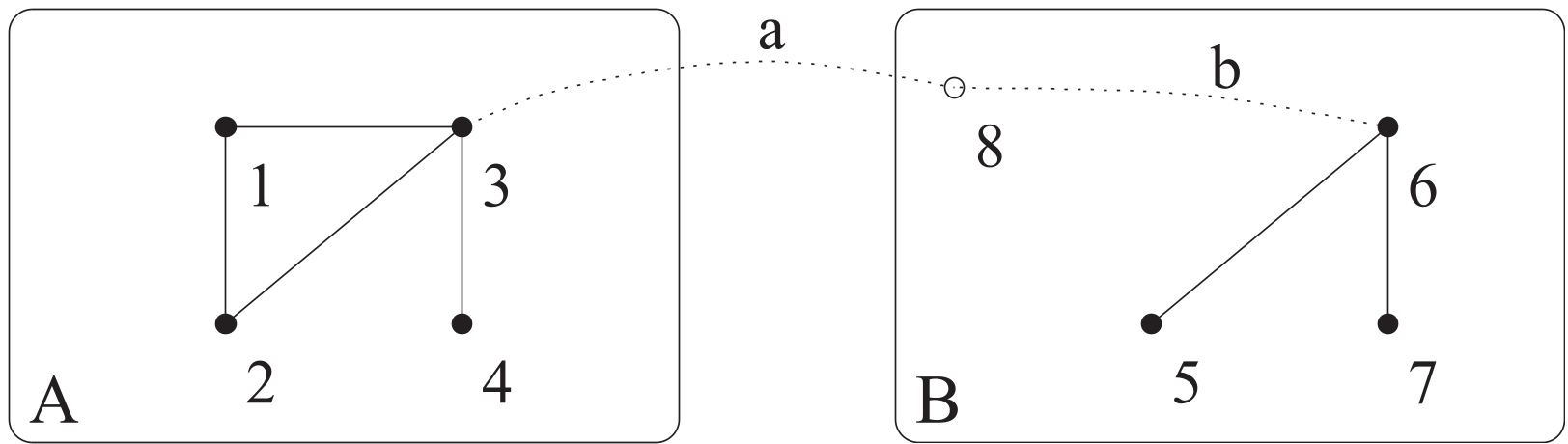 In the figure above, when homophily is high, a new entrant (Node 8) ignores the global "hub" and connects to a smaller node within its own group, fundamentally altering the network's growth trajectory.
The "Curvature Shift" Discovery
The researchers tested this model across five distinct seed topologies: Single Dipole, Multiple Dipoles, Ring, Random, and Star networks.
Key Experimental Findings:
- The Transition: As the level of homophily moves from 1 (no homophily) toward 0 (complete homophily), the cumulative degree distribution curve shifts from concave to convex.
- Invariance: Remarkably, this transition happens regardless of the initial network shape. Whether the network starts as a centralized "Star" or a decentralized "Ring," homophily eventually dominates the topology.
- The "Hump" Effect: In dense random networks, high homophily creates local "humps" in the distribution, indicating the formation of dense, isolated clusters that defy global scaling laws.
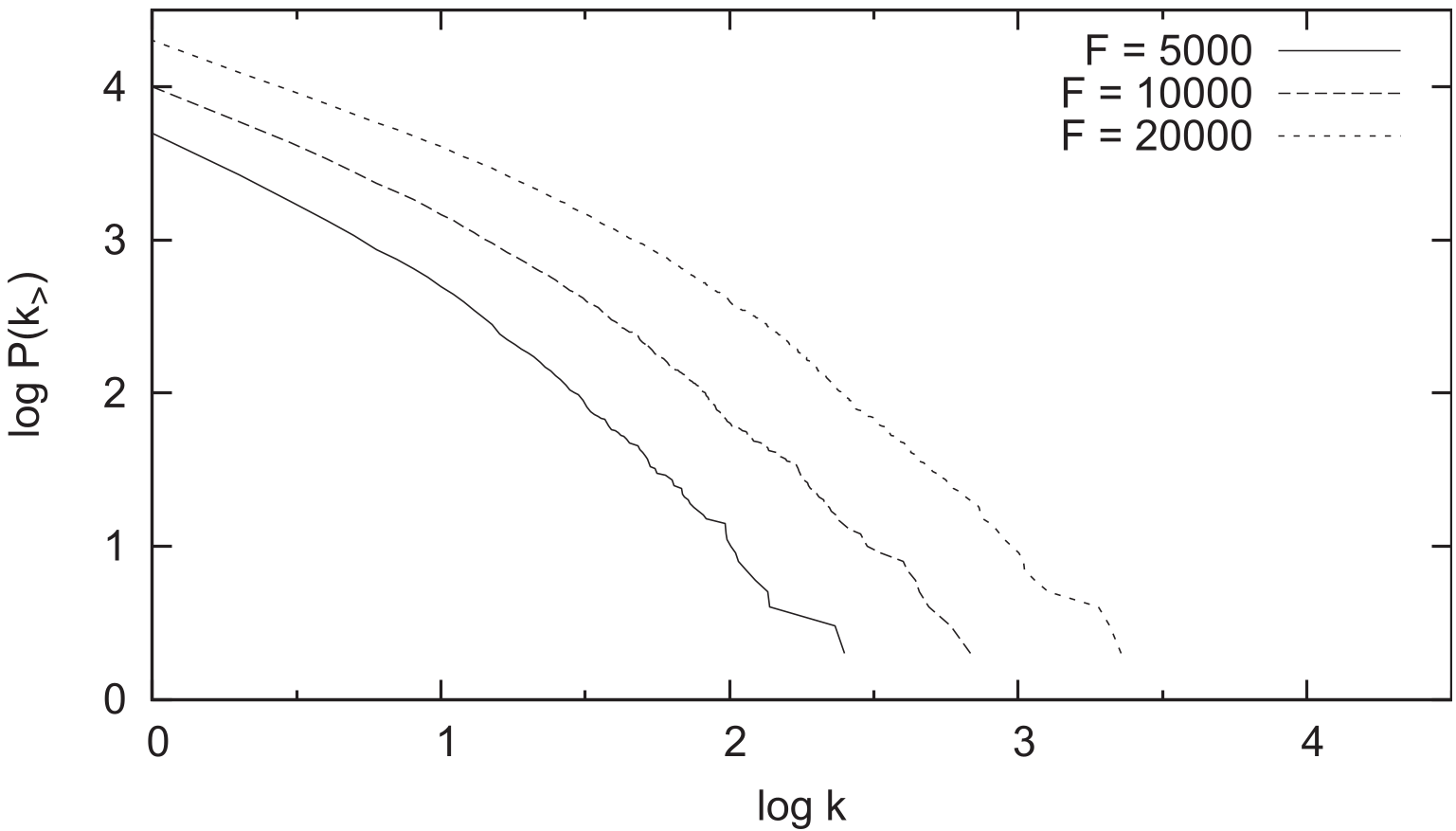 Note how the tail of the distribution extends further right as homophily intensifies, representing the emergence of "Super-Hubs" within specific sub-communities.
Why This Matters: From Theory to Policy
This isn't just academic curiosity. The study reveals a "Group Wealth" phenomenon: homophily makes individuals within a closed group significantly "richer" (better connected) than those outside.
- For Platforms: If a SaaS ecosystem shows a convex degree distribution, it’s a diagnostic signal that the market is fragmenting into homophilic silos.
- For Society: The model explains the structural roots of polarization. When we only connect with "our kind," the network architecture itself shifts to favor intra-group inequality, making the "rich" in one circle exponentially more powerful than everyone else.
Conclusion & Future Outlook
Kim and Altmann have bridged the gap between sociological theory and hard network physics. By adding the homophily index, they've turned a rigid mathematical model into a flexible tool that mirrors human behavior. While the model is currently a numerical simulation, the path is now open for an analytical relationship that could predict network health and fragmentation before they reach a tipping point.
Takeaway: Homophily doesn't just change who we talk to; it changes the very shape of our digital world.