
Beyond the Badge: How Social Comparison Drives Knowledge Sharing in Q&A Communities
The Effect of Gamification on Knowledge Contribution in Online Q&A Communities: A Perspective of Social Comparison
This study investigates how gamification elements impact knowledge contribution in online Q&A communities through the lens of Social Comparison Theory. By analyzing longitudinal data from Stack Exchange, the author reveals that both upward and downward comparisons of reputation scores significantly motivate users to provide more answers.
TL;DR
Why do some users spend hours answering questions for free? While "gamification" is the standard answer, this research suggests it isn't just about the points—it's about how your points stack up against everyone else. By analyzing Stack Exchange data, the study proves that both looking up at "experts" and looking down at "novices" creates a psychological drive that significantly boosts knowledge contribution.
Background: The Lurker Problem
The sustainability of any Q&A community (like Stack Overflow or Quora) hinges on a small percentage of active contributors. Most users are "lurkers." To combat this, platforms use reputation scores and badges. However, most researchers have treated these as simple "carrots." This paper argues that these rewards function as social signals, triggering a natural human instinct to compare ourselves with others.
The Psychological Engine: Upward vs. Downward Comparison
The author identifies two distinct levers for motivation:
- Upward Comparison: When you see someone with a higher reputation, it can be painful, but it also provides a roadmap for success. In a community where rewards are attainable, seeing a "Master" motivates "Apprentices" to contribute more to close the gap.
- Downward Comparison: Comparing yourself to those with lower scores provides a boost in self-esteem and perceived competence. To maintain this "superior" status, users are motivated to keep contributing.
Methodology: High-Resolution Community Analysis
The study analyzed a dataset from the User Experience Stack Exchange, covering nearly 30,000 questions and over 76,000 answers from 23,666 participants over a seven-year span (2013-2020).
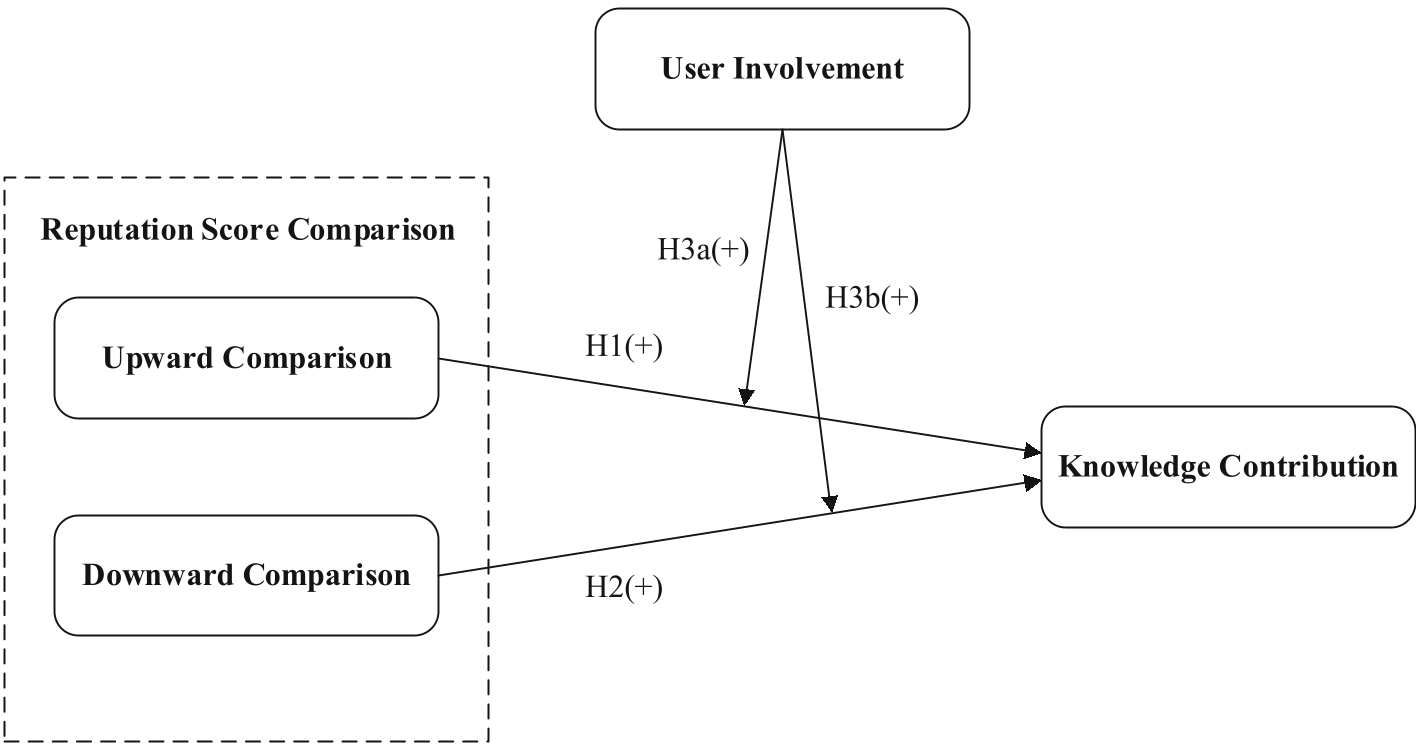 The model hypothesizes that comparison leads to contribution, with user involvement acting as a catalyst.
The researcher used fixed-effects Poisson models to handle the "count" nature of the data (number of answers) while controlling for individual differences that don't change over time (like a user's inherent personality).
Key Insights and Results
The findings offer a nuanced view of digital motivation:
- The Paradox of Comparison: Unlike in some organizational settings where upward comparison leads to jealousy/quitting, in Q&&A communities, it leads to increased activity.
- Involvement is Key: The "Social Comparison" effect is much stronger for users who are already active in commenting. Interaction makes the reputation of others more visible and relevant.
- Quantitative Proof: The correlation table reveals that user involvement is highly correlated with both downward comparison (0.834) and knowledge contribution (0.493).
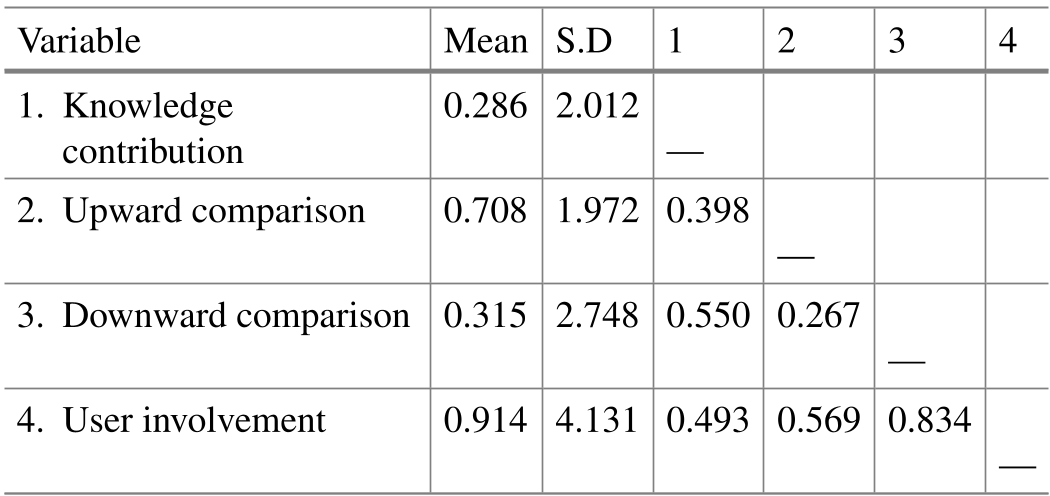 Table showing the positive correlations between comparison types and contribution.
Critical Perspective & Conclusion
This research moves the needle from "Gamification as UI Design" to "Gamification as Social Psychology." It suggests that the visibility of scores is just as important as the scores themselves.
Limitations & Future Work
While reputation scores are powerful, they are only one part of the puzzle. The author notes that future research should look at Badges (discrete rewards) and Leaderboards (system-wide comparisons) to see if they trigger different psychological responses. Furthermore, the model could be applied to "Knowledge Seeking"—does seeing someone much smarter make you less likely to ask a "stupid" question?
Summary for Practitioners
If you are building a community:
- Don't just give points; show the context. Let users see where they stand relative to their immediate peers in a thread, not just a global leaderboard.
- Encourage commenting. Since involvement moderates the effect of comparison, getting users to talk (even briefly) makes the gamified rewards more effective at driving high-value knowledge sharing.