
Behavioral Collaborative Filtering: Turning Finger Gestures into Content Recommendations
Effective Browsing Technique based on Behavioral Collaborative Filtering on Social Streams
This paper introduces a behavioral collaborative filtering method designed to enhance the efficiency of browsing SNS streams (like Twitter or Weibo) on smartphones. By analyzing implicit signals such as reading speed and flicking speed, the system predicts article relevance and reorders unread streams, achieving lower Mean Absolute Error (MAE) compared to traditional TF/IDF baselines.
TL;DR
In the era of information overload on platforms like Twitter (X) and Weibo, users often miss "gems" while mindlessly scrolling. This paper proposes a system that automatically learns what you like simply by watching how fast you flick your wrist and how long you linger on a post. By utilizing Behavioral Collaborative Filtering, it reorders your feed without ever asking you for a "Like" or a keyword.
Background & Positioning
Published in the KES2014 conference, this research sits at the intersection of Human-Computer Interaction (HCI) and Recommender Systems. While most systems at the time were obsessed with what users said (NLP), this paper focused on how users acted (Behavioral Analytics), positioning itself as a low-friction alternative to explicit rating systems.
The Core Friction: The Failure of Keywords
The authors identify two fatal flaws in prior work:
- NLP Limitations: Social media language is messy—slang, typos, and 140-character limits make keyword extraction unreliable.
- User Fatigue: Users hate being asked to rate things. If a system requires manual input to learn, it has already lost the battle for engagement.
Methodology: The Physics of Interest
The methodology is built on a simple but powerful hypothesis: interest slows you down.
1. Defining the Metrics
The researchers tracked two primary behaviors:
- Reading Speed (): Characters per millisecond. High speed = skipping; Low speed = reading.
- Flicking Speed (): Pixels per millisecond of the finger trajectory.
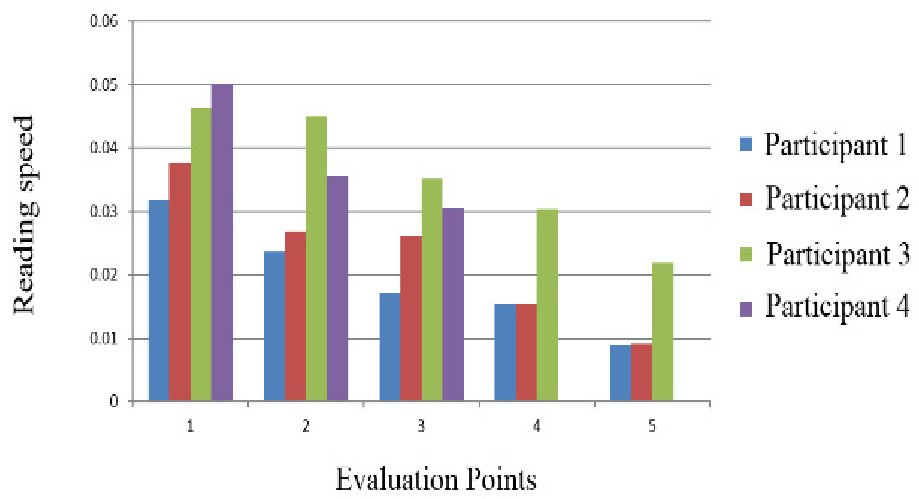 Fig 1: Experimental results showing that as interest (1-5 scale) increases, both reading and flicking speeds decrease.
2. The Recommendation Engine
The system follows a three-step pipeline:
- Behavior Normalization: Since different users have different "base" flicking speeds, the system uses Standard Deviation and Mean normalization.
- User Similarity: Using Cosine Similarity and a "Contribution" factor (the overlap of read articles), the system finds your "behavioral twins."
- Value Estimation: It uses Polynomial Curve Fitting to translate the raw speeds of your "twins" into a predicted score for articles you haven't seen yet.
 Fig 2: The logic flow of estimating unread article values through user similarity.
Experiments and Results
To test the theory, the authors compared their behavioral method against a TF/IDF baseline (which recommends based on word frequency).
- The Verdict: The behavioral method consistently outperformed TF/IDF in terms of Mean Absolute Error (MAE).
- Cold Start & Scalability: The system's accuracy improved as the user browsed more articles, effectively solving the relevance problem without needing a single text-based search query.
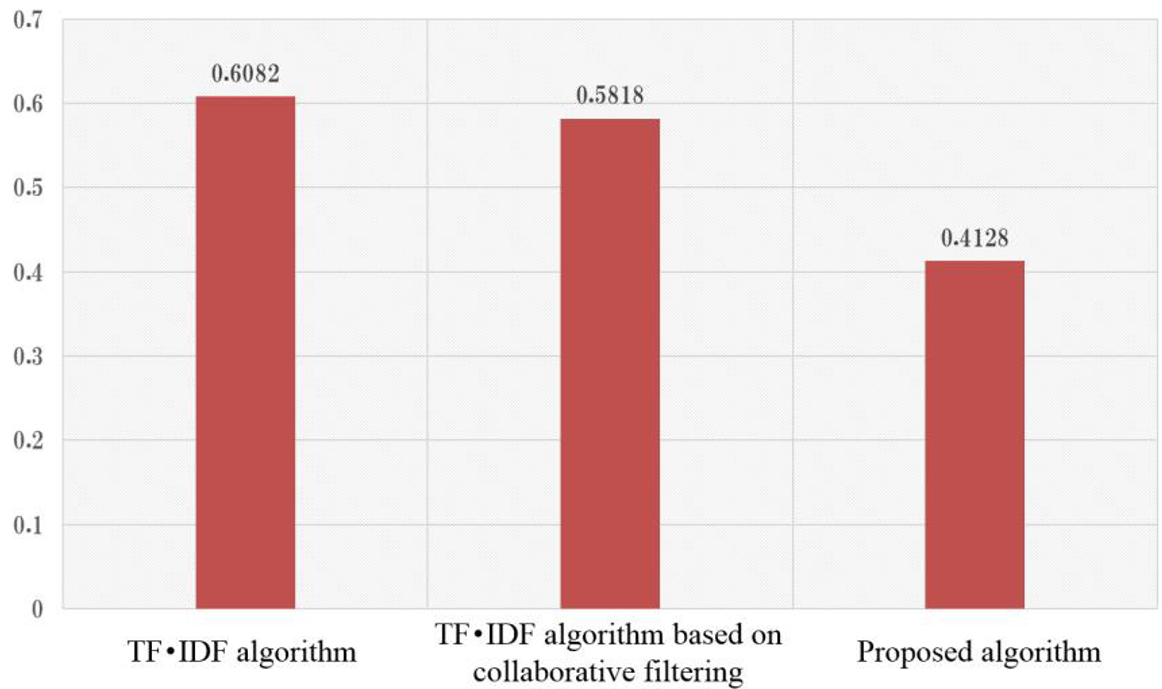 Fig 3: MAE results showing the proposed method achieves lower error than content-based baselines.
Critical Insight & Future Outlook
Takeaway: This paper was a precursor to the modern algorithms used by TikTok and Instagram today. It validated that implicit signals are often more honest than explicit ones.
Limitations: The study was conducted on a relatively small group of students. Furthermore, it doesn't account for "hate-reading"—where a user might read a frustrating article slowly but not actually "value" it.
Future Work: Modern iterations of this would likely replace the polynomial fitting with Deep Temporal Networks to capture how your interests shift throughout the day, perhaps even incorporating eye-tracking or haptic pressure data.